Three veins of spousal humor, starting in the early 19th century and ending in an edgily close-to-life comic stereotype realized in cartoons, tv shows, and movies.
Archive for the ‘Language and the sexes’ Category
Husbands and wives
September 22, 2017Sports Monday Linguistics
September 20, 2017Surely a record for the NYT sports section: both stories on the front page of Sports Monday this week were about language — language, televised sports, and gender; and language learning, baseball, and tv shows:
“Safest Bet in Sports: Men Complaining About a Female Announcer’s Voice” (on-line head) by Julie Dicaro.
“‘Friends,’ the Sitcom That’s Still a Hit in Major League Baseball” (on-line head) by James Wagner.
Revisiting 7: NL:W
September 17, 2017Yesterday, a posting on the story of a joke (Not Lady: Wife, NL:W for short) whose canonical form is
A: Who was that lady I saw you with last night?
B: That was no lady; that was my wife.
The vector for the spread of the joke seems to have been the vaudeville team Weber & Fields, who allegedly used it in their stage routines over a century ago. But I found no first-hand reports, so I appealed to the hounds of ADS-L for attestations. This netted a clear occurrence from 1859, but embedded in a long and complex back story (though again with the stage German accent of W&F). And an earlier British antecedent.
Then Larry Horn chimed in with some astute observations on the semantics and pragmatics of NL:W.
All will be reproduced here.
The NL:W punchline
September 16, 2017The lead-in tag to my recent posting on marmots:
That’s no beaver, that’s my marmot!
A take-off on a punchline to a vaudeville joke from long ago, a line that’s been played with many thousands of times in the last century. The No Lady: Wife (NL:W) formula, in two common instantiations in a two-man exchange:
1 A: Who was that lady I saw you with last night?
B: She was no lady. She was my wife.2 A: Who was that lady I saw you with last night?
B: That was no lady; that was my wife.
Lauren la flâneuse
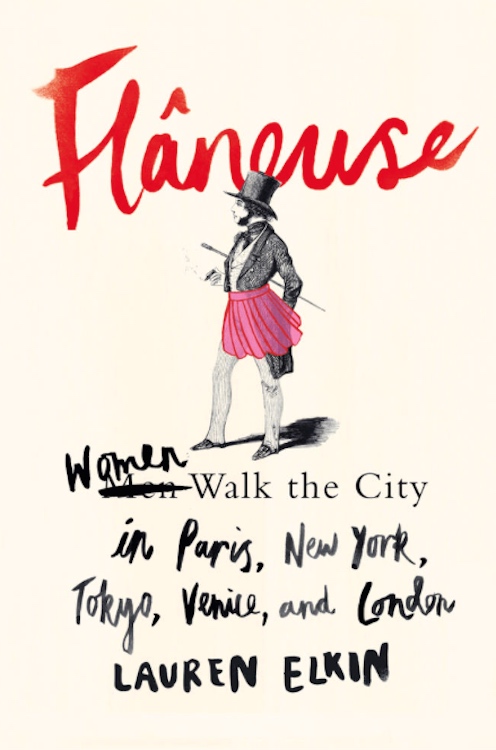
March 15, 2017In the NYT Book Review on 3/5/1 7, under the heading “Walk on By” — subtitle (in print) “A tribute to the pleasures of aimless urban exploration, female style”, (on-line) “A Celebration of Women’s Pleasure in Wandering a City” — a review by Diane Johnson of Flâneuse: Women Walk the City in Paris, New York, Tokyo, Venice, and London by Lauren Elkin (Farrar, Straus & Giroux, 2016).
 (#1)
(#1)
The cover art captures well Elkin’s reconfiguring the identity of the flâneur, for nearly 200 years the exclusive property of men, as a female identity, the flâneuse. Still urban and modern and primarily European in outlook, but now available to women (of independent spirit).
Animal instincts
November 7, 2016Today’s Bizarro:

(If you’re puzzled by the odd symbols in the cartoon — Dan Piraro says there are 2 in this strip — see this Page.)
Lionesses do most (but not all) of the hunting for a pride, often in groups, so it’s appropriate that Piraro’s character, retired from the hunt to take up office work, is depicted as a female secretary.
Then there’s the idea that hunting down and devouring prey is an almost uncontrollable animal instinct, urge, or drive — in the very nature of lions — which requires constant effort to keep in check.
Ah, we’ve seen an analogous idea in a very different sphere.
Sexual advance?
October 3, 2015A Dilbert from a while back (9/23) with co-workers Alice and Ted at cross-purposes:
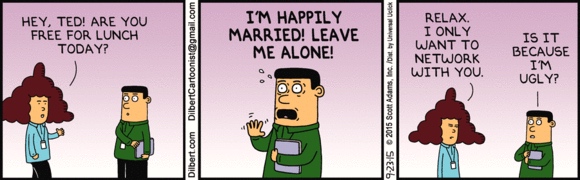
People are inclined to sexualize social relations between the sexes, to the point where some people are dubious that men and women can have non-sexually tinged friendships, and this inclination seems to be particularly strong among men. The rather dim-witted Ted is a pretty extreme case.
Annals of advertising: patriotism, sex, and overwhelming mouthfuls of food
June 9, 2015It burst recently (with actual fireworks) onto the American fast-food scene: the Most American Thickburger from Carl’s Jr. / Hardees:
This clip doesn’t include the final tag, “Because America, that’s why” (with the recently popular because NP construction). But the entertaining businessday (NZ) story about the ad does.
Crossword puzzle words
November 16, 2014Today’s Rhymes With Orange:

The cartoon is partly about the relations between the sexes, with the man “doing” the crossword puzzle by getting all the words from the woman. It’s also about those words — all of them “crossword puzzle words”, ranging from relatively rare (ARIA) to extremely rare (SMA) in everyday usage.