Archive for the ‘Language and the law’ Category
July 24, 2023
Also today’s food art. From Bill Badecker on Facebook this morning:
[The Orange Menace]’s lawyers have assailed the Georgia case in their efforts to derail it ahead of any indictments. “It is one thing to indict a ham sandwich,” some of his lawyers said in a recent court filing. “To indict the mustard-stained napkin that it once sat on is quite another.” – NYT, July 22
With this portrait of Helmet Grabpussy, a.k.a. Mustard Staining Cheesy Ham Sandwich:

Fond as I am of my own mocking names — do not utter the true name of the demon, lest you invoke him — Helmet Grabpussy and The Orange Menace — I admire Mustard Staining Cheesy Ham Sandwich. It is, alas, unwieldy, though I suppose it could be initialized to MSCHS (which has a nice rhythm). Or condensed to MusChee.
Posted in Abbreviation, Art, Initialisms, Insults, Language and food, Language and politics, Language and the law, Sarcasm and irony | Leave a Comment »
May 27, 2023
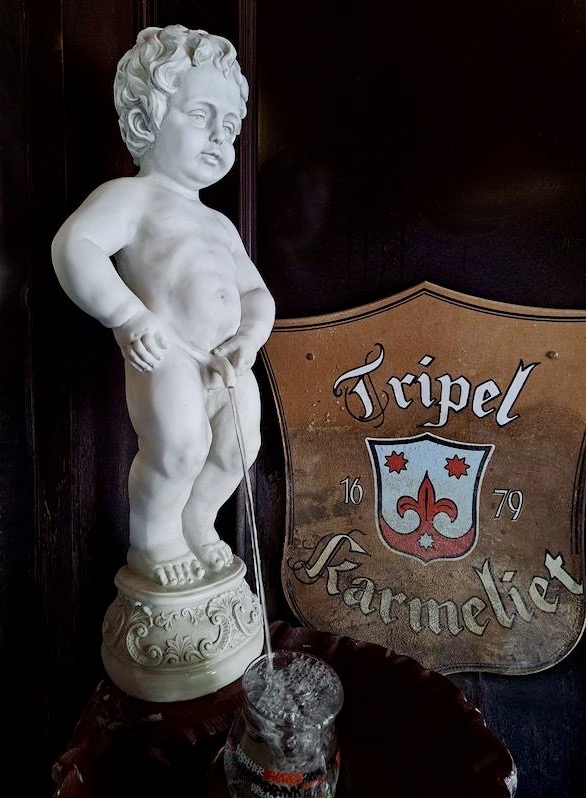
(warning: packed with allusions to, and sculptures of, playful cherubic penises, so subject to both the Art and the Infant exemptions from the X-rating of human penises (even those — or, maybe, especially those — that are in the midst of relieving themselves), but, still, not to everyone’s tastes)
It starts with the Peruvian Ernesto Cuba being touristic in Toronto, where, at the Prenup Pub (191 College St.), he encountered this whizzard in white, which he dubbed mojando la garganta ‘drenching the throat’:

(#1) From the Beer Advocate site: Tripel Karmeliet [‘Tripel Carmelite’] is a Tripel style beer [a strong pale ale; the origin of the name is unknown] brewed by Brouwerij Bosteels in Buggenhout, Belgium
(more…)
Posted in Art, Gender and sexuality, Language and food, Language and the body, Language and the law, Linguists, Phallicity, Pop culture | 9 Comments »
September 5, 2022
From my 8/15 posting “Fame-naming and family history”:
My intention was to get on with Cats 4, about naming cats for / after famous cats — in particular, famous fictional cats; in further particular, cats in cartoons and comics. If I name my cat Stallone (after the actor) or Rocky (after the fictional pugilist), I’m fame-naming a cat; if I name my cat Cheshire (from Alice in Wonderland) or Pyewacket (from the Salem witch trials and then various films, for example the wonderful Bell, Book and Candle (1958)), I’m cat-fame-naming my cat; if I name my cat Garfield or Sylvester, I’m cartoon-cat-fame-naming my cat. This is intricate, but pretty straightforward. And the topic of Cats 4 will in fact be the cartoon-cat-fame-naming of cats.
This is Cats 4. Where you could, if you were so moved, name your cat Garfield:

(#1) A lined notebook / journal for cat lovers (available via Amazon)
(more…)
Posted in Books, Comic conventions, Language and animals, Language and the law, Linguistics in the comics, Names, Terminology, Use and mention | 2 Comments »
April 28, 2022
From Nancy Friedman on her Fritinancy site (“Names, brands, writing, and the language of commerce”) on 4/25, “Word of the week: Bookchella”:

The Los Angeles Times Festival of Books, first held in 1996, returned to the USC campus last weekend after a two-year Covid hiatus. Because April 22 through 24 was also the final weekend of this year’s Coachella Music Festival, held 130 miles away in Southern California’s Colorado Desert, someone — maybe the person in charge of the Times’s Twitter feed — decided it would be cute to call the literary festival #Bookchella.
And just like that, –chella became the new –stock: a portable suffix denoting “festival.”
Except it wasn’t exactly “just like that.” And watch your back, LATFOB: the music festival in the desert has a history of refusing to give up its –chella without a legal fight.
Some linguistic background first. The –chella in #Bookchella operates as a “libfix” (liberated affix), as the linguist Arnold Zwicky dubbed such word parts, which are also known as productive bound morphemes. Tack –chella onto the end of another word and you communicate “festival.” For decades now, –stock, clipped from Woodstock, has played a similar role. (Read my 2013 article about “X-stock.”) Other well-known libfixes include –gate for any scandal and –preneur for any independent businessperson. (More libfixes here; read my 2014 article about –preneur compounds here.)
(more…)
Posted in Language and the law, Libfixes, My life | Leave a Comment »
March 14, 2019
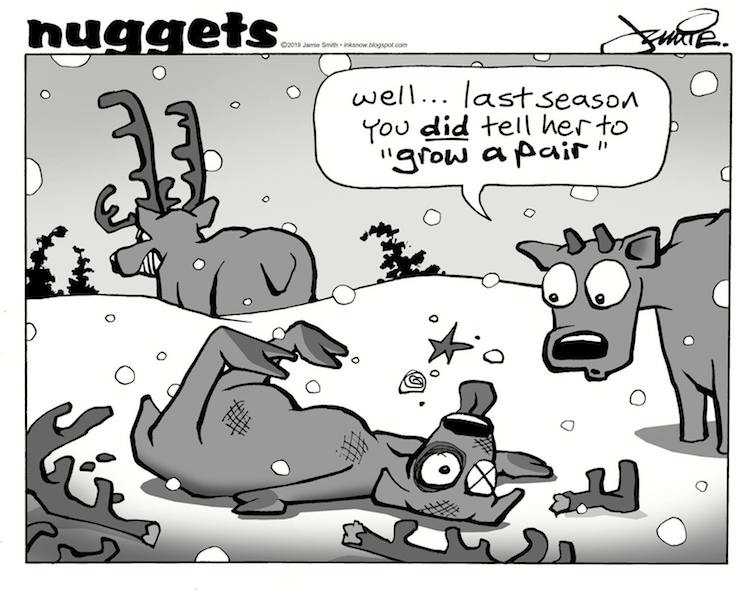
From Chris Waigl on the 10th, this bulletin from Alaska, the 2/24 Nuggets cartoon by Jamie Smith (inksnow.blogspot.com) in her local paper, the Fairbanks Daily News-Miner:
 (#1)
(#1)
[Chris:] [Since the cartoon is set in Alaska] the animals depicted presumably are caribou (NOT reindeer). Note that in caribou, females have antlers, often quite elaborate ones.
Also [since it’s illegal to kill caribou cows, but legal to hunt bulls,] the Alaska Department of Fish and Game has a remarkable multi-page illustrated leaflet about sexing caribou in the wild [here]
Ok: the idiom grow a pair; antlers on female caribou/reindeer; the distinction between caribou and reindeer; and as a bonus, an Ink & Snow blog posting “Bear Den” from 3/10 on the use of trademarked characters in cartoons.
(more…)
Posted in Art, Collages, Gender and sexuality, Idioms, Language and animals, Language and the body, Language and the law, Linguistics in the comics | 1 Comment »
February 23, 2019
What someone doesn’t say can be as significant as what they do say; more generally, a topic that someone doesn’t talk about can be as significant as the topics that they do.
So I don’t know quite what to make of a passage from a NYT op-ed column by Thomas T. Cullen (U.S. attormey for the Western District of Virginia), on-line yesterday under the title “The Grave Threats of White Supremacy and Far-Right Extremism: Hate crimes are on the rise. Police and prosecutors need better tools to fight back.” and in print today under the title “Rising Far-Right Extremism in America: Police and prosecutors need better tools to fight back”, about the case of Coast Guard Lt. Christopher Hasson, arrested last week and accused of plotting to assassinate Democratic members of Congress, prominent television journalists, and others. The passage:
In 2009, Congress took an important step in arming federal investigators to deal with hate crimes by passing the Matthew Shepard and James Byrd, Jr., Hate Crimes Prevention Act. This law makes it possible to prosecute as hate crimes violent acts committed against victims because of their race, color, national origin, religion, gender, gender identity or disability. The law provides stringent maximum penalties, including life imprisonment, if someone is killed during a hate crime.
The omission in the bold-faced clause is sexual orientation, which is specifically listed in the Shepard/Byrd law — as a result of the savage murder of Shepard in 1998 because of his sexual orientation.
(more…)
Posted in Art, Gender and sexuality, Language and the law, Pragmatics | 1 Comment »
March 24, 2018
(For the day of the Marches for Our Lives.)
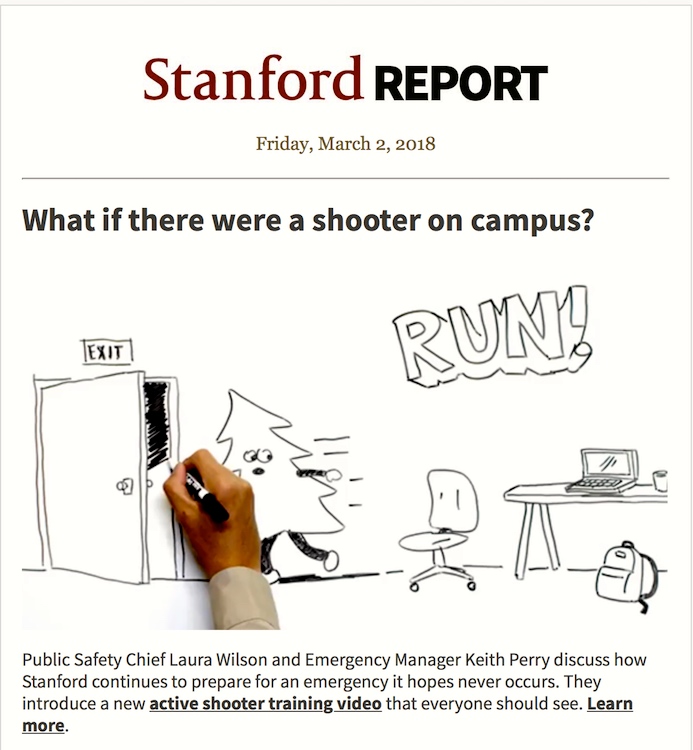
On March 2nd in the Stanford Report, the university’s daily newsletter for faculty and staff, the top item:
 (#1) About the video “Run. Hide. Fight. — Surviving an Active Shooter Event”
My main interest here is in the family of expressions that includes active shooter and armed gunman, but as usual my attention will wander far afield.
(more…)
Posted in Language and the law, Pleonasm | Leave a Comment »
March 1, 2018
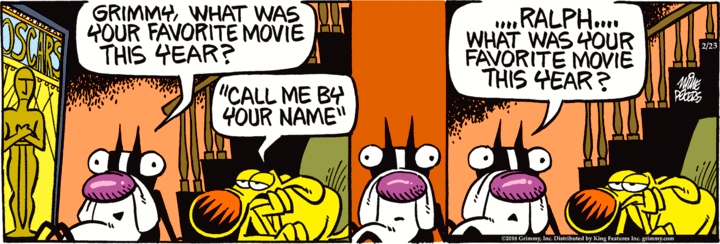
The Mother Goose and Grimm, from February 21st:
 (#1)
(#1)
A joke playing on use and mention: Grimmy mentions the name of the Oscar-nominated movie Call Me by Your Name, but Ralph understands him to be using the expression call me your your name, so he calls Grimmy Ralph.
That leads us to the movie and so to a thicket of issues about language, sexuality, gender, and the law.
(more…)
Posted in Art, Books, Categorization and Labeling, Gender and sexuality, Language and gender, Language and sexuality, Language and the law, Linguistics in the comics, Movies and tv, My life, Technical and ordinary language, Use and mention | 5 Comments »
May 3, 2016
My grand-daughter Opal arrived for breakfast on Saturday with a book she immediately immersed herself in. Not a children’s book, not a book of cartoons, but instead an entertaining 2015 book by jurist William W. Bedsworth about amazing legal cases — which Opal and her mother sampled for me as breakfast went on:
 (#1)
(#1)
(more…)
Tags:., .jj, ?./.
Posted in Books, Language and the law, Language play, Metaphor, Movies and tv, Music | Leave a Comment »