Archive for the ‘Language and society’ Category

Word associations as synonymy

December 31, 2010

From “Disappearing ink: Afghanistan’s sham democracy” by Matthieu Aikins, Harper’s Magazine for January 2011, p. 40:

The Anglicism “democracy,” for many Afghans, has become synonymous with unprecedented corruption, moral decay, and hypocrisy; it is another one of the plagues that the West has brought to this country.

So, for these Afghans, the word democracy has picked up (specific) negative connotations in certain sociocultural contexts. This is bad word association — [bad] [word association] , not [bad word] [association] — in fact, bad word association described by synonymous with in an extended sense.

(more…)

The idea of reality

December 8, 2010

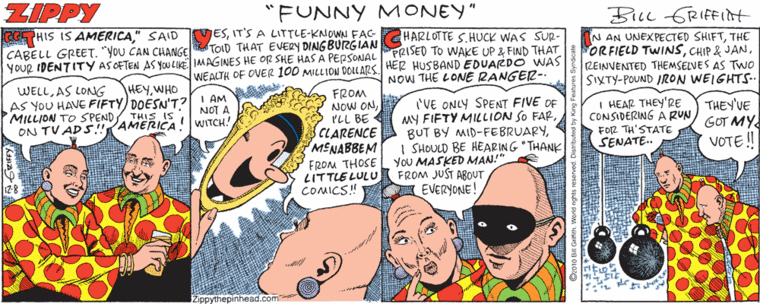
A Zippy on reinventing yourself:

Which brings me to Alexis de Tocqueville and to Alan Ryan’s review of Leo Damrosch’s Tocqueville’s Discovery of America (New York Review of Books, December 9). (more…)

Encounters and pranks

November 22, 2010

Two collections of linguistic points in the reporting following on the suicide of Rutgers-Piscataway freshman Tyler Clementi: one having to do with the terms used to describe an encounter between Clementi and another man that lies at the center of the story, one having to do with the characterization of the streaming of video of the encounter by Clementi’s roommate and a friend of his.

(more…)

Data points: address terms 11/17/10

November 17, 2010

Two address terms that caught my ear recently because they struck me as no longer widely in use:

(1) pal: in an episode of the 50s tv serial Tom Corbett, Space Cadet (Youtube for this episode here, Tom Corbett website here), one of the crew members to another, on the radio: “Ok, pal, she’s all yours” (referring to the next rocket firing).

(2) sport: in one episode of the gay porn film Arcade on Route 9 (Joe Gage for Titan Media) an older trucker (Ken Mack) hooks up with a young farmboy (Cole Ryan) and introduces him to the ways of gay sex, addressing him as “sport” throughout the encounter, as in a reference to “your big stiff dirty-boy boner; I’m here for you, sport”. (The farmboy mostly addresses the trucker as “sir”, leading to this weird bit of sex talk: “Suck my fuckin’ hard boner, sir”.)

(more…)

“autistic toddler” offensive?

November 5, 2010

A letter to Scientific American Mind (in the November/December 2010 issue) from Greg O’Brien of Gray, Maine:

In Erica Westly’s article “Too Much, Too Young” [Head Lines]. she uses the phrase “autistic toddlers.” I feel it is important that the editors recognize the disrespect inherent in that construction. The reverent phrasing would have been “toddlers with autism,” because people with autism (or any disability) are people first! This sentiment is exactly why we have the Americans with Disabilities Act and not the Disabled Americans Act. I would recommend, or at least request, editing articles of this ilk with an eye out for lapses in judgment.

There’s a shorter expression, autistic toddler, and a longer one, toddler with autism, both have toddler as the head noun, and they’re truth-functionally equivalent. In addition to the length difference, though, they differ as to which of the characteristics, autism or toddlerhood, is mentioned first. Perhaps that’s why O’Brien sees the shorter expression as disrespectful; perhaps he judges that mentioning the autism first highights it. (Though you could also argue that the highlighted characteristic comes with the word that gets the heavier phrasal accent: toddler in the shorter expression, autism in the longer.)

(more…)
widowered

November 4, 2010

I see that a colleague of mine lists her relationship status on Facebook as “widowed”. Clear enough.

But I say I’m “single”, because that’s the term I have to use on the census and other surveys. I had a wife, but she died 25 years ago. Then I had a male partner, for almost as many years, but then we didn’t count as “married”, so I was “single”. Then he too died, and I was still “single”. By my calculation, I’ve been made a widower twice, but I’ve been “single” since 1985.

What to say about widowered?

(more…)