Over on ADS-L we’ve been discussing the etymology of chicano/Chicano, and Jon Lighter introduced the question of the social status of the ethnonym; it was his recollection that in the 1960s the word was used disparagingly, and that was my recollection and Larry Horn’s as well. But on the whole it’s been reclaimed, a process that was already underway by 1970, with the rise of chicano political consciousness.
Archive for the ‘Language and society’ Category
chicano
April 28, 2013Synthetic compounds and back-formed verbs: rape
April 15, 2013From discussions of rape in recent news, the synthetic compounds slut-shaming and victim-blaming — and, no surprise, the back-formed verbs slut-shame and victim-blame.
Colored bottoms
March 29, 2013A comment on my Crimplene posting:
Since you’ve been into ads in a big way recently, I think you’ll appreciate this one if you haven’t already seen it
It’s a Joe. My. God. column with this image, seen at the Belk department store:
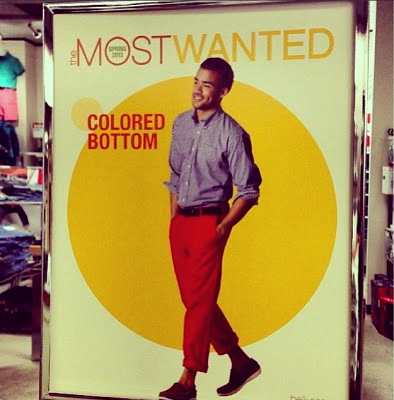
Only two words in colored bottom, but there’s an issue with each of them.
derpy
December 3, 2012Passed on by Gary Robert Kelly on Facebook this morning:
Bad Taxidermy Photos Are The Potato Jesus Painting Of The Animal World (by Josh Kurp, 11/14/12) [note the snowclone X is the Y of Z (here)]
Disfigured alive animals, not so funny. Disfigured dead animals, hi-larious. Now before calling me a serial killer (that’s only half true), know that I’m referring to animals that have been taxidermied, specifically animals that have been taxidermied terribly …
Thanks to a tip from Bobby Big Wheel, we were led on a path filled with cross-eyed cats, derpy-looking dogs, and whatever the hell happened to the poor guy you see above.

(In defense of the polar bear: his teeth are perfect. Reference here to Warren Zevon’s “Werewolves of London”: I saw a werewolf drinkin’ a pina colada at Trader Vic’s / And his hair was perfect.)
It’s derpy.
Brief mention: Accent perceptions
August 10, 2012In folk dialectology — the dialectology of ordinary people (not professionals) — some people are perceived as “having an accent”, while others don’t. Many times, but far from always, the people reporting on these phenomena believe they are accentless; accents are something other people have. (Typical folk reflections on these matters, in a California context, are noted here.)
And so we get, from Kathryn Campbell-Kibler (a card-carrying sociolinguist) this morning on Facebook:
Datum of the day: “Im sick of being told i have an accent. Bitch im from cleveland, you have the accent”
KCat is working this into a conference abstract on accent perceptions.
Cursing
August 4, 2012From Elizabeth Daingerfield Zwicky, a tale from the Not Always Right site (about obtuse or ill-behaved customers), with a lot of asterisked material:
[from Portland OR] (I’m working at the entrance of a local heritage fair when a white pickup truck pulls up. The driver, a large middle-aged man, gets out and stomps towards my desk.)
Customer: *slams his hands on the table* “What the f*** do you Mexicans think you’re doing?”
Me: *confused* “Sir, we—”
Customer: “Look, I don’t want you d*** w******* here in the first place. I want you all back over the border where you belong!”
Me: “Sir, I’m going to have to ask you to leave. You’re being very offensive, and this is—”
Customer: “But if you’re going to come to my godd*** country, you’re going to act like real Americans and not fly those f***ing Mexican flags and speak that s***-eating language, and you aren’t gonna celebrate being a bunch of f***ing foreigners!”
Me: “Security to entrance!”
Customer: *jumps back into his car and starts driving off* “Go back to Mexico!”
(The racist driver never returned. The heritage event in question, by the way, was the Scottish Highland Games.) [hence this story has been titled “Your Bigotry Is Kilting Me”]
Look back at the customer’s second turn in this exchange. What’s been asterisked out? In particular, “you damn what“?
Plain talk in the NYT
June 12, 2012In the NYT on the 9th, a piece by Seth Stephens-Davidowitz, “How Racist Are We? Ask Google”, reporting on his own research (“The Effects of Racial Animus on a Black Presidential Candidate: Using Google Search Data to Find What Surveys Miss”, here). The research design:
… many Americans use Google to find racially charged material. I performed the somewhat unpleasant task of ranking states and media markets in the United States based on the proportion of their Google searches that included the word “nigger(s).” This word was included in roughly the same number of Google searches as terms like “Lakers,” “Daily Show,” “migraine” and “economist.”
A huge proportion of the searches I looked at were for jokes about African-Americans. (I did not include searches that included the word “nigga” because these searches were mostly for rap lyrics.) I used data from 2004 to 2007 because I wanted a measure not directly influenced by feelings toward Mr. Obama. From 2008 onward, “Obama” is a prevalent term in racially charged searches.
Note that the Times here doesn’t shrink from printing nigger (and nigga). Not all the reports on the study have been so straightforward.
Bimbos and himbos
May 9, 2012I recently ran across the portmanteau himbo (him + bimbo), a male counterpart to bimbo. Turns out that bimbo has a complex history and a variety of senses in current English, with this variety of senses reflected in the way himbo is used.
Proud to be an American
February 12, 2012Exercise (for Americans): name an American movie that you consider to be a great movie that, in addition, makes you proud to be an American.
(If you’re not American, you can treat this as a hypothetical: … that, in addition, if you were an American, would make you proud to be one.)
(Corresponding questions for British, French, Italian, German, Swedish, Indian, etc. movies. And for books, music, art works, ideas, scientific achievements, etc.)
In my (recent) experience, the American movie question twists people into a knot. Name a bunch of great American movies, easy; many people have assembled such lists (ranked lists, lists in chronological order, lists in alphabetical order). Saying which ones make you proud to be an American, that’s hard. Some people just reject the idea that an American movie (or whatever) could make you proud to be an American.
Why do I bring this up? Because of a brief piece by Joan Acocella in the 12/5/11 New Yorker about the 50th anniversary of the film version of West Side Story, which she (rightly) celebrates. Her piece ends with this claim:
When you watch the movie you’ll be proud to be an American.
work
October 31, 2011In the NYT Sunday Review yesterday, a piece by Craig Lambert, “Our Unpaid, Extra Shadow Work”, in which the question of what counts as work is central; this is a matter of both categorization and labeling. The beginning of Lambert’s piece:
The other night at the supermarket I saw a partner at a downtown law firm working as a grocery checker, scanning bar codes. I’m sure she earns at least $300,000 per year. Even so, she was scanning and bagging her purchases in the self-service checkout line. For those with small orders, this might save time spent waiting in slower lines. Nonetheless, she was performing the unskilled, entry-level jobs of supermarket checker and bagger free of charge.
This is “shadow work,” a term coined 30 years ago by the Austrian philosopher and social critic Ivan Illich, in his 1981 book of that title. For Dr. Illich, shadow work was all the unpaid labor — including, for example, housework — done in a wage-based economy.