Archive for the ‘Humor’ Category

¡Albondigas! ¿No te dije?

November 22, 2017

“New Sentences: From Duolingo’s Italian Lessons” by Sam Anderson, in print in the New York Times Magazine on Sunday the 19th:

‘Gli animali rimangono nello zoo.’ (‘The animals remain in the zoo.’)

— From Duolingo, a “science-based language education platform” available on Apple, Android and Windows smartphones and online.

Language-learning sentences are always slightly funny. They exist to teach you linguistically, not to communicate anything about the actual world. They are sentences that are also nonsentences — generic by design, without personality or ambiguity: human language in merely humanoid strings. [They are, as the philosophically inclined among us sometimes say, mentioned, not used.] The subtext is always just “Here is something a person might say.” It’s like someone making a window. What matters is that it’s transparent, not what is being seen through it.
(more…)

The Mankoff rat cartoon

November 15, 2017

On Language Log on October 5th, Mark Seidenberg, “Cartoonist walks into a language lab”:

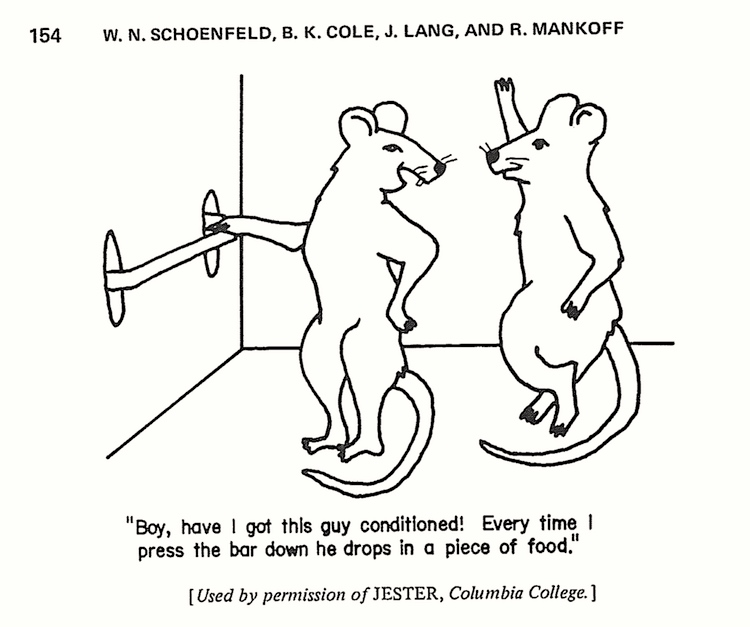
[Bob] Mankoff’s involvement in humor research isn’t a joke. He almost completed a Ph.D. in experimental psychology back in the behaviorist era, which is pretty hard core. Before he left the field he co-authored a chapter called “Contingency in behavior theory”, as in contingencies of reinforcement in animal learning. The chapter included this cartoon:

  (#1)

(more…)

Further adventures in cartoon understanding

October 28, 2017

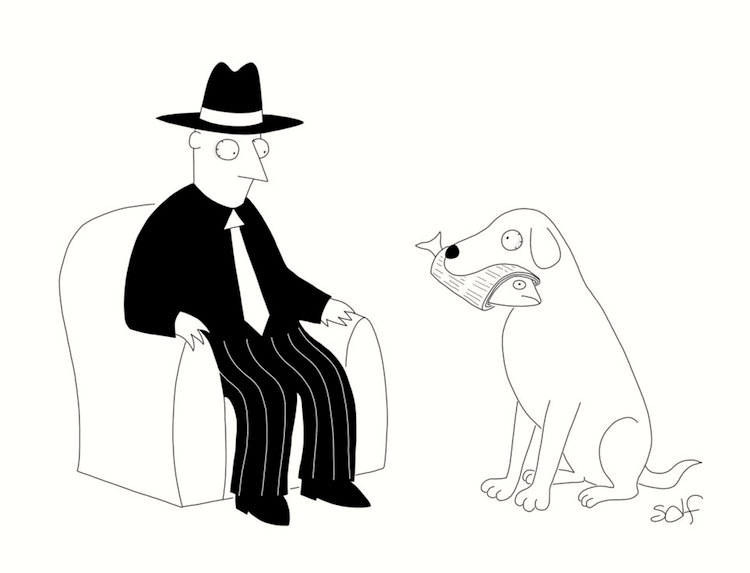
From the October 30th New Yorker, two cartoons:

(#1) By Seth Fleishman (sdf)

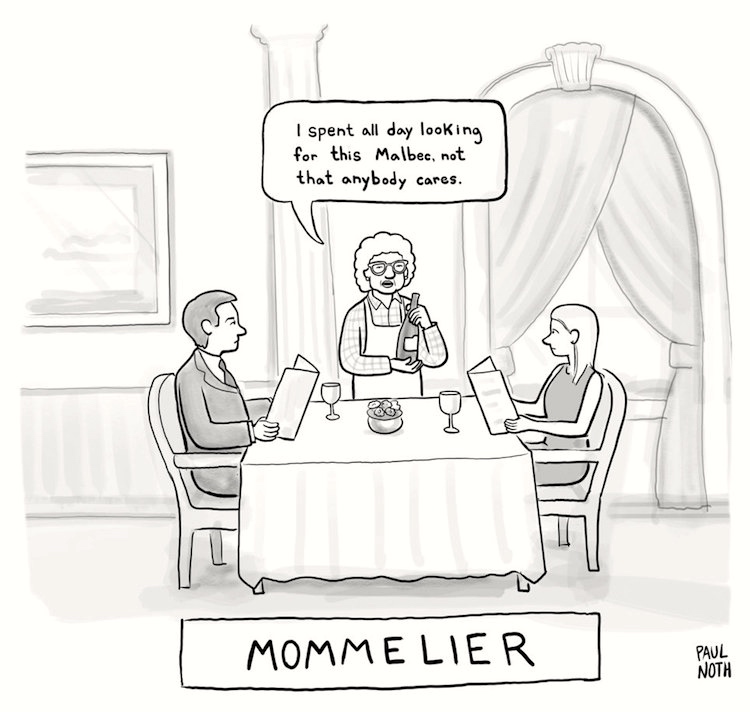
(#2) By Paul Noth

(more…)

Eggcornic verse

October 25, 2017

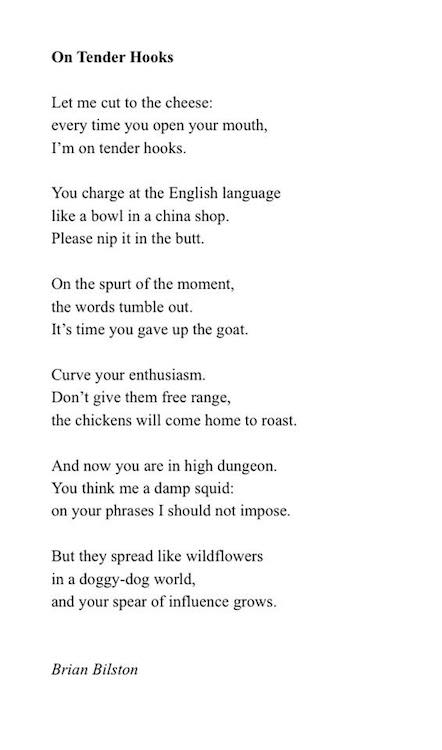
Passed along on Facebook, this work by Twitter poet Brian Bilston:

(#1)

(more…)

Fixing things

July 9, 2017

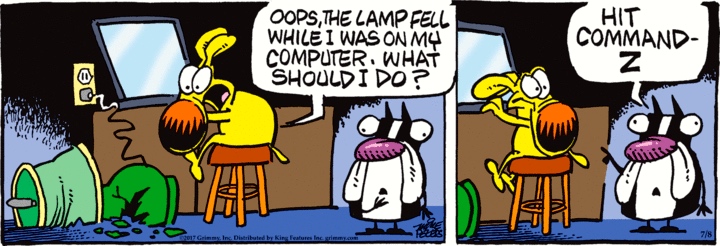
Yesterday’s Mother Goose and Grimm, featuring the computer dogs (the bull terrier Grimm at the keyboard, the Boston terrier Ralph advising him):

(#1)

To understand this strip, you need to know about keyboard shortcuts on a Mac computer, in particular the combination

Command-Z: Undo the previous command. You can then press Command-Shift-Z to Redo, reversing the undo command.

⌘-Z undoes, or reverses, keyboard actions. In the cartoon, the dimwitted Ralph suggests using this computer key combination to reverse events in general — in this case, the falling of the lamp to the floor and the breaking that resulted from the fall. ⌘-Z will fix it!

If only.

(more…)

Poems About Sluts

June 13, 2017

(Until the last section, this posting is mostly about silliness. The last section, however, descends to talk of men’s bodies and mansex in street terms, so is not for kids or the sexually modest. I’ll insert a warning when this material is imminent.)

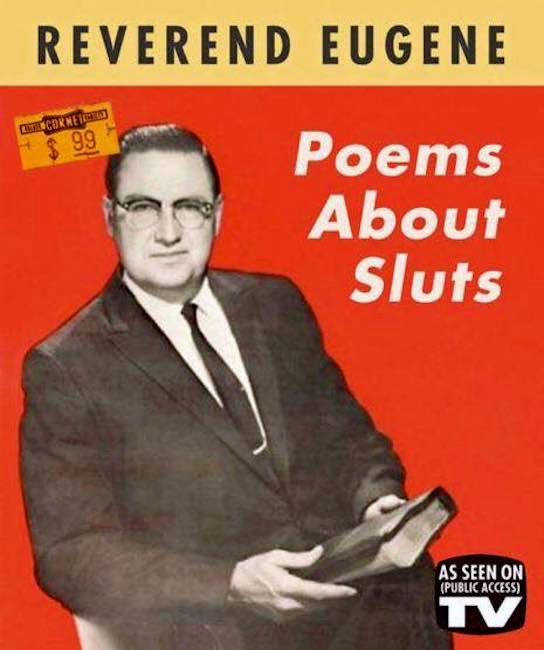
Passed on in Facebook by Michael Palmer, this preposterous book cover:

(#1)

Yes, of course, a hoax. And appeared as such in a volume entitled Bad Little Children’s Books: KidLit Parodies, Shameless Spoofs, and Offensively Tweaked Covers. Then there’s the real book whose cover was tweaked to yield #1.

Beyond all that, we could take the title of #1 at face value and celebrate sluts and sluthood.

(more…)

Ruthie in the sky with O’Ryan

April 29, 2017

Just a few days ago I was wondering how Calvin Trillin was doing — he’s in my age cohort, five years older than me, so I have a certain fellow feeling — and then Andy Sleeper pointed me to a Shouts and Murmurs piece of his in the most recent (May 1st) New Yorker: “The Irish Constellation: Until about five years ago, I was under the impression that Orion was spelled O’Ryan”. Andy was reminded of Ruthie from One Big Happy, who does her best to turn the unfamiliar into something she recognizes.

But good to see Trillin doing what he does so well.

(more…)

The maiden, the monster, and the hero

April 15, 2017

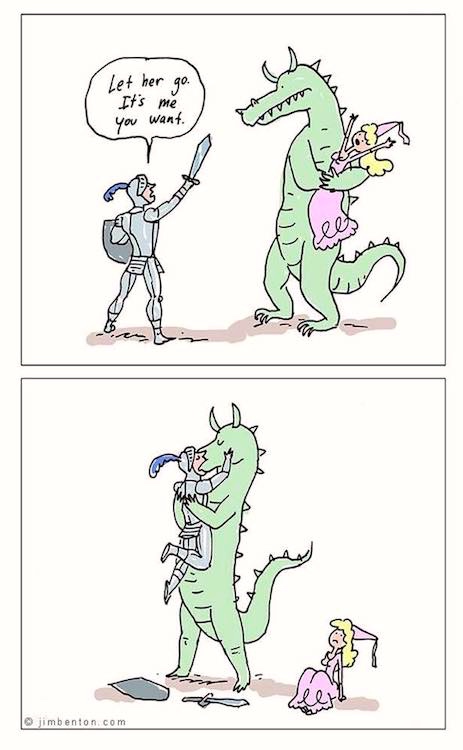
In the LGBT precinct of Facebook recently, this Jim Benton cartoon (eventually this posting will be about Benton, but first the folktale scenarios):

(#1)

The basic scenario is Beauty and the Beast: a beautiful maiden (that is, a virgin), often a princess; and a monster, a grotesque creature, either literally an animal (a gigantic ape, a dinosaur, a mutant lizard, a dragon, whatever — but male) or a man animalistic in form, sometimes in nature as well. The monster desires the maiden: to devour her (literally), to despoil her (sexually), or merely to love her (romantically).

A third character, the Knight, figures in an extended scenario: a hero, a handsome and virile young man, often in armor, often a prince, whose role is to challenge the monster in battle and overcome him, thereby rescuing the maiden — for himself; she is his prize. In the extended scenario, two males are rivals for the maiden.

In Benton’s version, the hero challenges the monster, demanding that the monster deal with him rather than the maiden. And so the monster does. Sometimes in a love triangle, the rivals become lovers. (Combat between men is sometimes a route to mutual respect, male bonding, and friendship; in this case, the relationship goes one step further.)

(more…)

The Yule log

December 18, 2016

It starts with another feature of cultural, as opposed to religious, Christmas, the Yule log. Moves to the cover of the current New Yorker (12/19&26), Ana Juan’s “Yule Dog”. And then, briefly, to sexy word play on the log of Yule log (with a digression on a vintage postcard with a gay Yule log joke). And culminates in an orgy of cake: Bûches de Noël, edible simulacra of the Yule log.

(more…)

Poet in Search of His Moose

November 30, 2016

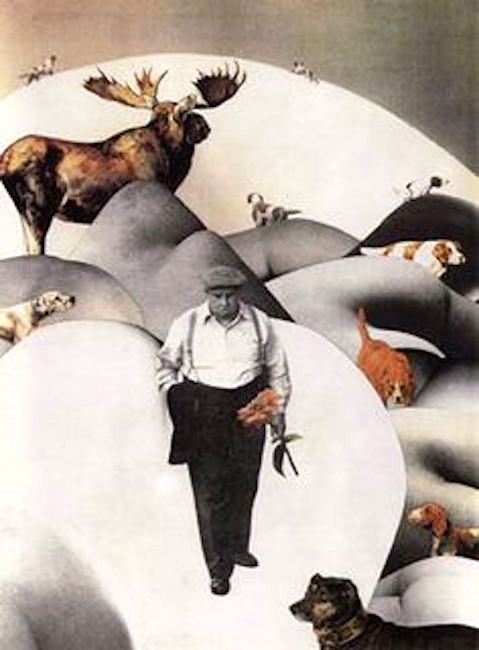
The title of one of the eleven comic collages by Barry Kite that I have hanging on my walls:

(#1)

Poets and artists notoriously have muses, and poets and their muses are sometimes subjects of an artist’s work: “The Poet and His Muse” by Giorgio de Chirico, “The Poet and His Muse” by Henri Rousseau (both with female muses), and in a very different vein, “The Poet Decorates his Muse with Verse”, a playful photo montage by Duane Michals, with a male muse. Kite’s collage has a central figure that I at first took to be the artist Pablo Picasso, whose many (female) muses were his sexual partners and the subjects of a great many of his works, but that now seems likely to be the poet Pablo Neruda (see below). Women appear in the collage as stylized erotic body parts serving as the landscape the central figure is walking through. Meanwhile, his dogs are in search of the poet’s moose.

The collages are parodic or surreal, and quite funny, combinations of elements from art history and from popular culture, with wry titles. Like Bill Griffiths on art in Zippy the Pinhead, Kite shows great affection for the culture that he ransacks to create absurdist, countercultural works.

(more…)