My “Grocery store semiotics” posting looked briefly at two canned-food preparations: Manwich and Beefaroni. Manwich: “a canned sloppy joe sauce … The can contains seasoned tomato sauce that is added to cooked ground beef in a skillet” to yield a filling for hamburger buns. And Beefaroni: “pasta with beef in tomato sauce”, essentially a ground beef casserole in a can. Both names are portmanteaus, and both are somewhat opaque in their meaning.
Archive for the ‘Grammatical categories’ Category
Manwich and Beefaroni as portmanteaus
May 16, 2013Sex/gender symbols
April 13, 2013From Kim Darnell on Facebook, a story from a year ago (4/17/12) about the adoption of a gender-neutral pronoun in Swedish, with this handsome accompanying graphic:
 (#1)
(#1)
The graphic has three interlinked components: The “female symbol” (or “mirror of Venus”), a circle (representing a body) with a cross below it (♀ in biological literature); the “male symbol” (or “spear of Mars”), a circle with an arrow at the upper right (♂ in biological literature); and a plain circle in the center, representing a body unspecified as to sex. Turning to grammatical gender rather than biological sex, the mirror of Venus represents feminine gender (as in the Swedish pronoun hon ‘she’), the spear of Mars the masculine gender (as in the Swedish pronoun han ‘he), and the plain circle the new gender-neutral 3sg Swedish pronoun hen).
A complexity here is that this symbol is sometimes taken to be a transgender symbol, the central circle represeting someone who in some sense is *both* female and male. And for this purpose there are a number of competing symbols.
Manliness and money
April 13, 2013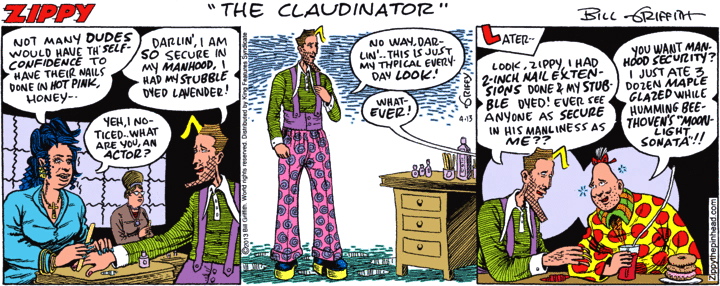

At the sign of the Z
October 30, 2012Yesterday, lunch at Gordon Biersch with visiting friends Max and Ned (down from San Francisco to cheer me up and keep me company). Ned ordered the half turkey sandwich with a cup of soup, and this is how the sandwich and lobster bisque looked when they arrived:
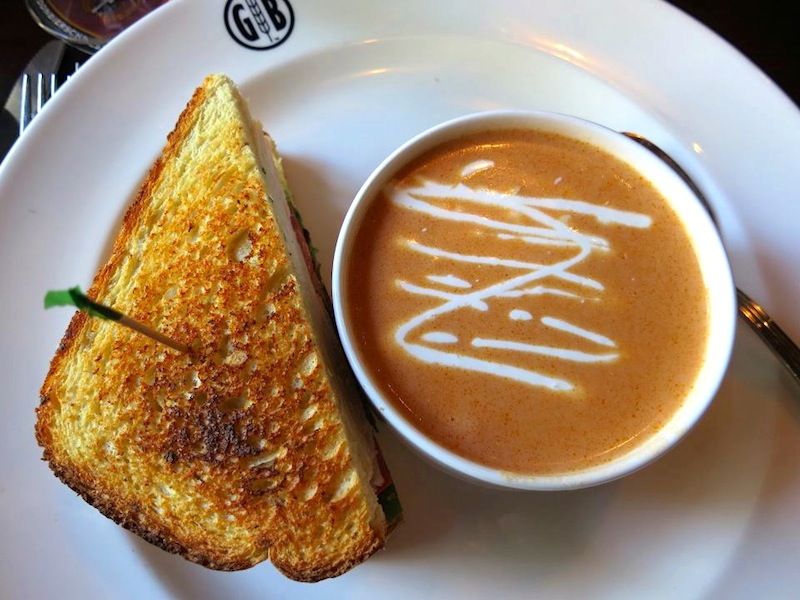
Yes, the Sign of the Z (a crossed Z, even). More specifically, as Ned said, Zwicky Bisque. Or possibly, as Rod Williams suggested on Facebook, the mark of … Zorro! Maybe not as impressive as the Baby Jesus and the Virgin Mary on a tortilla, but surely it means something, right?
The silent tiger-duck
October 24, 2012Making up cards to send to correspondents yesterday, I pulled out a booklet of German stickers for kids. About a creature that appeared to be a wooden pull-toy with the name Tigerente. Tiger-duck? Well, yes, and you can sort of see that:

On the masculinity beat
June 3, 2012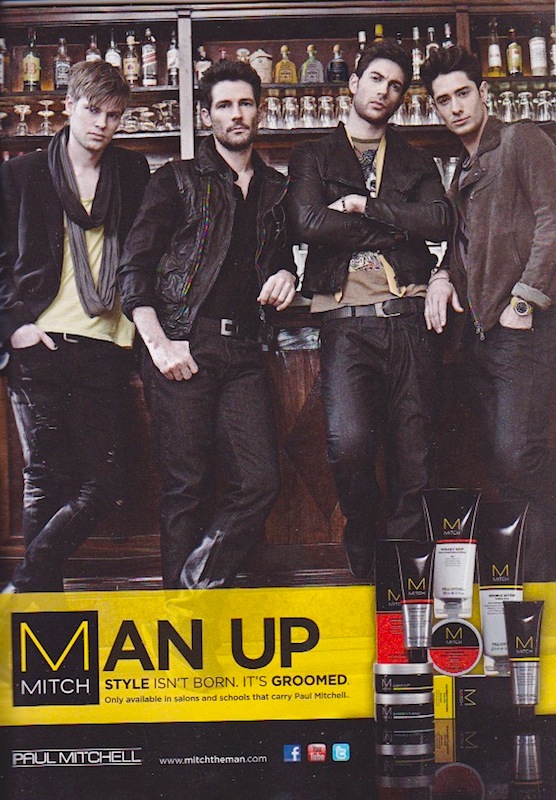
software development
September 19, 2011The initial find, by Megan O’Neil and me a little while ago, while we were looking for something totally different:
Besides VirtualBox, there are in fact quite a number of virtualization software in the market such as VMware Workstation, Microsoft’s Windows Virtual PC (for Win7) and Virtual PC 2007 (for Vista or XP).
In the market, there are a lot of software that claims itself capable of boosting the PC performance. (link)
It takes several steps to get to these two usages for software.
muskox(en)
July 28, 2011From Chris Waigl (in Fairbanks AK), two photos of Arctic ruminants:

LARS is the Large Animal Research Station at the University of Alaska, Fairbanks. Photo by Chris.
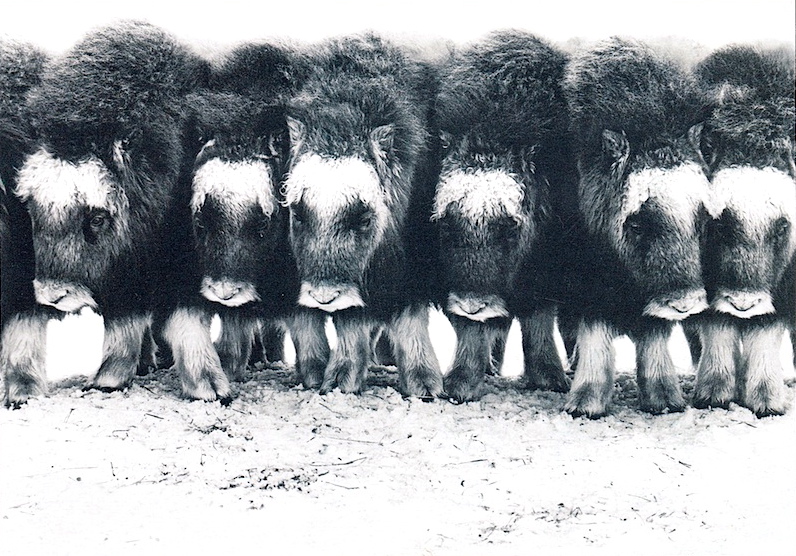
This photo is on a card from Greatland Graphics in Anchorage. The linguistic hook comes in the text on the card:
More on Google+
July 17, 2011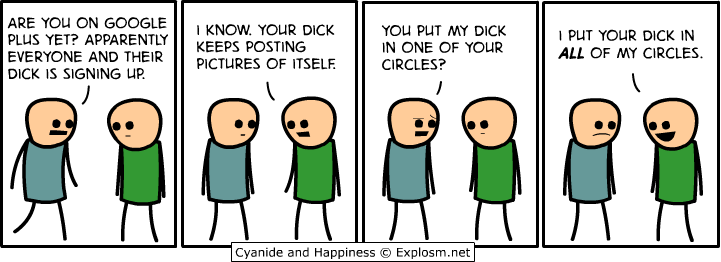
A pain in the grammatical butt
June 21, 2011The English word buttocks presents a problem for speakers: in the standard language, it’s both formally plural (with final /s/) and grammatically plural (rejects singular determiners like a, takes plural verb agreement: *a buttocks, Kim’s buttocks were/*was perfectly symmetrical). However, buttocks plays a double role semantically:
it denotes a matched pair of body-parts (NOAD2’s definition for buttock: “either of the two round fleshy parts that form the lower rear area of a human trunk”; buttocks gets only a subentry here: “the rump of an animal”); this is buttock, roughly ‘ass-cheek’, seen in left buttock vs. right buttock
and it denotes the two as a unit — roughly, ‘ass, butt, bottom, behind, backside, rear end, …’ (for which I’ll use the gloss ‘butt’) — in which case it acts somewhat like a plurale tantum (cf. pants), plural formally and grammatically, but singular in reference, and somewhat like formally plural singular nouns (shingles the disease, linguistics, etc. — there are several subtypes of these, well studied)
How to reconcile this double role?