Archive for the ‘Grammatical categories’ Category

lx and g&s

August 6, 2025

(Not lox and Gilbert & Sullivan, though that’s a charming idea for a matinee; I’d prefer to think of lx (linguistics) and g&s (gender and sexuality studies) as two gay linguists, Lex and Gus, who go together like, oh, politics and poker (from Act I of the 1959 Broadway musical Fiorello!) — or, more relevantly, like mind and body)

A non-academic friend, new to my net presence, wondered what the things I said my blog is mostly about — lx and g&s — have to do with one another. My immediate, overly glib, reply:

Nothing intrinsic, but they happen to come together in me, along with gardening, Sacred Harp singing, an interest in food and cooking, Mozart and Haydn, and more. Various accidents of history and outgrowths of different parts of my make-up.

Strictly true, but in fact my postings about lx tend to have a lot of g&s content, and my postings about g&s very often end up illustrating points of lx. And sometimes they meld together — as in my recent (from 7/26/25) posting “F-lexicography”, on the semantics of the sexual verb fuck.

So now a quick visit to Lex and Gus’s world, just picking out things from here and there in work by me and my colleagues. Not a systematic survey, just the odd snapshots.

(more…)

The discontinuous groin

July 23, 2025

(About male crotch care, carefully phrased, but still deeply into male crotches, so not to everyone’s taste.

From a morning some time ago, after a pleasant long sleep that ended with a hot sex dream that turned into a sweet romantic dream, from which I awoke feeling especially refreshed. Got to the morning wash-up portion of the program (scrub hands, refresh face, wash crotch); if you take quick whizzes every hour during the night, bedside, then your hands and all of your crotch, from pubes to perineum, need a serious washing (and your damp briefs go into the laundry basket, to be replaced by fresh dry skivvies). Normally the crotch wash is a brisk businesslike affair, pleasing but in no way sensuous — but on this morning my body was singing along with my spirit, and I experienced the cleansing as a delicate, luxurious massage of my guy parts. It was delightful.

I began humming the tune to “Der Vogelfänger bin ich ja / Stets lustig heissa hopsasa!” (I find Papageno inspiring) while I went through the routine: pubes and the belly just above them; penis shaft and base; testicles; the clefts on either side of the genitals, alongside the thighs; and the perineum. Along the way, I idly wondered what those clefts — roughly analogous to armpits — were called. When I got to my computer I quickly discovered that the compound thigh pit (analogous to standard armpit and informal elbow pit ‘the inside of the elbow’ and knee pit ‘the back of the knee’; this is the world of paired bodily concavities, or clefts) was moderately common (a few cites below); that crotch pit seemed to be used only for the perineum; and that the noun groin ‘thigh pit’ was also common (a few cites of both groins below).

Then, since there’s a use of the noun groin for the whole area (in kick him in the groin and the like) I went to see what NOAD said about the paired concavities. And was mightily surprised to find that it seemed to maintain that the groin was a spatially discontinuous region of the body, not unlike the nation of Pakistan at the time of the partition of British India into separate nations of India and Pakistan, with Pakistan coming in two widely separated pieces: West Pakistan and East Pakistan (now Bangladesh). For the groin, one region, two sides; not two paired bodyparts. This view of the semantics of groin is shared by the Wikipedia entry. But not, it seems, by most speakers.

A careful look at the OED (in an entry still in revision) suggests that it’s the source of the confusion, since it attempts to treat the bodypart noun (in things like along with my armpits, both my groins are sweaty and in need of deodorant) and the body region, or place / location, noun (in things like the glands in my groin, on both sides, are swollen) with just one definition (despite their different semantics and distinct syntax), and mixes examples of both types.

(more…)
Lost in translation

June 4, 2025

A midweek quickie. Yesterday on Facebook, a posting from Thorstein Fretheim (Professor at the Norwegian University of Science and Technology in Trondheim, specializing in pragmatics and semantics: intonation, discourse markers, prosody, context), as it came to me in English  translation:

‘Trondheim’s Own Chocolate Factory’ (Address Newspaper) or ‘Trondheim’s Own Chocolate Factory?’

(Address is the regional newspaper in Trondheim)

Now this was utterly baffling, so I asked for the Norwegian original:

‘Trondheims egne sjokoladefabrikk’ (Adresseavisa) eller ‘Trondheims egen sjokoladefabrikk’?

(more…)

Adpositions and case inflections, from 1988

January 20, 2025

There was this paper of mine (“Jottings on Adpositions, Case Inflections, Government, and Agreement”), originally from 1988 but not properly published until 1992 (in The Joy of Grammar: A festschrift in Honor of James D. McCawley), that I wanted to quote from in an on-line discussion a week ago, only to discover that after the great dispersal of almost all my books and files some years back, I had no trace left of the thing, no copy of any kind (this sort of thing keeps happening to me). I couldn’t find a way to get a copy on-line, but in a stroke of luck it turned that Benjamins was selling off its remaining stock of the paperback edition of Joy at a price I could actually afford, so I bought their last copy and had it mailed to me next day delivery. This morning I created jpegs of all 15 pages (369 through 384); the quotation I need is on the first page, but now I can add this posting of all 15 pages to the little set of publications of mine available on-line.

(more…)

More surprise etymologies

November 30, 2024

🐅 🐅 🐅 three tigers for ultimate November and the feast day of St. Andrew the Apostle, patron saint of 🏴󠁧󠁢󠁳󠁣󠁴󠁿 Scotland 🏴󠁧󠁢󠁳󠁣󠁴󠁿 (and several other countries) and of fishermen, fishmongers, rope-makers, textile workers, singers, miners, pregnant women, butchers, farm workers. and more

A follow-up to my 11/28 posting “Today’s surprise etymology”, about the history of Jordan almond, which elicited a nice brief comment by David Preston about Baker’s Chocolate and German Chocolate Cake. Which I now elaborate on.

(more…)

great pumpkin pie

November 28, 2024

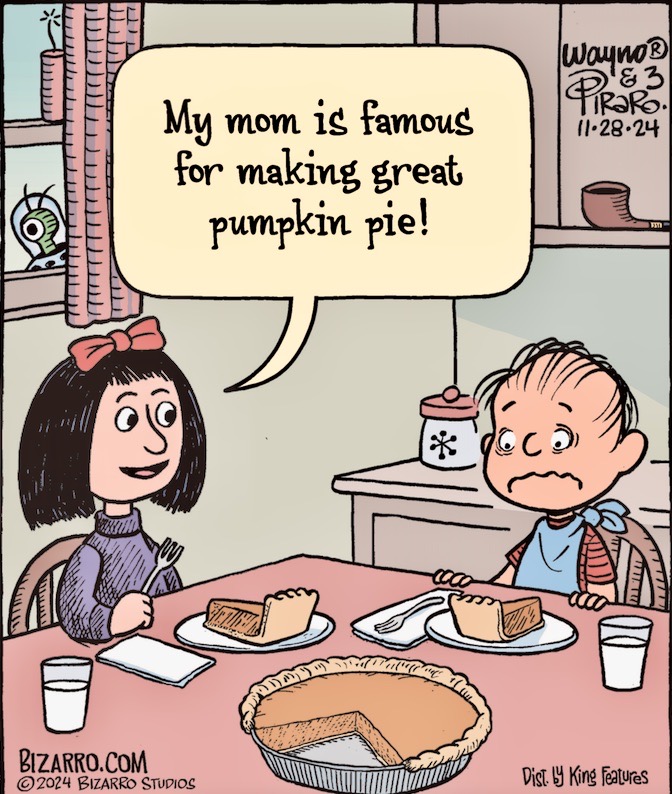
The Wayno Bizarro for today, 11/28, is an exercise in cartoon understanding:


(#1) Wayno’s title: “Horrifyingly Tasty”; I would have suggested the more bloodthirsty “Eat Your Gods” (if you’re puzzled by the odd symbols in the cartoon — Wayno says there are 3 in this strip — see this Page)

But it’s all totally baffling unless you recognize the references to Charles Schulz’s comic strip Peanuts; you really have to know about Linus and the Great Pumpkin. (Meanwhile, your appreciation of the strip will be enriched if you know that today is US Thanksgiving, a harvest festival for which the traditional foods include pumpkin pie for dessert.)

And while we’re talking festivals, the cartoon is a festival of ambiguities in English, structural and lexical.

(more…)

Apostrophobia

November 16, 2024

Wayno’s Bizarro for 11/8 — yes, I am hopelessly overwhelmed with posting material, wondering whether I’ll ever catch up; on the other hand, my health has taken a turn back to normal awful, which I’m entirely able to cope with — is a Psychiatrist strip in which the patient is said to be suffering from (in fact, cowering behind the therapeutic couch in the grips of) the fear of contractions:


Of the types of traditionally-labeled “contractions” in English, the patient here — call him NoA — seems to exhibit sensitivity specifically to just one, now known in the linguistic literature as Auxiliary Reduction, AuxRed for short (in I am > I’mI had > I’d, and you are > you’re), though in fact Wayno sees NoA’s sensitivity as triggered by all occurrences of the punctuation mark the apostrophe, of which there are a great many types — hence Wayno’s title for this cartoon, “Punctuation Trepidation” (if you’re puzzled by the odd symbols in the cartoon — Wayno says there are 7 in this strip — see this Page)

Now if this is NoA’s affliction, he’s in for a world of trouble, because in modern English spelling the apostrophe is used as an abstract mark for possessive forms of nominals — singular in someone’s cat and the queen of England’s hat, plural in the boys’ bat — a visual mark accompanying the possessive S; but while the the letter S in such forms corresponds to phonological content, the apostrophe neither represents phonological content nor indicates a place where some phonological content is omitted. So, how does  NoA know that /sʌm.wǝnz.kæt/ in some sense has an apostrophe in it and he should cringe in fear at it?

(more…)

“I have a ##”

October 20, 2024

So my caregiver León Hernández Alvarez said to me last Tuesday; ## represents a word I totally failed to recognize, at the most elemental level; I didn’t recognize any of the sounds in the word, though I thought it was probably of the form CV. L then came closer to me and said it again, more slowly: “I have a n#”. Ah, an initial n — a Spanish n (distinct from an English n), but clearly something in the [n] zone, and followed by a vowel.  On the third repetition, I was able to identify the vowel: u — a Spanish u (distinct from an English u), but clearly something in the [u] zone. Apparently, L was telling me that he had a [nu].

I recognized the word phonetically, but still totally failed to recognize the lexical item he was talking about. Surely he didn’t have a GNU. Is there such a thing as a NOO? Ah, finally it dawned on me: L was telling me he had a NEW. Hmm, a new what? And then, finally, the realization that he was telling me that he had a piece of news, that he had reconstructed a singular NEW ‘report of a recent event’ from the word NEWS ‘report of recent events’.  This is clever, but alas mistaken.

(more…)

N1 of N2

May 1, 2024

🐇 🐇 🐇 from my 5/1/20 posting “Trois lapins pour le premier mai”:

It’s the first of the month, which I have learned to greet with three rabbits — by starting the day saying “rabbit, rabbit, rabbit”. More than that, it’s the first of May — by some cultural reckonings the beginning of spring in the northern hemisphere and also (in some countries) International Workers Day, so: dance around the maypole, set bonfires for Beltane or Walpurgis, prepare for outdoor bo(i)nking (rabbits again!), break out the lilies of the valley (muguets pour le premier mai), cue the choruses of L’Internationale, and march in solidarity with the workers. (Feel free to choose from this menu, as your taste inclines and your schedule allows.)

But enough of lapins; time to attend to our moutons, the sheep of the day being English NPs of the form N1 of N2 (like bouquet of flowers and tons of stuff) and how they work as subjects of clauses. These sheep came to us on 4/29 from Steven Levine, who wrote on Facebook:

Here’s a sentence I just came across that seems odd to my ears:

By the mid century a variety of celebrations was engaging morris dancers.

I know that the subject is variety [AZ: no no no; the subject is a variety of celebrations; this is important] and the verb is was, and yet it seems off to me — I was expecting were. I’m not asking for a grammatical analysis, I’m asking if this would stop you for a second if you were just reading along.

To which I wrote:

Steven said he didn’t want a grammatical analysis, but here it comes anyway.

I warned you.

(more…)

Baby foods

February 29, 2024

🐅 🐅 🐅  three tigers for ultimate February; for Leap Day, the US is having wild weather (four days of cold rain predicted here on the SF peninsula, where the first flowering fruit trees are already in bloom)

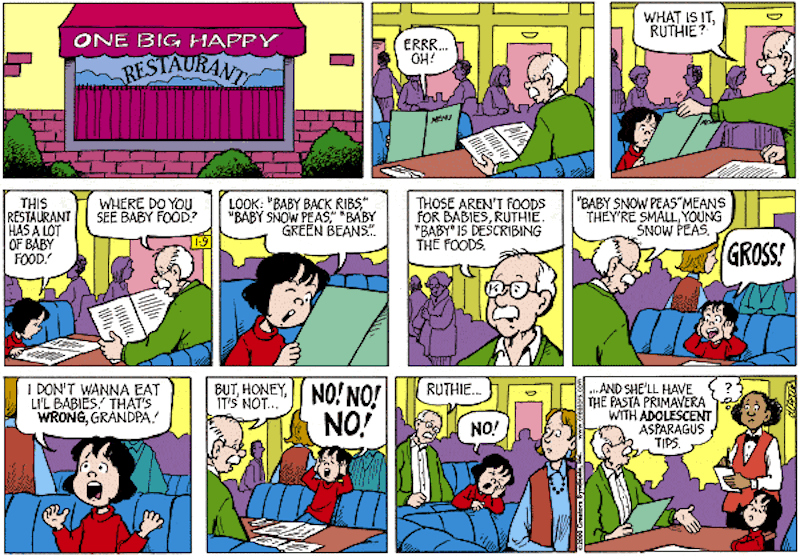
An old One Big Happy strip that turned up in my comics feed recently. The linguistic point is a familiar one on this blog, the enormous potential for ambiguity in N + N compounds in English:


(#1) baby back ribs, baby snow peas, baby green beans, with N1 baby ‘young, immature; small, insignificant (in comparison with others of its type)’ (the sense on the menu) versus baby food, baby carriage, baby book, with N1 baby ‘intended for (use by) a baby’ (the sense Ruthie understands)

The contrast is between two semantic interpretations of the relationship between the modifier N1 and the head N2 in these N1 + N2 compounds.

On the one hand, baby food ‘food for a baby’ is what I’ve called a Use compound; Use compounds (‘N2 for (use by/on/in) N1’) are very common, and sometimes present a pesky ambiguity with also very common Source compounds (‘N2 made from N1’) — some contrasts: Use compound saddle oil ‘oil for (use on) saddles’ vs. Source compound mink oil ‘oil made from minks’ (ugh, but true); Use compound snow tire ‘tire for (use in) snow’ vs. Source compound snowman ‘(simulacrum of a) man made of snow’. The snow examples come from my 1/25/23 posting “Snow tires” on Use vs. Source compounds, taking off from

a classic Don Martin Mad magazine cartoon for the winter season, illustrating the utility and flexibility of N + N compounds in English — and also their enormous potential for ambiguity, which has to be resolved in context

… [with] four examples of N1 + N2 compounds in English, all four highly conventionalized  to very culture-specific referents. In these conventionalized uses, two (snow tiresnowshoe) are use compounds …, two (snowmansnowball) are source compounds … But N + N combinations are potentially ambiguous in  multiple ways; this lack of clarity is the price you pay for the great brevity of these combinations (which lack any indications of the semantic relationship between the two elements).

So: [in the cartoon] we get snow tire and snowshoe understood as source compounds …: ‘(simulacrum of a) tire made of snow’, ‘(simulacrum of a) shoe made of snow’.

On the other hand, baby back ribs ‘back ribs (of pork) that are smaller than the usual (spareribs)’ is what I will now label an Attributive compound, in which some characteristic that’s metaphorically associated with N1 is attributed to N2. Only a few Ns have been conventionalized for use in Attributive compounds: baby for attributing relative smallness (in baby back ribs) or immaturity (in baby peas); giant and monster ‘gigantic, huge’ for attributing (relative) great size (in giant marigold and monster truck); killer ‘exceptional, impressive’ for attributing excellence (in killer abs and killer idea). Since only a few Ns have been conventionalized in this way, Attributive compounds are not very common. But there’s another compound type that’s fairly common and superficially resembles Attributives: what I’ll call the Predicative type, conveying ‘N2 that’s a N1’: baby prodigy ‘baby who’s a prodigy’, killer clown ‘clown that’s a killer’, cowboy poet ‘poet who’s a cowboy’. (The compound killer clown is then ambiguous as between Attributive and Predicative: someone who’s really good as a clown vs. a clown that kills.)

(more…)