Archive for the ‘Folklore’ Category

The gopnik wedding

February 17, 2025

Hollow Man Roboputin, dead at the core, and his grotesque consort Drumpfitsa at their gopnik wedding, in an AI image Hana Filip posted on her Facebook page on 2/15, when she was (as she put it) working on her anger at the performance of Roboputin and Drumpfitsa’s baby (James Donald Bowman) at the Munich Security Conference on 2/14/25:


To come: the gopnik subculture (stereotypically conservative, aggressive, homophobic, nationalist and racist) in Russia and its European surround; the source of this image; hollow men (from T. S. Eliot); and Gopnik as a family name

(more…)

Diamonds, dildos, and in Seattle, clams

August 27, 2024

Acres, folks, acres. Diamonds and dildos got covered in my 8/26 posting “Acres of dildos”. Then from Wendy Thrash on Facebook the next day, more acres that I probably should have talked about in the first place. WT wrote:

Sorry, but as an old Seattleite this forces me to think of Acres of Clams

and referred to a Folk Music Blog posting, “The Songs of Ivar Haglund” by Jacqui Sandor on 5/28/19. I was just going to post WT’s note as a comment on my posting here, but then it occurred to me that “Acres of Clams” might not be familiar to everyone, and even if you know about the folk song (a text climaxing in acres of clams, set to an old Irish jig tune), the note might not have transported your imagination to Seattle, or, indeed, to Ivar Haglund. It might just have been baffling.

So now I will take you into a gigantic morass of the folk song world — in which, however, shines the canonical “Acres of Clams” text, which ends up being about Puget Sound (where Seattle is located), where clams abound, and where there’s a seafood restaurant founded by folksinger Ivar Haglund named Ivar’s Acres of Clams. You see, it does hang together. (And, despite the previous dildos, the clams in question are — surprise! — not lady-parts, but edible bivalves.)

The morass is a consequence of the fact that an extraordinary number of texts have been set to that same jig tune — possibly more than to any other folk tune — and then both the tune and all those texts have been popularly known by names that are phrases from the texts (you’ll see a small sampling of these names in a moment). Even the canonical clam text (from about 150 years ago) is so popular that virtually every folksinger who performs it alters the text to fit their own interests, passions, aims, and politics.

To set the stage, from the HistoryLink site:


(#1) From “Ivar Haglund opens Ivar’s Acres of Clams at Pier 54 in July 1946” by David Wilma on 6/19/00

(more…)

Former Frog in Fableland

August 7, 2024

Today’s Wayno / Piraro Bizarro, in which a prince grouses, over a tipple, about his amatory career, to a nobleman, one of his courtiers:


It seems the prince was once a frog and could rake in the chicks with nothing more than a few commanding ribbits; those were the days of easy scores (if you’re puzzled by the odd symbols in the cartoon — Dan Piraro says there are 3 in this strip — see this Page)

What do women want?, the princel wonders with a whine, recalling that once upon a time a short squat body, moist smooth skin, and long hind legs for leaping used to drive them into an osculatory frenzy. It’s all so damn unfair. (Wayno’s title for the cartoon: “Unhappy Ending”.)

(more…)

What shall we do with the leftover pie dough?

July 24, 2024

Now we sing, to the tune of “Drunken Sailor”:

What shall we do with the leftover pie dough? … …
Cut it into slabs and then you bake them.

Do that, and you get the yummy stuff that Ann Daingerfield Zwicky called piecrust crumblies (a family term whose origin was lost to her); she used that name, so I did too, and my guy Jacques, and probably Elizabeth (Daingerfield Zwicky) as well, so maybe now Opal (Armstrong Zwicky) too. Such things get passed around.

(Spelling note: I will use the solid spelling piecrust, but many writers use the separated spelling pie crust; these are stylistic variants, and are listed as such by, among other sources, NOAD.)

Now it turns out that there’s a term of culinary art for the stuff; food writers seem to call them piecrust treats —  a specialization of NOAD‘s

noun treat: an event or item that is out of the ordinary and gives great pleasure: he wanted to take her to the movies as a treat.

Whatever you call them, they’re just one possible answer to the question in my title, so let’s survey the uses of leftover piecrust dough.

(more…)

Free-range folklore

May 5, 2024

… Wayno’s title for yesterday’s Wayno / Piraro Bizarro, with its excellent POP (phrasal overlap portmanteau) laissez-fairy godmother:


(#1) laissez-faire + fairy godmother yields a hands-off mentor and guide, of not much use to the disgruntled Cinderella, who will now have to do her own prince-finding (if you’re puzzled by the odd symbols in the cartoon — Dan Piraro says there are only 2 in this strip — see this Page)

(more…)

Green grow the pickles, O

October 13, 2023

This remarkable photo left me dumbstruck yesterday when Monica Macaulay passed it along on Facebook, having gotten it from the Art Deco FB group on 10/10:


The Pickle Sisters, a vaudeville group from the 1920s (photo: eBay.com)

[Here I repeat a note from the last posting I was able to manage, the 10/7 posting “THE shirts”, six days ago:

Note: this is massively a Mary, Queen of Scots, Not Dead Yet posting, indeed something of a celebration of my being able to post anything at all, not to mention through enormous pain in my swollen fingers. But no details about any of that here; at the moment, I truly am pleased to be still alive and want to show that I can manage a posting.

This caution applies fully to this Pickle Sisters posting.]

(more…)

Today’s exercise in cartoon understanding

February 17, 2023

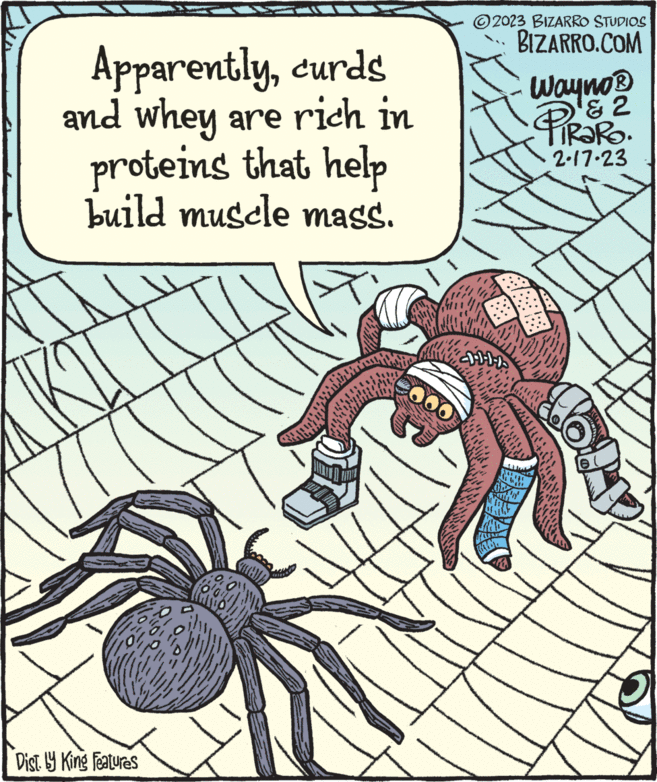
Today’s Wayno / Piraro Bizarro — Wayno’s groan-punning title: “Tuffet Luck” — depends on your knowing one thing from popular culture in the Anglosphere (of, roughly, the past 200 years). If you don’t know that, you’re SOOL; the spider, curds, whey, and tuffet are just weird stuff.


(#1) The spider as ambulatory assault victim; apparently, the spider’s prey was not frightened away, but instead used what they’d learned in self-defense classes (If you’re puzzled by the odd symbols in the cartoon — Dan Piraro says there are (only) 2 in this strip — see this Page.)

Yes, it’s a nursery rhyme. “Little Miss Muffet”, said to have been first recorded in 1805. Traditionally, part of growing up for most children in the Anglosphere (though I wonder if that’s still true), but probably little known elsewhere. And largely opaque to the children who chant it, though I suspect that modern kids are inclined to interpret it as a tale of a male imposing himself on female, and her fleeing from him. Kids would probably understand it as a boy annoying or grossing out a girl with creepy-crawlie things. Older people will think of unwanted advances on the subway, Tyrone F. Horneigh pursuing Gladys Ormphby on Rowan and Martin’s Laugh-In, and the like.

The Bizarro version, on the other hand, is much more up-to-date: Muffet Fights Back.  Muffet, in fact, Kicks Ass.

(more…)

leprobates

March 12, 2021

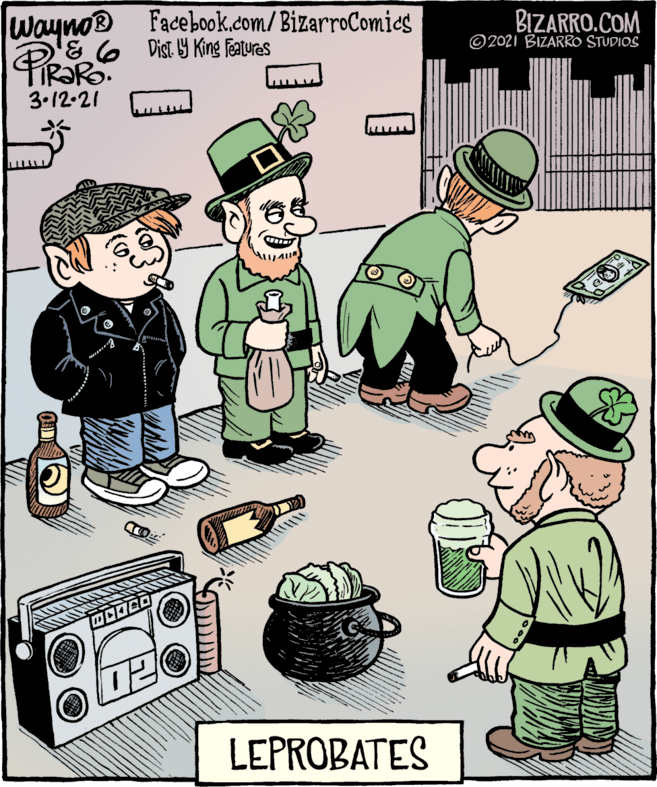
Today’s Wayno/Piraro Bizarro (Wayno’s title: “Mythical Miscreants”):


(#1) (If you’re puzzled by the odd symbols in the cartoon — Dan Piraro says there are 6 in this strip — see this Page.)

leprobate, a portmanteau of leprechaun reprobate. Naughty, naughty boys.

(more…)

genealogy, genie-ology

March 10, 2021

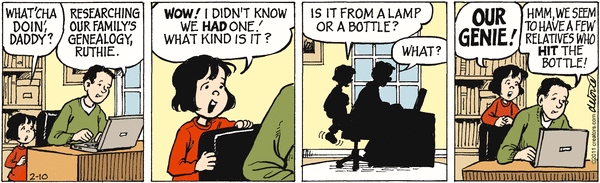
The 2/10 One Big Happy, recently in my comics feed:


(#1) Bonus word play: the genie’s fabulous bottle and the idiom hit the bottle ‘drink heavily

Ruthie understands genealogy as genie-ology, or at least as a word with first element genie, the name of a mythological spirit that has come to play a significant role in American popular culture (and she recognizes both lamp genies and bottle genies). But genealogy is new to her.

(more…)

Crossed folk stories

September 9, 2020

Yesterday’s Wayno/Piraro Bizarro cartoon:


(#1) (If you’re puzzled by the odd symbols in the cartoon — Dan Piraro says there are 4 in this strip — see this Page)

The strip explicitly refers to the legend of the Pied Piper of Hamelin, but also alludes to the Piper’s son as having stolen a pig. This is baffling unless you know a particular English nursery rhyme, so we have another exercise in cartoon understanding.

Ok, let’s assume you get that. Then the cartoon is a kind of conceptual portmanteau, a cross between the Piper legend and the Piper’s son nursery rhyme. Then set in a modern law-enforcement context, juxtaposing some (stereotyped) version of the real world with the world of these two folk stories. Cool.

(more…)