From Charlie Doyle on ADS-L, this F Minus cartoon (by Tony Carrillo):

Doggy-dog made it into the Eggcorn Database back in 2005, here.
From Charlie Doyle on ADS-L, this F Minus cartoon (by Tony Carrillo):
Doggy-dog made it into the Eggcorn Database back in 2005, here.
From “Better Drug Ads, Fewer Side Effects”, a NYT op-ed piece by Ian D. Spatz (February 10), on direct-to-consumer drug ads on tv:
Nearly 14 years later [after such ads were allowed], with parents confronting uncomfortable questions from their young children about “reptile dysfunction” and nearly $5 billion a year spent on TV ads for treating everything from toe nail fungus to cancer, critics, the medical community and even the drug companies themselves are wondering if there is any way to put this genie back in its lamp.
Yes, reptile dysfunction, which originated as either a simple mishearing or an eggcornish reshaping of unfamiliar material (erectile, in particular) to something that contains more familiar parts (reptile), or perhaps one on some occasions and the other on others. And, probably, as deliberate word play on still other occasions.
Passed on by Jeff Shaumeyer on Facebook, about the story “RCMP say vicious beating of gay man at St. Leon’s Hot Springs a hate crime” in the Arrow Lake News (BC):
It’s a vicious hate-crime and the RCMP should get their man, although it may take a bit longer if they keep looking for “….a Caucasian male standing at about 6 feet tall (180 cm), around 44-years-old with a stalky, muscular build.” ‘Stalky’? Like celery?
Found in an R. Crumb cartoon on a postcard I sent out yesterday:
The proof is in the pudding.
The original proverb is
The proof of the pudding is in the eating.
But, thanks to the fact that the sense of proof having to do with the trying or testing of something has largely disappeared except in this proverb, in its elliptical form the proof of the pudding, and in the idiom to put to (the) proof, the saying became opaque to many people and was reanalyzed and simplified, to yield the mysterious the proof is in the pudding.
From Lars Ingebrigtsen and Ned Deily, this blog comment with the puzzling expression run around the ringer (boldfaced in the quote):
(1) … it’s getting burned by these borderline deceptive tactics that drive small software companies to begin to take harder stances on things like this. I can’t tell you how many times we’ve been run around the ringer for discounts, extra support, customizations, etc. only to suddenly not hear from the person anymore, or find out they went with someone else with absolutely no explanation. (link)
A weekend cartoon from Hilary Price, with a pun on thong and the thon part of the libfix -athon:
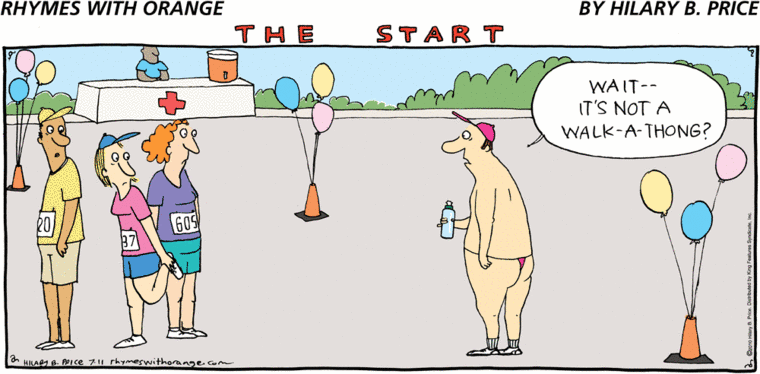
Well, it’s complicated. Price is making a pun. But if the guy who’s speaking were a real person, rather than a character in a cartoon, we might see walk-a-thong as an eggcorn, a kind of misunderstanding that improves on the meaning of walkathon, with the speaker then acting on the supposition that thongs were involved in a walking event.
Or if someone announced a Walk-a-Thong as an event, then we might see walk-a-thong as a kind of intentional portmanteau, of the substitution type (analogous to inadvertent substitution blends), so that it would be understood as combining the meanings of walkathon and thong as well as their forms, to produce a new item meaning something like ‘walkathon in a thong’.
It all depends on who’s speaking and what they have in their heads.
In class yesterday, I said, about some usage, that you could find it “all over the time”. For me, this was an inadvertent blend, of “all over the place” and “all the time”, both conveying frequent occurrence; it was not what I intended to say, and I caught it on the spot. Then I checked my error files, and found that I had made the very same inadvertent error in a different class in 2007. Well, that happens; some errors are more likely than others and will occur again and again.
A Google search pulls up more (relevant) examples of “all over the time”, for instance these:
BARKER: We have had our billboards and our signs up all year-round in many states, all over the time. (link)
This is a classic deceptive practice that is used all over the country, all over the time. (link)
There are lots of irrelevant examples, and many with “all over the time” understood as ‘all during the time’, but there are also some that look like genuine combinations of time and place meanings. The question is whether all of these are inadvertent errors (like mine), or whether some of them came out as intended. That is, it’s possible that for some people all over the time is now an idiom on its own (unmoored from its origins as a blend), which people simply pick up from other people.
A somewhat different example: my Fay/Cutler malapropism (errors in word retrieval, based on phonology) files include the expression “spread like wildflower” (for “spread like wildfire”), which I’ve uttered in error several times in error (correcting myself each time).
“Spread like wildflower(s)” has made it into the Eggcorn Database (here), where it’s noted that people “often comment on the poetic character of the ‘wildflower(s)’ versions”. In any case, some of the examples are not inadvertent errors, but were intended to be as they are; by whatever route, some people have picked up the “wildflower(s)” version, believe it to be an ordinary expression of English, and are willing to explain that it makes good sense, because wildflowers spread fast.
Note the larger lesson here: the same expression can have different statuses for different speakers on different occasions.
Passed on by a friend, who got it from the friend who came across it, the written sentence:
As I persevered and mustarded up all my energies, my creativity flowed and I was able to improve our sessions.
The story starts with the eggcorn pass mustard for pass muster, in the eggcorn database here. A comment on this entry has mustard as a verb, in “to mustard up some sort of compassion”; there are a fair number of googolable examples, for instance:
Looking back you will see that it was not your talents that kept you from your dreams, it was your inability to mustard the courage, at all cost, to make them come true. (link)
That’s stage 2, mustard as a verb.
[A development in a different direction: mustard for mustered. A contribution to the eggcorn forum notes that you can find plenty of examples of this one, for instance:
Dad would have liked it. I even mustard the courage to speak to those present, with a little help for a prop, one of my dad’s trademark hats on my head! (link)]
Once we have mustard as a verb, the way is open for stage 3, conjugating it, as in the use of mustarded in the quote above, and in a few other examples you can google up, for instance:
Despite having at least 2 love interests in her lifetime, Sylvia has never mustarded the courage for sex. She’s actually quite afraid of intimacy. (link)
Ben Slade posted last week on his blog (Stæfcræft & Vyākaraṇa) on some phenomena in the language of reggae music, under the heading:
Overstand the downpression of the kin-dread by outformers: On what to call “reverse eggcorns” in Dread Talk
Kin-dread here is a pretty standard eggcorn (though it’s a deliberate play on words), with kindred reinterpreted as having the second element dread (metonymically referring to Rastafarians, or sometimes to people in general); the reinterpretation turns on phonology. But the other three are different (though they’re also deliberate), since the reinterpretation turns primarily on semantics, in particular the semantics of opposition.
So: overstand is an intended improvement on understand, on the grounds that the under in understand would suggest low comprehension, while its opposite over would (correctly) suggest high comprehension.
Similarly for downpress in downpression: if oppress is understood as up-press, then it would seem to mean ‘lift up’, and so it should be reanalyzed as downpress ‘press down’.
Finally, outformer replaces the usually positive in- of informer with the more explicitly negative out-.
There are more: livicate ‘dedicate’ (live vs. dead) and blindgarette ‘cigarette’ (blind vs. see).
At a loss for terminology, Slade hit on reverse eggcorns. In the spirit of the way eggcorns were named, I’d suggesting calling them overstandings.
Over on his blog, John McIntye posted a little while back (December 6) on editing slip-ups in various newspapers, including this one from the NYT:
It is the breakfast hour, the day before Thanksgiving and the lobby is busy with clean-looking families who are up and Adam, ready to set off in their varsity-letter jackets and Rockports for some holiday shopping, maybe a show. (link)
Eggcorn Forum contributor Jill caught this one too. And it turned out that there already was a thread there on up and Adam for up and at ’em, focusing on whether the expression was an eggcorn. Certainly, you can google up lots of hits for it, and some of them look like intentional puns, but many do not. For the latter, the question is whether up and Adam is just a demi-eggorn (in which an opaque expression is interpreted as containing some familiar material, even if that doesn’t make full sense) or a straightforward eggcorn (with Adam contributing meaning to the whole).
It’s probably a demi-eggcorn for many people who use it, but some of the forum contributors reported having rationalized it as involving a reference to be biblical Adam, as in this commen from charsnyder:
There was imagery for me. I didn’t know much about Adam and Eve but I’d seen the Michelangelo painting segment where God’s finger is sort of commanding Adam to “get up”. I wasn’t sure about Adam and didn’t think “up and Adam” meant it was an exhortation to DO anything, but just to sort of “spring forth” into the world. So that made some sense in terms of my Mom wanting me to get out of bed.
The impulse is fairly strong not only to see meaningful elements in partially opaque expressions, but also to make the whole expression meaningful. So one person’s demi-eggcorn can be another person’s full eggcorn. Chris Waigl reported on ADS-L on August 16 about another case:
I was mentioning B-line [for bee-line] as a very questionable eggcorn to an interested friend a while ago, and she surprisingly said she used to think it came from the letter B, thinking of the vertical line in it as the very image of a straight line. So this is just to show (once more, after many times) the subjective nature of making sense of some lexical item.
(There are also hits for up and atom, not all of them plays on words. I am of course reminded of the 1960s television cartoon The Atom Ant Show, the motto for which was “up and at ’em, Atom Ant”. There was also a later computer game Up and Atom, Atom Ant.)