Archive for the ‘Categorization and Labeling’ Category
August 17, 2022
Yesterday’s Wayno / Piraro Bizarro, at the grocery store:

(#1) Wayno’s title: Joint Replacement (If you’re puzzled by the odd symbols in the cartoon — Dan Piraro says there are 5 in this strip — see this Page.)
So: let’s start with elbow macaroni and go on from there.
(more…)
Posted in Ambiguity, Categorization and Labeling, Constituency, Italian, Language and food, Language and the body, Linguistics in the comics, Metaphor, My life, Names, Naming, Parsing, Syntax, Understanding comics | Leave a Comment »
May 24, 2022
(A few references to man-on-man sexual acts, which I have, contrary to my usual practice, reworded with technical terminology, rather than plain street talk, so as not to contaminate this whole posting for some readers. But the references remain.)
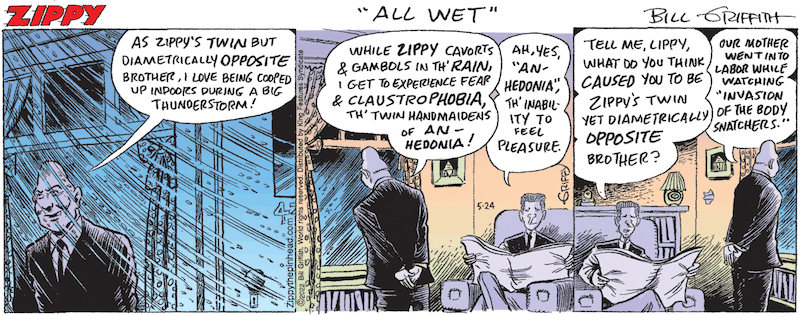
Today’s Zippy strip:

(#1) Ah, the peri-natal trauma: the film podfolk have robbed Lippy of the ability to experience pleasure
But as Bill Griffith fully realizes, it’s a pressing question: how do we come to be the way we are? Framing the answer in this preposterous fashion only points up the complexity and mystery of the question. And how it nags at us: could I have been otherwise?
(more…)
Posted in Categorization and Labeling, Gay porn, Gender and sexuality, Homosexuality, Identities, Language and the body, Linguistics in the comics | Leave a Comment »
May 15, 2022
As in yesterday’s posting “Romper buddies”, about an ad for Romperjacks: not RAJ the land of Uttar Pradesh, Madhya Pradesh, and Andhra Pradesh, but ROJ the land of rompers, overalls, and jumpsuits. With a photo gallery. To whet your interest, two Romperjacks items:

(#1) The floridly beautiful Jungle Print romper

(#2) The elegant White Chateaux romper
(more…)
Posted in Categorization and Labeling, Clothing, Fashion, Gender and sexuality, Lexical semantics, Masculinity, Play, Social class, Sociocultural conventions | Leave a Comment »
May 14, 2022
Taking off from a delightful ad for Romperjacks on Facebook back in November and December:

Here I give you the ad photo, and inventory some of the things it inspires me to write about in future postings (several being themes from earlier postings on this blog).
(more…)
Posted in Art, Categorization and Labeling, Clothing, Context, Facial expression and gesture, Fashion, Homosexuality, Lexical semantics, Masculinity, Music, My life, Race and ethnicity | 1 Comment »
May 3, 2022
(Men’s genitals, man-on-man sex, lots of street talk about them, entirely unsuitable for kids and the sexually modest.)
The Merry Homomonth of May on my two male calendars for 2022: the Tom of Finland calendar (which is mostly free of naughty bits) in my living room, where visitors (I do have an occasional one) can see it; the Cocky Boys / CockyBoys / Cockyboys calendar (which is all about the naughty bits) stashed away in my bedroom, where it can be viewed from my bed and so can provide me with an inspirational penis boost as called for by the exigencies of the moment.
So, in order: the ToF, which turns out to be primarily (though not exclusively) about gay men’s nipples, or tits, as we usually call them (metonymically); and then three months of CockyBoy cocks (April through June).
(more…)
Posted in Categorization and Labeling, Compounds, Effeminacy, Gay porn, Gender and sexuality, Homosexuality, It's Just Stuff, Language and the body, Male art, Masculinity, Metaphor, Metonymy, My life, Semantics of compounds | Leave a Comment »
April 27, 2022
(This has turned out to be quite a large meze, but it’s only about one idiomatic slang expression. Well, men and masculinity come into the thing, and you know what can happen then.)
Reflecting a couple days ago on my Princeton days (1958-62) and the tangle of the attitudes of the (all-male) students at the time towards (among things) masculinity, male affiliation (as systematized in a pervasive system of male bands, the eating clubs of the time), women, homosexuals, race, and social class. The topic is vast, also deeply distressing to me personally, and I suspect that I’ll never manage to write about the bad parts of it in any detail — note: there were some stunningly good parts — but in all of that I retrieved one lexical item of some sociolinguistic interest (and entertainment value), one slang nugget: the idiomatic N1 + N2 compound noun face man / faceman / face-man.
A common noun frequently used among my friends, which was then also deployed as a proper noun nicknaming one of our classmates, a young man notable for his facial male beauty: everybody had to have a nickname (mine was Zot, for the Z of my name and the cartoon anteater), so we called him Face Man because he was a face man.
(more…)
Posted in Categorization and Labeling, Common vs. proper, Faces, Gender and sexuality, Homosexuality, Idioms, Innovations, Language and gender, Lexicography, Masculinity, Metaphor, Movies and tv, Music, Nicknames, Semantics of compounds, Slang | Leave a Comment »
March 29, 2022
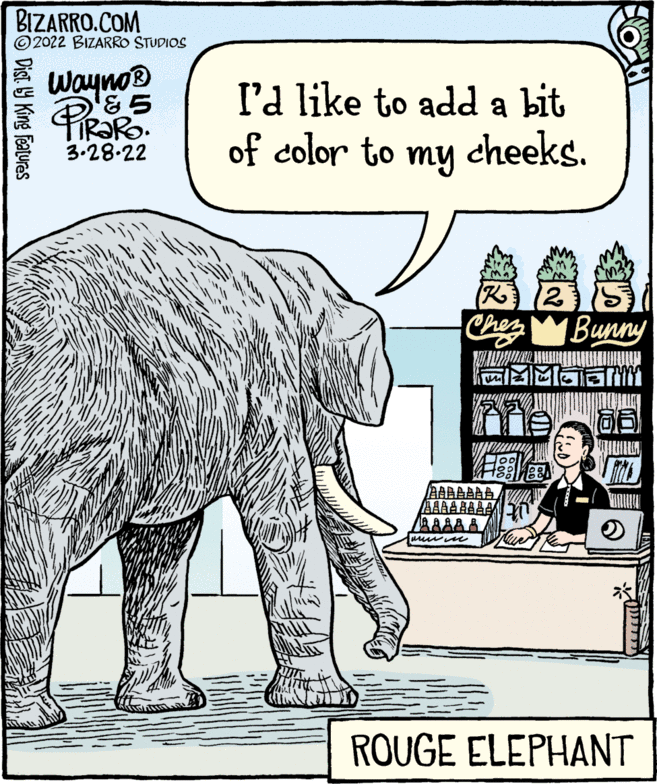
Effeminacy in the animal world, first in yesterday’s (3/28) Wayno/Piraro Bizarro:

(#1) Not only elephant effeminacy, but also a cosmetic anagram, a rouge and peasant salve (If you’re puzzled by the odd symbols in the cartoon — Dan Piraro says there are 5 in this strip — see this Page.)
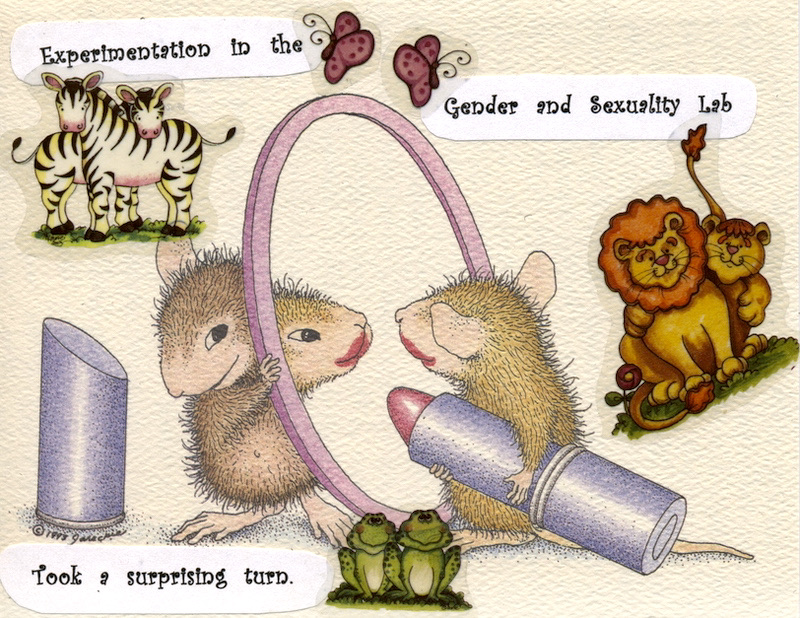
And in one of my academic collages, with mice in the lab:
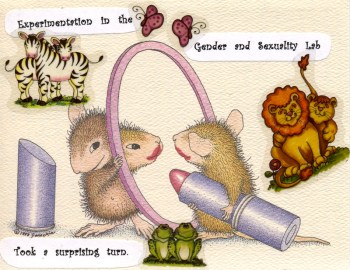
(#2) Continuing the theme of makeup for males
(more…)
Posted in Anagrams, Categorization and Labeling, Collages, Effeminacy, Gender and sexuality, Homosexuality, Language and gender, Language and sexuality, Language and the body, Linguistics in the comics, Music, My life | 3 Comments »
March 14, 2022
The year has rolled around again to Four Days in March:
— 3/14, today, Pi Day, a holiday both mathematical and alimentary
— 3/15, the Ides of March, also (in my household) Higashi (Removal) Day, the day in the distant past when my man Jacques and I would set off from Palo Alto to drive east (higashi) across CA, AZ, NM, TX, OK, MO, IL, IN, and OH to Columbus, to trade universities
— 3/16, National Panda Day, a significant occasion for several of my ailuropodotropic friends
— 3/17, the culmination in St. Patrick’s Day
So this morning came a New York Times mailing for Pi Day with five pies — well, five things from the PIEESQUE category, embracing pies, tarts, flans, quiches, etc. — for us “to bake in the name of science”.
(more…)
Posted in Categorization and Labeling, Holidays, Language and food, My life | Leave a Comment »
March 13, 2022
(Considerable discussion of sexual practices in this posting — largely in cautious language, but some may find the topics — male masturbation and male-male sexual acts — distasteful.)
To understand the brilliant 3/11 Wayno / Piraro Bizarro, you need to marshal detailed information about the Pillsbury Doughboy, the Roman Catholic confessional, the language of male masturbation in English, and self-rising flour (I wonder what, say, a Japanese exchange student in the U.S. would make of the cartoon; there is just so much culturally specific knowledge needed to understand it):

(#1) (If you’re puzzled by the odd symbols in the cartoon — Dan Piraro says there are 5 in this strip — see this Page.)
You must recognize the central figure as Poppin’ Fresh the Pillsbury Doughboy (though you can’t see the Pillsbury label on his chef’s hat), the dough-creature mascot of the (American) Pillsbury baking brand since 1965; and you must recognize that he’s at the grill, or screen, separating the penitent from the priest in the confessional box of a Roman Catholic Church, where he is confessing his sins (seeking absolution from the priest); then you must understand that the particular sin he’s confessing is masturbation (stimulating his penis by hand to become erect — to rise — for the purpose of sexual pleasure), and that this is a grave sin, requiring confession; and finally, and crucially, you have to see that his reference to his masturbating as self-rising (metonymically causing himself to rise) is a play on words, the ordinary use of self-rising being to flour (available mostly in the US and the UK) with added ingredients that will cause dough made from such flour to swell — to rise — on its own.
What makes the cartoon so delightful is that all of this is woven together by the fact that Poppin’ Fresh is an anthropomorphic being — a male one, with the desires of a sexually mature male — made of dough.
(more…)
Posted in Categorization and Labeling, Double entendres, Language and food, Language and religion, Language of sex, Linguistics in the comics, Metonymy, Subsectivity, Understanding comics | Leave a Comment »