CK special for Pride Month:
 (#1)
(#1)
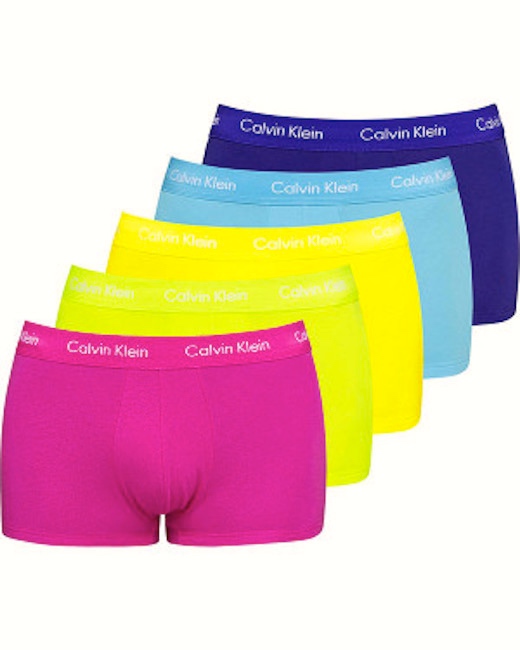
(#2) Pride Trunks
In five neon colors: pink, yellow, lime green, aquamarine, dark blue.
CK special for Pride Month:
(#1)
(#2) Pride Trunks
In five neon colors: pink, yellow, lime green, aquamarine, dark blue.
Darya Kavitskaya on Facebook yesteday:

This is sour cherry clafoutis. No more food for today.
I commented:
I think French needs a verb clafouter ‘to cook a clafoutis; to devour a clafoutis’.
Come to think of it, I could use an English verb clafoute /kla’fut/ with these senses:
I think I’ll clafoute for tonight’s dessert. Maybe plum.
Terry piggishly clafouted. Seven at a sitting!
To come: a reminder about what clafoutis is; about the forms of the invented French verb clafouter; on “having no word for” some concept; about needing — or at least wanting — a word for it; about the ambiguity of these invented verbs (both ‘to cook’ and ‘to eat’); about the source of such ambiguities in marker-poor combinations of elements (lacking explicit indicators of the semantic relationship between the elements — there’s nothing in French clafouter or English clafoute to indicate the semantic role of the referent of their subjects, as creator or consumer); and about the motivation for marker-poor combinations, in a drive for brevity (vs. clarity). French and English could be clearer, less ambiguous — I’ll illustrate with still more invented French verbs — but only at the cost of greater length and effort.
All this from (delicious) French sour cherry flan.
An innocent-sounding request a few days back, from a Daily Beast reporter on its lgbt beat: [I’m] “working on a series of interviews with unsung (or, at least undersung) LGBT heroes. … I’m wondering if you’d be interested in being interviewed about your contributions to linguistics?”
Two claims here: I’m a person of significance in a professional field, linguistics; I’m a person of significance in the lgbt world. I am now asked to defend these claims, to demonstrate that I have done important things in both these areas of my life.
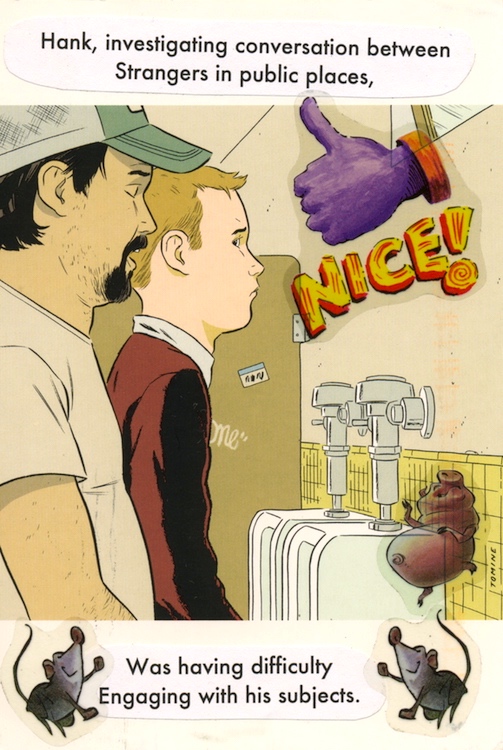
Difficult fieldwork moments in the linguistics-lgbt interface
This is where I curl into a ball of misery, in two ways at once. What have I done with my life, that people should read about me? I’m very proud of what I’ve done, in the academic world and the lgbt world, but I’m not even remotely a magisterial figure, a Great Person, in either. Sigh.
Reflections on my academic work to come. There will be lists. Long lists. I can’t promise quality, but quantity I can deliver.
From Bitty Ramirez on Facebook:
It is really unusual to have a K-12 lesson that allows discussion of dice and playing cards. This may be the first time I’ve encountered it. And I am finding it really disconcerting that the writer keeps dividing suits by color instead of by major/minor.
This was at first completely baffling to me: major/minor?
It turned out to be significant that Bitty is a bridge player, and I am not. Major/minor is a thing in bridge.
I turn now from deserts (the plants at Stanford’s cactus garden, in a series of recent postings) to desserts.
This is the first in a series of follow-ups to my 4/29 posting “All the dessert world is not either cake or pie”, about the categorization and name of a strawberry dish made by Stephanie Shih’s friend Darya Kavitskaya. Darya called it a pie, but Steph insisted it was better labeled as cake. On looking at a picture of the dish (#2 in that posting), I identified it as a strawberry clafoutis, a crustless dessert of strawberries baked in a thick custardy flan-like batter (#3 in that posting) — something distant from both canonical cake and canonical pie. Hence the title of that posting.
But now Darya has sent me the recipe, and I see that it’s not a clafoutis at all, but in fact a fruit pizza, with a sweet base crust and a strawberry topping.
Steph Shih on Facebook today:
There is this dessert that Darya [Kavitskaya, who is natively Russian, which will eventually become important, but not in this posting] sometimes makes and she calls it a “pie” when really I insist it falls better into the category of a “cake”. So finally today, I drew this.
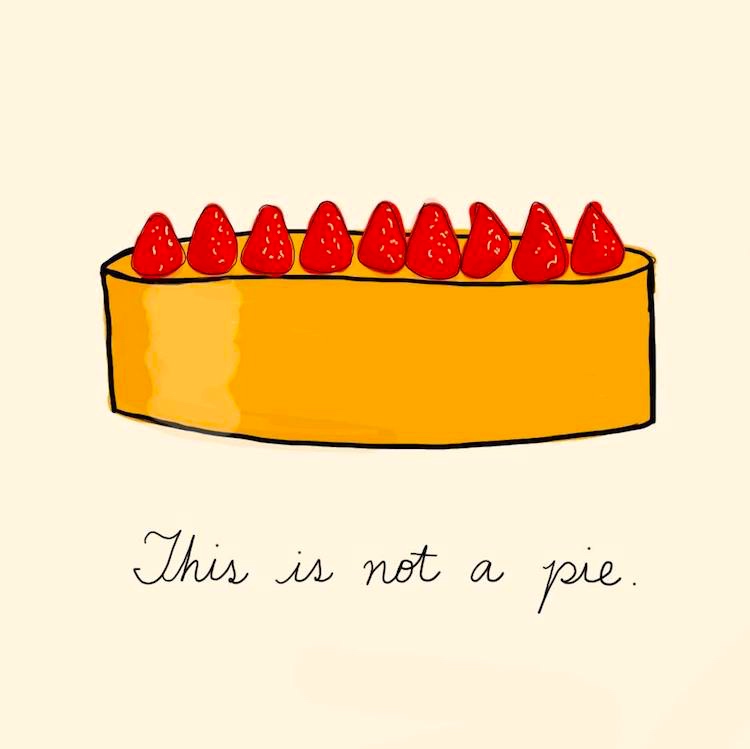 (#1) Steph’s objection framed as a Magrittean disavowal (it’s obviously a pie, but… — except that for Steph, it just isn’t a pie)
But, as it turns out, it’s not much of a cake either, as most people use that label these days. It looks a lot like a clafoutis, but most of you won’t even know that name — for anything, much less a fruit flan (a term also unknown to most of you). Unlike pie and cake, clafoutis and flan are specialized cooking terms
The subject of a somewhat confused exchange on Facebook a few days ago. Jeff Shaumeyer on the 9th:
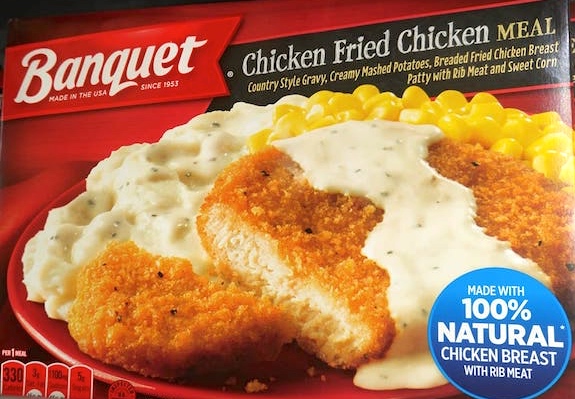 (#1)
(#1)
We were at the Safeway this weekend, when I saw this. I’m still perplexed by the idea of “chicken fried chicken”.
Chris Waigl on the source of the perplexity:
“Chicken fried steak” (I was taken aback by this one, too, at first) means “steak fried in the manner of fried chicken”. So “chicken fried chicken” would be “chicken fried in the manner of fried chicken”. That is, fried chicken.
Well, no. Chicken fried steak doesn’t mean ‘steak fried in the manner of fried chicken’; it’s the name of a dish, a fried steak preparation that resembles in some ways Southern fried chicken. As I hammer home again and again, Labels Are Not Definitions.
Back on December 17th, my posting “Xmas follies 2017: the shirtless men of the season” featured (in #1 and #2 there) pole dancer Domenico Vaccaro, engaging in an activity that is both sport — there are competitions — and art form — performances are scored on aesthetic criteria as well as on the achievement of specific moves. Think of it as ballet with a prop, a prop that allows a dancer to fly suspended in mid-air. Male pole dancers frequently perform shirtless, so they also show off their full bodies, which are aesthetic objects in their own right.
And now, thanks to Kim Darnell, another male pole dancer, the Hungarian Peter Holoda, a great pleasure to watch in action. In a still shot:
 (#1) You can watch here a piece of a stunning performance by Holoda to music from the film Schindler’s List, played by Holoda’s frequent collaborator, cellist Tina Guo
The Mother Goose and Grimm, from February 21st:
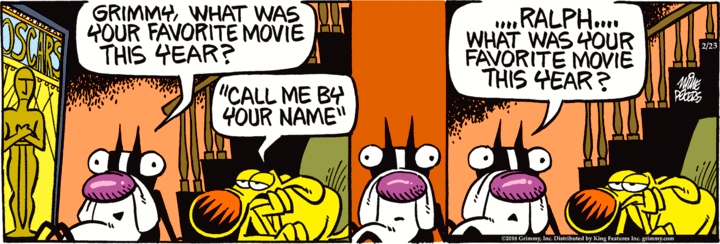 (#1)
(#1)
A joke playing on use and mention: Grimmy mentions the name of the Oscar-nominated movie Call Me by Your Name, but Ralph understands him to be using the expression call me your your name, so he calls Grimmy Ralph.
That leads us to the movie and so to a thicket of issues about language, sexuality, gender, and the law.
