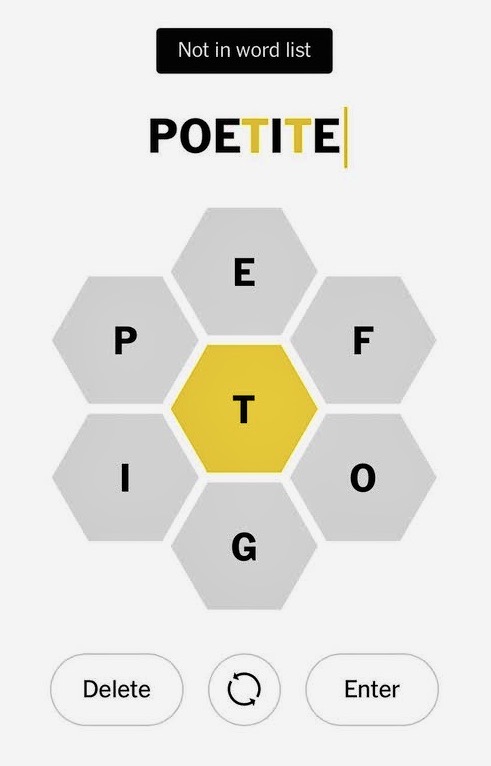
Faced with this judgment on Facebook today about the Spelling Bee puzzle from the New York Times,
Dennis Baron owlishly protested with word play incorporating a pun on concrete:
It’s the stuff concrete poems are made from.
Well played, Dennis!
Faced with this judgment on Facebook today about the Spelling Bee puzzle from the New York Times,
Dennis Baron owlishly protested with word play incorporating a pun on concrete:
It’s the stuff concrete poems are made from.
Well played, Dennis!
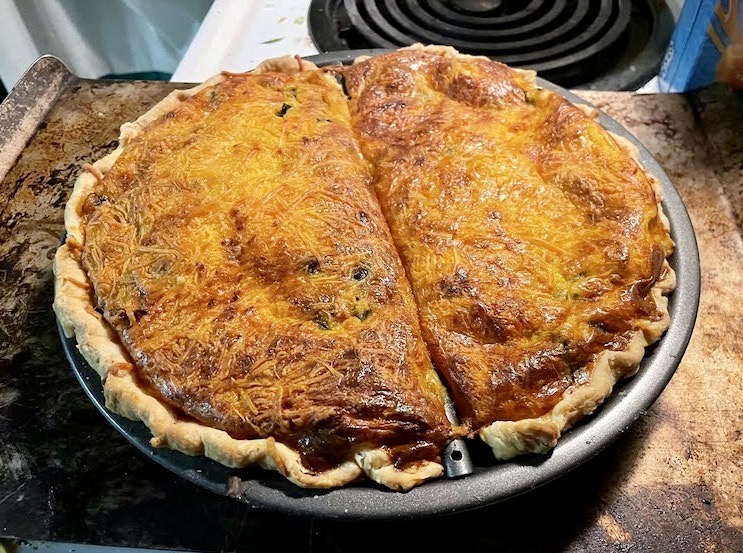
Gretel Cunningham Young (of Columbus OH, where she grew up, with my daughter Elizabeth, many years ago) on Facebook yesterday:
— GY: My goal was to make a half-vegetarian, half-carnivorous quiche, so I ordered this divided pan
Noting her reference to carnivorous quiche, plus an odd quirk in way English vegetarian is used, I reacted to her statement with some alarm (my response in an expanded and improved form here):
— AZ: But I don’t think I want to get near a carnivorous (‘meat-eating’) quiche, lest I be devoured by it. vegetarian quiche has the adjective vegetarian ‘(of food or diet), plant-based, excluding meat’, not the noun vegetarian ‘(of people) a vegevore, someone who eats only plant-based food; a non-carnivore, someone who does not eat meat’. A quiche that’s a vegetarian would not be a threat to me (as a being made of meat), but it would nevertheless be creepy, in a cannibalistic sort of way. The meaty correspondent to vegetarian quiche ‘quiche for vegetarians’ would be quiche for carnivores.
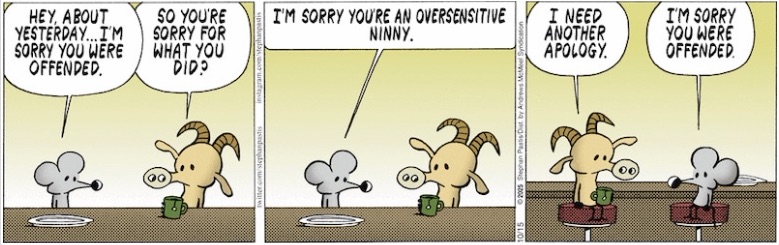
The most recent Stephan Pastis Pearls Before Swine strip:
A classic NAA (non-apology apology): if you take offence, it’s your problem (in the strip: I’m sorry you were offended; ramped up: I’m sorry you’re an oversensitive ninny) (see Edwin L. Battistella’s Sorry About That: The Language of Public Apology (Oxford, 2014))
From Wikipedia:
A non-apology apology, sometimes called a backhanded apology, empty apology, nonpology, or fauxpology, is a statement in the form of an apology that does not express remorse for what was done or said, or assigns fault to those ostensibly receiving the apology. It is common in politics and public relations.
I’m Chiquito Quesito, and I’m here to say,
Cheese dip has to be made the Arkansas way
The jingle to go along with native Arksansan Bill Halstead’s reproducing (on 8/31) this silly dip pun he found on Facebook (from who knows what source):
(#1) The signage is for a dip in NOAD‘s sense 3a, wilfully misunderstood as about sense 2:noun dip: … 2 a thick sauce in which pieces of food are dunked before eating: tasty garlic dip. 3 [a] a brief downward slope followed by an upward one: the road’s precipitous dips and turns. [b] an act of sinking or dropping briefly before rising again: a dip in the share price.
And queso is short for chile con queso (‘chili with cheese’), which Wikipedia identifies as:
an appetizer or side dish of melted cheese and chili peppers, typically served in Tex-Mex restaurants as a dip for tortilla chips.
Now three further explorations: about dip signage; about dipspreads and dips in general, and varieties of queso in particular; and then some Facebook exchanges with Bill Halstead about cheese dip as a significant item in Arkansas’s food culture.
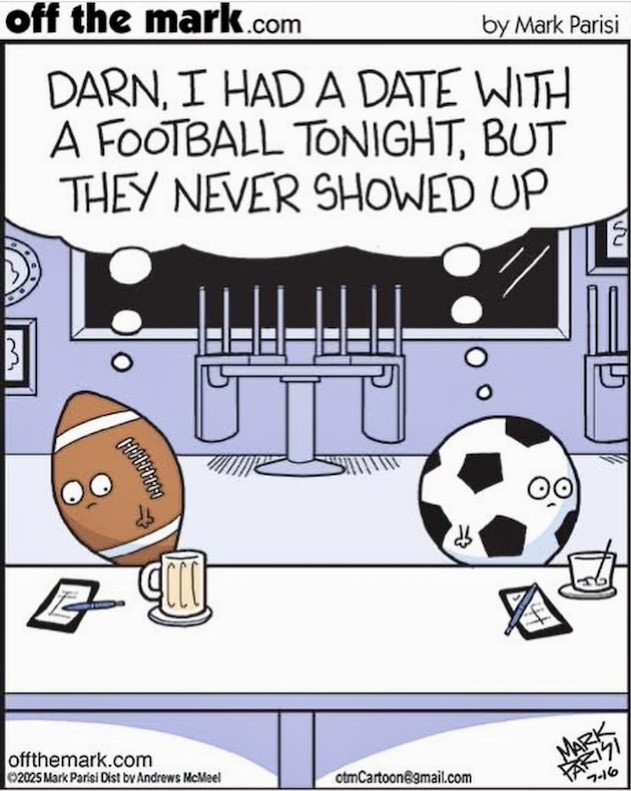
Very briefly (it’s been a hellish day). In my comics feed for today, penultimate July, Mark Parisi’s off the mark cartoon of 7/16/25, in which an AmE football and a BrE football fail to hook up with a sportsball of their own kind — next to one another in a bar.
In the RomCom version, of course, they go on to find satisfaction in hooking up with (aka dating) one another, in the thrill of the new and different.
Otherwise, you see the pitfalls of dating through text only; if they communicated by voice, they’d get nationality information. (Though in the real world, a British football would know that such a brown sportsball was called a football in the US. Whether an American football could be depended upon to know that a soccer ball was called a football in the UK is not so clear to me.)
(all about the F-word and its uses, so obviously not for kids or the sexually modest)
Another posting that’s been hanging around for months. I argue that the OED treatment of the semantics of the sexual verb fuck is unsatisfactory, not compatible with the actual usage of English speakers for a long time now — apparently because earlier lexicographers, embracing normative views of sexual behavior, posited a single sense of sexual fuck, centrally denoting an agentive act of penis-in-vagina intercourse but with a large penumbra of vagueness, embracing many other sorts of sexual encounters. Then this inadequate treatment was adopted without comment or critique in Jesse Sheidlower’s The F Word. So that essentially all the authoritative literature on sexual fuck gets things wrong. I will explain; there will be no pictures.
In memoriam John Robert Ross (May 7, 1938 to May 13, 2025). The news of Haj’s death came in my morning e-mail on Wednesday 5/14, right next to a Bizarro cartoon with a cowboy joke / restaurant joke, turning on an absurd pun on ranch dressing that Haj (who was a walking library of jokes) would have appreciated, and so with a synchronicity that Haj would have delighted in.
J.R. Ross was an outsized figure in linguistics, whose ideas (beginning with his 1967 MIT dissertation, Constraints on Variables in Syntax) altered the field. Haj Ross was a literally outsized person physically, a large, blocky man (he really did play football for Yale as an undergraduate) with a big presence. And Haj, no surname needed, had an outsized personality — endlessly imaginative, enormously funny, astonishingly empathetic and gentle, “big and sparkly” (me on Facebook), with “an amazing facility for the intricacies of English” (John Beavers on FB) and “an innocent sense of wonder about language, poetry, and the world” (Susan Fischer on FB). And resolutely counter-cultural (often barefooted, and rarely standing on ceremony), also attuned to all the Zen-inflected frequencies on your radio dial.
He was a good friend of mine, and an inspiration to me, from 1963 on. So this posting is hard to write. I will collect myself and pick out some facts, some assortment of outrageous anecdotes, a small selection of his poetry and artwork, and even (since, like Haj, I’m hopelessly a linguist) a note about a neglected feature of his work on syntax that I think is important in the intellectual history of the field. I will do all that in another posting, I hope tomorrow.
Today I’ll start the way Haj often started his public presentations. With a joke, that Bizarro cartoon (remember the cartoon?). From which a Google AI Overview search then led me, goofily, into a strange dusty canyon of verse, Jim Ross’s self-published Pull Up a Chair: Cowboy Poetry. Truly, Haj would have loved that.