Author Archive

The history-rebooted Easter egg

March 14, 2024

In the Economist‘s 2/10/24 issue, early in the piece “Chronicling the past: The present as prologue” (a review of 2020 by Eric Klinenberg, a book treating the Covid pandemic, still unfolding, as a historical event), this passage:

It has been an alarming few years. History — widely assumed to have stopped somewhere around the fall of the Berlin Wall and the Spice Girls’ first record — has got going again, with gusto.

The implicit claim is that any history worth recording came to an end with the fall of the Berlin Wall, in 1989 (the end of an old political order), and the Spice Girls’ first record, in 1996 (the end of an old pop-cultural order), but sprung back to life with the onset of the pandemic; things are happening again.

Readers with a keen ear, especially if they are British (the Economist is a British publication), might have detected something vaguely familiar in the way that claim has been worded; it’s a distant, glancing allusion to the first verse of a famous (in some circles) poem by British poet Philip Larkin — easy to miss, especially since it contributes nothing of substance to a review of Klinenberg’s book, but is just a little gift to readers who recognize the allusion to a culturally significant text: it’s what I’ve called an Easter egg quotation.
(more…)

Indirect speech acts on the phone

March 13, 2024

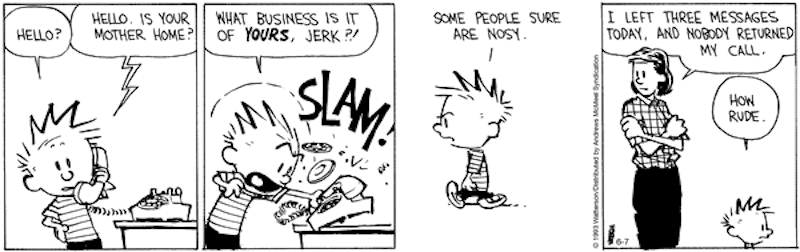
To cope with a day when I’m overwhelmed with e-mail to answer, an old Calvin and Hobbes strip salted away for just such days:


They exchange greeting hellos, and then the caller, detecting that the phone has been answered by a child, shifts to an indirect speech act designed to have the child get an adult — the caller specifically asks about their mother — to come to the phone: instead of (directly) asking Calvin to call his mother to the phone, they ask (politely) if his mother is home, assuming that Calvin will understand that they’re asking this because they assume she’s home and they want to talk to her, so they want him to turn the call over to her

The overall story here doesn’t depend on the phone being answered by a kid. It’s enough that the caller recognizes that the person answering the phone is not the one they want to talk to. In which case they could ask for them indirectly: Is Marcia home / in? (this being one big step of indirection beyond the conventionally indirect question May / Can I talk to Marcia?).

The crucial step in dealing with the yes-no question Is X home? is recognizing that because a literal understanding of it would be bizarre — why would some random caller need to know if X is home? — the caller must have some other motive in asking it. And on from there. But that’s where Calvin runs aground.

Well, that’s a lot for a little kid to work out in less than a second on the phone (and Calvin is not a patient or especially cooperative child). I actually remember being taught, explicitly, that if a phone caller, or someone at the door, asked if my mother was at home, that meant they wanted to talk to her, so I should get her. I imagine I could have worked this out eventually, but it might have taken some misfires for me to get the point.


Powdery residue falls on Canadian plains

March 12, 2024

It’s held on the tips of three fingers, it’s orange, it’s fully erect, and it leaves a messy powder. But is it art? Is it edible? Is it, omigod, about to shoot? A swirl of questions envelope the phallic cheese puff resting in the Cheetle Hand of Cheadle, Alberta, shown here accompanied by a bag of the cheese snack Cheetos, for scale:

(more…)

Manual monuments

March 12, 2024

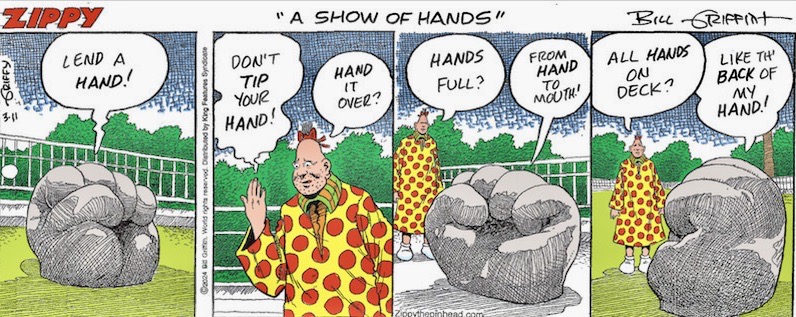
Today’s Zippy strip offers us a talkative piece of public sculpture in the shape of a hand — actually, a closed fist, upraised — that riffs together with Zippy on the manual, hand-based, lexicon of English:


The hand exclaims, Zippy questions, but their exchanges are absurd

The big topic here is the manual lexicon: lexical items that involve the noun or verb hand. The manual lexicon is enormous. embracing some fixed expressions referring to the bodypart, but mostly composed of figurative expressions etymologically traceable to the bodypart but now semantically distant from it.

The other topic is also sizable, but it’s artistic rather than linguistic: statues of hands, especially fists, especially in works of public art. I’ll start with that.

(more…)

Howdy Out

March 11, 2024

The second installment of my adventures with Howdy Boy, aka Troy Anderson (Stanford ’89/’90). In the first installment (my 3/8 posting “Howdy”), with the folksy-friendly salutation “Howdy”, he introduced himself as a student in my gigantic 1989 syntax course — and thanked me for not flunking him. Now, I have a passionate interest (both personal and scholarly) in people’s lives — their daily lives and their life histories — so when I learned that Troy was not only a Stanford football player (a huge guy who looks like the offensive tackle he was at Stanford) but also a high-ranking Go player, now a business executive, who got a BA in anthropology, and as a member of the Coquille tribe in Oregon compiled a dictionary of its lost language, Miluk, for his MA thesis in linguistics, well, I was totally intrigued. We embarked on learning about each other.

Meanwhile, there was the almost flunking out. I wrote him:

It [has] occurred to me that if there was any chance of your flunking out, it would have been because you were juggling too many balls at once, always a danger for very smart manic multi-taskers, as you obviously were at the time (and probably still are).

(I’ll return to the barely not flunking out below). And I added:

I haven’t been able to piece together your history in recent years, so if you could fill me in some, I’d like to hear about it. I might try to talk you into letting me write about you on my blog. (You can sample my blog at www.arnoldzwicky.org.)

Troy turned out to be extraordinarily open in his response — giving me an inventory of major life events, some quite personal in nature, offering to supply further details, and inviting me to post whatever I wanted. An attitude that resonates with the way he presents himself; as I wrote to him a little while later:

you’re a sunny person; your most natural facial expression is a smile of pleasure... I take that disposition to be a sign of a way of being, a moral quality — of openness, of empathy, of enthusiastic commitment. In any case, whether you know it or not, you project a kind of niceness (despite your imposing body) that has surely served you well in life

Clearly, I appreciated his brand of charm, despite his being so startlingly unlike me (except for sharing linguistics, that sunny presentation of self, and serious moral commitments).

But then, more or less in the middle of the inventory, came a swerve and a surprise.

(more…)

E-mail queries

March 11, 2024

I’m inundated by queries about my (many) published articles and (gigantically many) postings, queries that are variously self-serving, malicious, and, yes, seeking understanding. But I can’t possibly reply to everyone who has questions about things I’ve written; I pretty much confine myself to short responses to people I know well and replies to people writing theses (undergraduate honors theses, MA theses, and PhD theses), and even these must be brief, given the demands of my life.

And so a story, in which I explain some things that might be useful or illuminating to other readers. It begins with e-mail I got some time back from a purported graduate student — call them GS — in a European university — call it EU — who said they were writing a thesis on English syntax in which the notion of head within NPs and VPs plays a significant role. Our exchange as it unfolded …

(more…)

JKZ on a short snorter

March 9, 2024

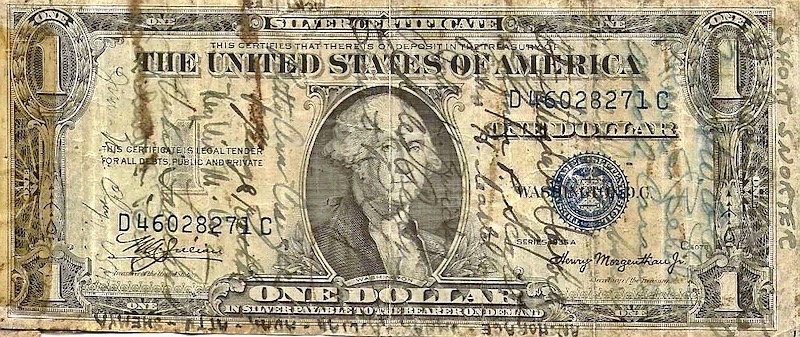
AMaZing Mail Department, from yesterday: this object:


(#1) A short snorter whose signers include John K. Zwicky (across the very right edge of George Washington’s face); JKZ, of Coalinga CA, is a familiar — as well as familial — character on this blog

#1 came in surprise e-mail yesterday from James A. Downey, who’s been researching the names on the short snorter and so was led to this blog. So, two things: JKZ and short snorters.

(more…)

Howdy

March 8, 2024

Under the header “Howdy” (a folksy salutation I rarely encounter), this e-mail from 3/4 (somewhat edited):

I was in your syntax class at Stanford in the late 80s …

Recently had a colleague [who] said he was basing [a] clitics and circumclitics paper on your theories! So, thought I’d say hello and thank you for not flunking me.

Now, I get an unbelievable amount of ill-intentioned mail from trollers, spammers, and seekers of commercial deals; now that these annoying entities have access to impressive AI programs, their junk e-mail regularly makes reference to details of my published work and is generally pretty sophisticated in its attempt to gain my confidence. That “Howdy” really was a red flag; also, although Howdy Boy wouldn’t have been the first former student to thank me for not flunking him, it’s a rare event, and might just have been a clever stroke to catch my attention.

On the other hand, his colleague’s paper was said to be about the language Miluk (a language I don’t recall having heard of before; it’s an extinct Coosan language of Oregon), and his e-name was miluk — two things lending some verisimilitude to him. And then his signature was

Troy Anderson, ‘89/‘90

which would put him at Stanford when I taught my really big Intermediate Syntax course, Linguistics 121, in winter quarter 1989 (more on this course in an appendix to this posting; but it’s relevant here that enrollment in the course was unexpectedly gigantic, requiring the last-minute hiring of a raft of additional grading assistants, who I then had to co-ordinate and manage, and making my memory of individual students quite hazy). But then “Troy Anderson” is the sort of everyday name that trollers and spammers make up.

Alas, my net experience includes astonishingly inventive malicious trollers, whose only purpose is to demonstrate their cleverness by deceiving otherwise intelligent people and wasting their time; and, a few months back, being disastrously defrauded by people who did a remarkable job of creating detailed counterfeits of a series of commercial websites. So I’m really really cautious. (Yes, this is a truly grotesque way to have to live.)

(more…)

A dirge murmured around the grave

March 7, 2024

Awoke this morning for a 12:50 whizz, with the line “‘Tis a dirge that is murmured around the lowly grave” (from “Hard Times, Come Around No More”) in my ear, causing me to think that if there were a memorial service or wake for me after my death, this is one of the pieces of music I would want played at it; death is a constant presence for me, so I muse on things like this.

But then I realized that there would be no memorial service for an old person whose surviving friends are spread all over the world; if they aren’t able to spend some moments with me while I’m alive, why would they gather to mourn my death? The song line for this is “Give me the roses while I live”, from Odem (Second), Sacred Harp 340 (more on this below). Come by and I will entertain you with random thoughts and stories from my life — and play for you my music of joy, or all the versions of “Hard Times” I have (listed below), or my favorite Mozart Operas (Figaro and Zauberflöte, but it’s a hard choice), or Sacred Harp songs, or the rock music I used to dance to (heavy on the Rolling Stones), or Haydn’s Missa in Tempore Belli, or Linda Ronstadt, or Louis Moreau Gottschalk, or Candide (the original one), or Company, or Heitor Villa-Lobos, or I can go on annoyingly for a really long time in this vein.

(more…)

Bloody Sunday

March 7, 2024

🩸🩸🩸 … on this day in 1965: NEVER FORGET

From my 4/15/22 posting “LET US NOW PRAISE FAMOUS BLACK WOMEN”, about the confirmation of Ketanji Brown Jackson as an Associate Justice of the US Supreme Court, but also about James Agee’s book Let Us Now Praise Famous Men (celebrating the Appalachian poor) and about the late US Representative John Lewis, who on 3/7/65 led the first of three Civil Rights marches across the Edmund Pettus Bridge in Selma AL — an event now known as Bloody Sunday, because of the savage attack on the marchers by state troopers and police:

(more…)