Author Archive

magnolias

January 19, 2015

A notice on “magnificent magnolias” from the San Francisco Botanical Garden in 2013, but equally relevant this week:

In a cool and misty corner of San Francisco, the New Year begins with one of the city’s most breathtaking annual natural marvels. San Francisco Botanical Garden is home to the most significant magnolia collection for conservation purposes outside China, where the majority of species grow. Long considered the signature flower of the Garden, nearly 100 magnolias, many rare and historic, erupt in a fragrant riot of pink and white from mid-January through March. Paleobotanists consider the magnolia family to be among the earliest flowering plants, with magnolia fossils dating back nearly 100 million years. Ice age survivors, they bloom for us now.

People in the East and South of the U.S. think of magnolias as intense summer flowers, but here they’re one of the signature winter flowers.
(more…)

Uneasy anaphora

January 19, 2015

From today’s New York Times, in a death notice, “Yoko Nagae Ceschina, Countess and Fairy Godmother to the Arts, Dies at 82” by Margalit Fox:

I used to play 120 concerts a year,” [the violinist Maxim Vengerov said. “She would follow me — not to all of the concerts, but to the most important ones, which were probably about 80 or so. I would go to Chicago; she would be there. I would go to Japan; she would turn up there. Then she finally announced that she would like to be my grandmother.”

And so, in effect, she became, on one occasion flying to Switzerland to bring Mr. Vengerov, ill with pneumonia in a hotel room there, an immense fur coat.

The crucial bit is boldfaced.

I read this at first as an anaphoric ellipsis of the complement of became (with so as a sentence-introducing adverb: ‘as a result, consequently’). Then it occurred to me that the so might have been intended as the complement of became: ‘that she became, she became that (i.e., his grandmother)’. The first structure is just impossible for me, and the second is very awkward.

(more…)

Anonymously on the internet

January 19, 2015

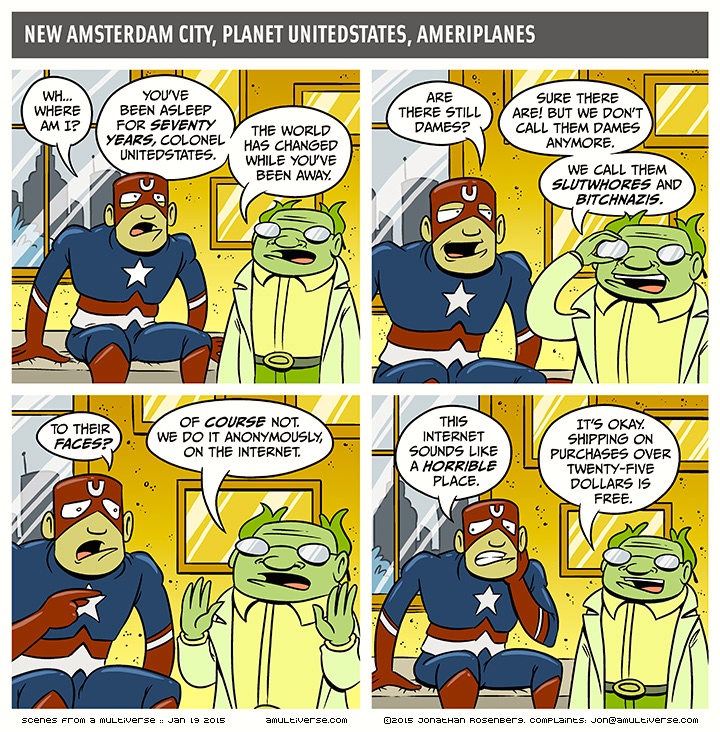
Today’s Scenes From a Multiverse (on-line here) has the superhero Colonel UnitedStates woken from 70 years of sleep:

Of course, not to their faces! Insults go behind people’s backs!

Gendered playthings

January 19, 2015

Today’s One Big Happy:

(The strip appeared in my feed today, but it’s dated December 25th, in keeping with its content.)

In any case, both Ruthie and her older brother Joe seem to be fully satisfied with their (stereotypically gendered) Christmas presents.

“Has no name in Creole”

January 19, 2015

From Sim Aberson, a Miami Herald story from the 12th, “Martelly asks Haitians to ‘Give the country a chance'” by Jacqueline Charles:

Port-au-Prince. President Michel Martelly used his nation’s most solemn anniversary to issue an appeal for calm and unity, asking Haitians to remember the victims of the country’s devastating earthquake five years ago Monday by putting Haiti first.

… Martelly reminded Haitians that it wasn’t just the earthquake, which has no name in Creole and has become known as goudougoudou, that killed the victims, but the lack of development in the country that led to the poorly constructed homes, businesses and government buildings that came crashing down during the 35 seconds.

What could Martelly have meant by saying that that the earthquake has no name in Creole (but has become known as goudougoudou)? Is this the “no word for X in L” meme (no word for earthquake in Haitian Creole)? Or a claim that there is no proper name for this particular earthquake? Either way, it looks to me like Martelly has it wrong.

(more…)

The racy ATM

January 19, 2015

From the BBC site in October (the 28th), this cash machine story:

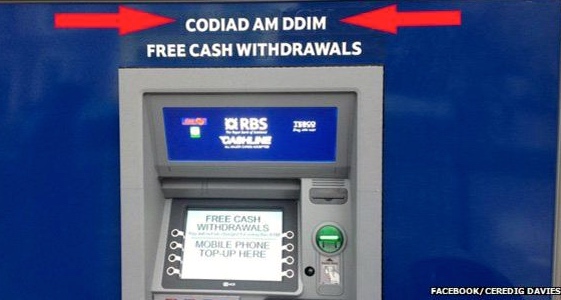
A cash machine outside Tesco Express in Aberystwyth has been promising customers “free erections” after a translation error.

Above the ATM at the new store in west Wales it said “codiad am ddim” which would translate colloquially as “free erections.”

A more correct version would have been “codi arian heb dâl”.

The Welsh noun codiad translates as ‘rise, increase’ in a number of senses, including the rising of the sun, and is not in itself racy (the plural is codiadau, by the way); am ddim is ‘for nothing, for free’. But apparently in colloquial usage codiad can also be used for a penile erection.

The BBC story’s version, codi arian heb dâl, translates roughly as ‘raising money/cash without charge’; codi arian am ddim would have done, or even just arian am ddim ‘cash for free’.

(The story was picked up by a great many sites. The BBC version came to me through Sim Aberson.)

Dangler time

January 18, 2015

It’s been a while since I posted about “dangling modifiers”, so here’s a nice example from the Economist last month (December 13th), in a story “Charting the plastic waters”. On p. 81:

The Five Gyres Institute, for example, is campaigning to phase out the use of plastic microbeads in facial scrubs and other consumer products in favour of natural alternatives made from such materials as apricot husks. Sewage treatment plants do not capture all the beads which wash down the drain, so some inevitably end up in the sea. And being so small, no one really knows where they are going.

The crucial bit is boldfaced.

(more…)

The creatures of Fibonacci

January 18, 2015

(About art and mathematics rather than language.)

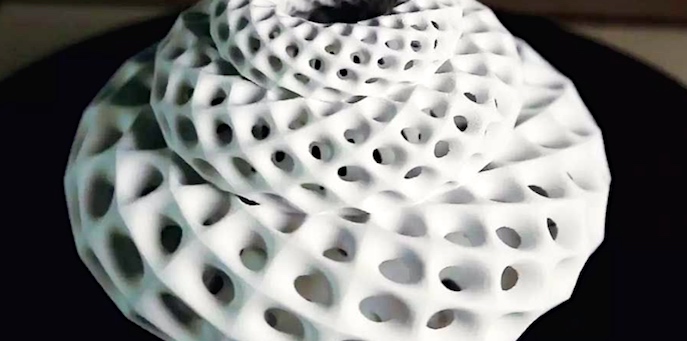
In the January 16th San Francisco Globe, the article “3D Printed Sculptures Look Alive When Spun Under A Strobe Light”:

This series of 3D printed sculptures was designed in such a way that the appendages match Fibonacci’s Sequence, a mathematical sequence that manifests naturally in objects like sunflowers and pinecones. When the sculptures are spun at just the right frequency under a strobe light, a rather magical effect occurs: the sculptures seem to be animated or alive! The rotation speed is set to match with the strobe flashes such that every time the sculpture rotates 137.5º, there is one corresponding flash from the strobe light.
These masterful illusions are the result of a marriage between art and mathematics… the [Fibonacci] sequence starts with two 1’s, and each following digit is determined by adding together the previous two. Therefore, Fibonacci’s Sequence begins: {1, 1, 2, 3, 5, 8, 13, 21, 34, 55, 89…} etc.
… The creator of these sculptures, John Edmark, is an inventor, designer and artist who teaches design at Stanford University

(more…)

Whore-igami

January 18, 2015

Briefly noted: in the short story “I Can See Right Through You” by Kelly Link in McSweeeney’s No. 48 (2014), on p. 81:

Meggie says, “She’s a nice kid. Makes Whore-igami in her spare time and sells it on eBay.”

“She makes what?” the demon lover says.

“Whore-igami. Origami porn tableaux. Custom-order stuff.”

“Of course,” the demon lover says. “Big money in that.”

(Other occurrences as a joke about paper-folding prostitutes, on various sites. As far as I can tell, there are as yet no commercial products.)

A pun on origami, or a portmanteau of whore and origami, or of course both.

diabetic X

January 18, 2015

Dee Michel wrote me a little while ago with the Adj + N phrase diabetic socks, which he found entertaining: how could socks be diabetic? The short answer is that though diabetic is an adjective in this phrase, it functions semantically like a noun, in particular like the noun diabetic ‘someone suffering from diabetes’; diabetic socks are ‘socks for diabetics’. From Wikipedia:

A diabetic sock is a non-binding and non-elasticated sock which is designed so as to not constrict the foot or leg. Typically sufferers of diabetes are the most common users of this type of sock. Diabetes raises the blood sugar level, which can increase the risk of foot ulcers. Diabetic socks are made to be unrestrictive of circulation.

(I am in fact wearing diabetic socks as I write this posting.)

So diabetic here is a type of non-predicating adjective, a type known in the trade as a pseudo-adjective: an Adj in form, but interpreted by reference to a N.

In the case of diabetic, we have not one, but two, pseudo-adjectives — one evoking the noun diabetic (as above), one evoking the noun diabetes (as in diabetic coma ‘coma caused by diabetes’).

(more…)