(The latest ad from the Daily Jocks people, with a caption from me. Not about language.)
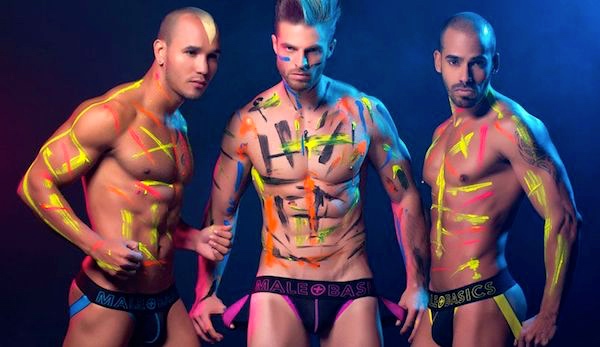
Their new jockstraps
Unleashed their
Raw bestial spirits.
(The latest ad from the Daily Jocks people, with a caption from me. Not about language.)
Their new jockstraps
Unleashed their
Raw bestial spirits.
In today’s One Big Happy, Ruthie again copes with vocabulary she’s unfamiliar with but nevertheless struggles to accommodate — in this case, allayed ‘diminished or put to rest’ (said of fear, suspicion, or worry):

Well, it sounds like it had laid in it.
Just added to the Pages of Linguistics Notes on this blog: one with an inventory of postings (on Language Log and this blog) about taboo vocabulary: the choice of words labeled as taboo, the open use of these words, schemes for avoiding them, etc. Can be accessed directly by clicking here, or by clicking on “Taboo vocabulary” in the list of Pages on the right side of the main page.
This new Page joins other inventories of postings on linguistic matters: on abbreviation, anaphoric islands, attachment (in parsing), danglers, Faith vs. WF, illusions, libfixes, and mishearings. More to come.
Meanwhile, I’m struggling to find a way to format some collections of my data as Linguistics Notes, so that other researchers can have access to this material (and it can be publicly updated). In particular, my file of VPE (Verb Phrase Ellipsis) examples, with an index to them; and my file of 2pbfV (two-part back-formed verb) examples, again with an index to them. Stay tuned.
A recent Cyanide & Happiness:
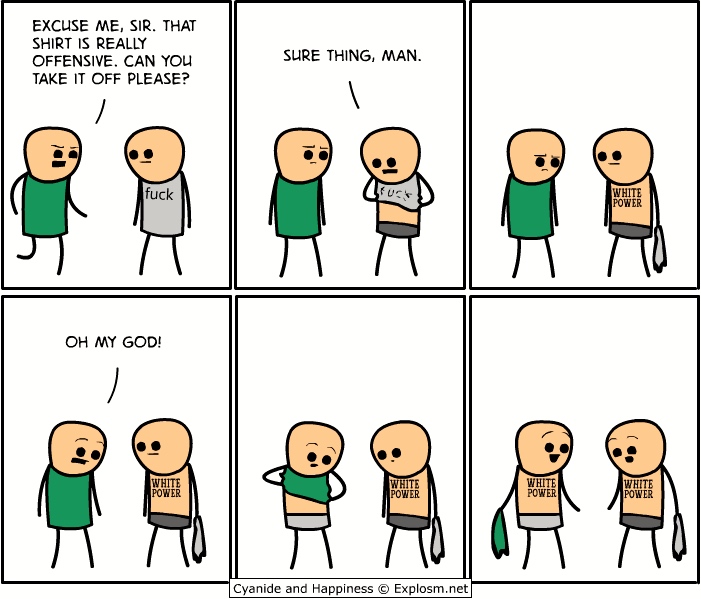
The fuck is offensive, but then they get down to the white supremacist tats and it’s all cool, bro.
A breakfast picnic this morning at the Elizabeth F. Gamble Garden in Palo Alto. First sandwiches, tea, and fresh fruit, then some touring of the garden.
A bench in the herb garden at GG:
 (#1)
(#1)
Today’s Bizarro:

Hun / hon.
The informal clipped form hon (for honey) as a term of address is stereotypically used, along with other pet names like the full honey, sweetie, dear(ie), and doll, by waitresses to their customers, in addition to the use of these as terms of endearment to genuine intimates. Many customers find the usage disrespectful and insulting, expressing intimacy in a situation where they see that deference to authority is called for.
(If you’re puzzled by the odd symbols in the cartoon — Don Piraro says there are 4 in this strip — see this Page.)
The label on a plant that a friend gave me yesterday. Note the head-first word order, standard in botanical naming, in this case with the (supposed) genus name Coleus before the variety name ‘Jade’; the species name, not given on the label, is scutellariodes (that is, the plant is named Coleus scutelliodes ‘Jade’), or possibly the plant is a hybrid of several species, in which case it makes sense to leave out a species name.
Coleus plants are old friends of mine — wonderfully colorful ornamentals (for garden or house) illustrated in photos in this posting on the compound annual labiate, of which the coleus is one.
Notice that I just lowercased coleus, treating it as a common name rather than a term of botanical taxonomy. In my earlier posting, I reported, in fact, that my Sunset New Western Garden Book gives Solenostemon as the genus name for coleuses. Most seed and plant companies agree with that usage. But the relevant Wikipedia entry gives the genus name Plectranthus instead. We are in deep terminological waters here.
 (#1)
(#1)
Start in 1985 and go back 30 years (as Marty McFly does in Back to the Future) and you’re in 1955; go forward 30 years (as Marty McFly does in Back to the Future Part II) and you’re in 2015, this year. So this year we celebrate BTTF2. Expect to be transported back to 1955, and then in Part III to 1885. Great years in film.
Back in 1975, Alan Dundes and Carl R. Pagter published the first in a series of Urban Folklore From the Paperwork Empire books, in which they catalogued an assortment of material — drawings (most with captions or other text on them) and slogan signs — created by office workers, photographically reproduced, and distributed through office mail. In addition, “dirty” drawings and pictures were passed from hand to hand, just as “dirty” jokes spread by word of mouth. All of this material cycled informally, and (like classic folklore) no one had any real idea where it came from, beyond the person who gave it to you, nor did people care about that.
 (#1)
(#1)
This dissemination of subterranean cultural material continues, but now mostly by digital means. And at a vastly increased rate. And a fair amount of it is the same stuff that used to be passed around the office.
In any case, few people care about the source of the stuff that comes their way — an attitude that distresses me with respect to cartoons and obvious artistic creations and makes me uneasy in lots of other cases. Meanwhile, some of my friends treat my attitudes as charming academic eccentricities that don’t, and shouldn’t, concern ordinary people.
In today’s Zits, Sara and Jeremy undo what they had done before:
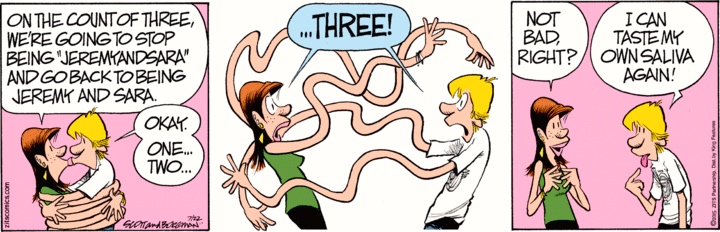
(On their couple word, see this posting.)
Disentanglement!