The One Big Happy from 8/7:
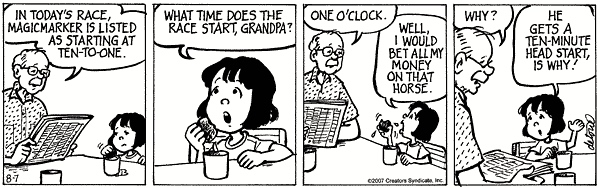
Ah, the ambiguity in ten to one, turning on two dfferent uses of to. Ruthie’s grandfather intends one sense, Ruthie gets another (closer to her everyday experience).
The One Big Happy from 8/7:
Ah, the ambiguity in ten to one, turning on two dfferent uses of to. Ruthie’s grandfather intends one sense, Ruthie gets another (closer to her everyday experience).
Today’s Wayno/Piraro Bizarro collabo:

(#1) (If you’re puzzled by the odd symbols in the cartoon — Dan Piraro says there are 5 in this strip — see this Page. The HBD — happy birthday — note is presumably for one of Piraro’s two K-named daughters.)
A twist on the caveman cartoon meme, with a Neanderthal pursuing a higher education. And attempting to get college credit for his life experiences.
Every so often I have a spectacularly vivid dream in which the solution to some linguistic puzzle that’s been deviling me explodes in my mind. All I have to do is save it, in my mental cloud storage, until I can enter it into my computer. The idea is not only good and true, it is also very beautiful. Unfortunately, when I shake myself fully awake, I see that it is in fact crackpot crap.
So it was yesteday morning, after a sleep primed by a moving performance of Stephen Foster’s “Hard Times, Come Around No More” on my iTunes. The conviction that yes, that was it, that song was the answer to everything, persisted through three hazy toilet breaks, until I actually woke up and faced the hard truth that I didn’t even know what the question was. But, having had Anonymous 4 and Bruce Molsky take me to 1865 and into the world of the song, I was deeply sorrowful: hard times would surely come around again, and my linguistics was helpless against that bleak future.
I ended up spending the morning with Foster’s “Hard Times”, specifically mourning the tragedy of American chattel slavery, disasters of the 1850s, the Civil War, the Great Depression, and the poverty of Appalachia and the Ozarks, but then dissolving into free-floating anxiety over everything from the Babylonian captivity to the madness of our king (and there’s an awful lot to weep over in between).
All this driven by the music.
Recently in Facebook postings from Steven Levine, issues of a Popular Mechanics annual supplement Home Kinks from the 1940s and 1950s, supplying illustrated advice on home maintenance. Two things: some of the covers are entertainingly sexually suggestive, just as pictures. But then there’s the title of the series, with a sense of kink that seems now to have been swamped by the sense ‘mental twist, esp.in sexual matters’; it’s now easy to see these illustrations as images of fetish practices.
In recent tweets from Hong Kong about protests and the governments attempts to put them down, New York Times columnist Nick Kristof repeatedly writes water canon instead of water cannon (both with /kǽnǝn/) — not an uncommon sort of spelling error, but somewhat surprising from an experienced journalist, and one that introduces an unintended misinterpretation, since it happens that CANON is the spelling of an English word (a number of different English words, in fact) distinct from CANNON. And that opens things up for little jokes about what a water canon might be. On Facebook I was responsible for one such joke, a bit of musical foolishness:
The reference is of course to the round “By the Waters of Babylon”. Though I doubt it’s effective against throngs of protesters.
Roz Chast in the September 2nd New Yorker:
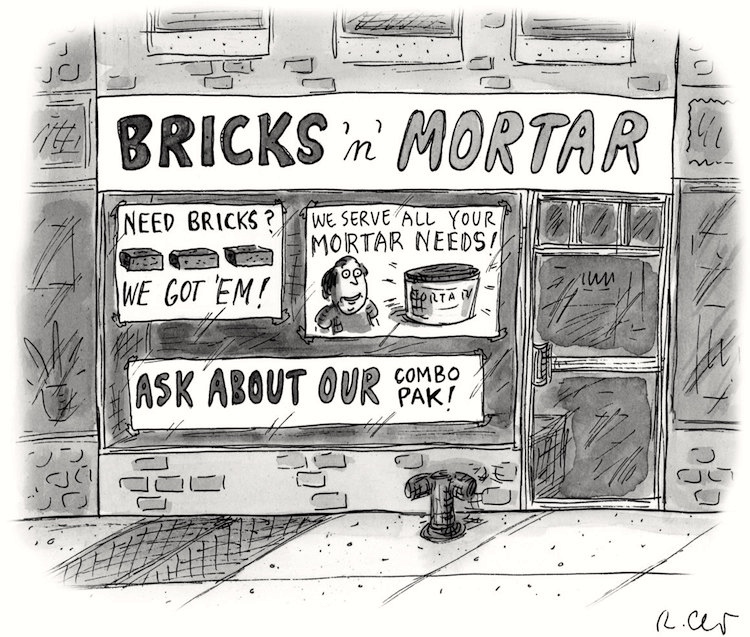 (#1)
(#1)
An exercise in the semantics of N + N compounds, exploiting an ambiguity that might not have occurred to you:
in the semantics of the modifying N, N1 (here, the coordinate N bricks and mortar);
in the semantics of the head N, N2 (here, the understood N store);
and in the semantics of the relation between N2 and N1 (here, ‘N2 for N1, (specifically) N2 selling N1’, in this case ‘store selling bricks and mortar — rather than the ‘N2 (made) of/from N1’ relation in the familiar conventionalized compound brick(s) and mortar store ‘store (made) of/from bricks and mortar’.
… an arresting line from the Sacred Harp (1991 Denson revision), #404, Youth Will Soon Be Gone, suggesting perhaps:
OUR CARNAL WEAPONS
(#1)
adj. carnal: relating to physical, especially sexual, needs and activities: carnal desire. (NOAD)
But in SH404 it comes from St. Paul, in 2 Corinthians 10:3-4 (KJV):
For though we walk in the flesh, we do not war after the flesh … For the weapons of our warfare are not carnal
And it all depends on what the compilers of the King James Version meant by carnal, which is evidently not what comes first to modern minds.
As the summer comes to an end, days shorten, and plants prepare for fall and winter, there also comes the beginning of a new school year. Local primary and secondary schools where I live are on various schedules, but most of them are now into the new year. Many colleges are already in gear; Stanford classes begin on Monday, September 23rd.
Then we find Andrew Carnie (at the Univ. of Arizona) reporting on Facebook today that
The beginning of the semester is always a time for stress dreams for me, and the most common stress dream I have is the packing dream. Usually there’s some combination of having too much stuff, not enough containers, and not enough time before the movers or the taxi or whatever arrives.
Aieee! I am unprepared!
Andrew is far from alone. I haven’t taught a class for years now, but the approach of fall still brings stress dreams with it every year. I had a particularly distressing one last night.
As we slide into a US holiday weekend — leading to Labor Day, the first Monday in September, this year on the 2nd — my birthday (on the 6th) looms as well. Coming up is a prime-th birthday, the 79th, an auspicious number to my mind, just one short of the 80th, which many view (like the similarly vigesimal 20th, 40th, and 60th) as a landmark birthday, in this case the gateway into old age. But for the moment I’m prime, baby.
The One Big Happy from 7/28, all about fixin’s (also known as fixings):
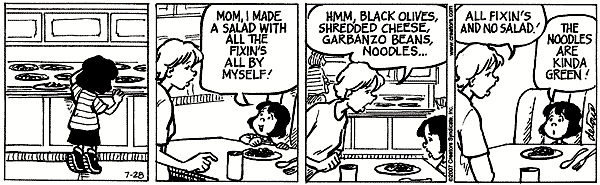 (#1)
(#1)
The cartoon turns on a culinary distinction between main, or principal — essential — ingredients and accompanying, or accessory – in principle, optional — ones, the fixin’s. Without the leafy greens it’s not a green salad (though it could be a chopped salad), but if it’s got the leafy greens and no fixin’s (with nothing else except dressing), it’s a green salad.
From AHD5:
noun fixings: Informal Accessories, trimmings: a holiday dinner with all the fixings.
The example here has the full conventional collocation, or stock expression, with all the fixings, usually pronounced as informal (esp. Southern) fixin’s (spelled with or without an apostrophe). Simplifying considerably: nominals in –ing (as in beatings and singings) do have variants in /n/ rather than /ŋ/, but these pronunciations are mostly characterstic of South Midlands and Southern speech, especially in informal speech.