In the June/July Details magazine, a feature (pp. 106-11) on breakfasts: some inventive breakfast dishes from around the U.S., a little glossary of international foods to know, several pages on reinventions of familiar breakfast fare, and a few unusual brunch dishes. Here some comments on the first two features.
Archive for 2013
Breakfasts
June 7, 2013tapping
June 7, 2013(Not about some sexual practice you’ve never heard of before, and not about the sexual slang tap ‘fuck’, but about a kind of self-administered therapy involving tapping the body with the fingertips.)
In the June/July Details magazine, a feature (pp. 84-5) “Press for Success”, with the subhead:
Despite scientific skepticism, droves of young men are taking up tapping (known as EFT) to overcome anxiety and perform at the office. Is the secret to advancement really right at their fingertips — or is it all in their head?
EFT stands for Emotional Freedom Techniques. (I would have said these guys “are taking up EFT (known as tapping)”, rather than the reverse.) Tapping uses the traditional acupressure points to “tap away” pain, stress, destructive emotions, or self-defeating beliefs.
investigational
June 7, 2013Heard in television ads for cancer treatment centers, the phrase investigational drugs. From an FDA site on “Access to Investigational Drugs”:
Investigational or experimental drugs are new drugs that have not yet been approved by the FDA or approved drugs that have not yet been approved for a new use, and are in the process of being tested for safety and effectiveness.
This passage treats investigational and experimental as synonyms in the drug context — but then the site goes on to use investigational exclusively. This specialized use of investigational (as opposed to the transparent general use ‘of or relating to investigations’) seems to be fairly recent — recent enough that it’s not in the dictionaries I’ve consulted. It seems to have replaced experimental as the appropriate technical term for drugs undergoing testing, perhaps because some people in the relevant community had come to feel that experimental no longer sounded sufficiently technical, but had become part of ordinary language.
Speed dating talk
June 6, 2013In the Stanford Report of 5/6/13, a story by Brooke Daniel about research on speed dating, “New Stanford research on speed dating examines what makes couples ‘click’ in four minutes”:
Stanford researchers analyze the encounters of men and women during four-minute speed dates to find out what makes couples feel connected.
That’s the question at the heart of new research by Stanford scholars Dan McFarland and Dan Jurafsky that looks at how meaningful bonds are formed.
McFarland, a sociologist at Stanford’s Graduate School of Education, and Jurafsky, a computational linguist, analyzed the conversations of heterosexual couples during speed dating encounters to find out why some people felt a sense of connection after the meeting and others didn’t.
Their paper, “Making the Connection: Social Bonding in Courtship Situations,” was published this month in the American Journal of Sociology.
… There is a great deal of uncertainty, the paper notes, about the meaning of signals we send to other people, and how that plays into forging interpersonal connections.
[McFarland] “We wanted to see if there is anything about the interaction that matters or is it really just what I look like, what I do, what my motivation is. Is it all things that are psychological or in my head or is there actually something in how we hit it off?”
Their analysis of nearly 1,000 dates found that words, indeed, do matter. How the words are delivered, when and for how long make a difference to how people feel toward each other, and in this case, whether the men and women sensed that they “clicked” during their encounter.
… “We were looking at conversational behaviors or speech features and how they express characteristics of the social experience, how you feel about the other person,” Jurafsky said.
Women reported a sense of connection to men who used appreciative language (“That’s awesome” or “Good for you”) and sympathy (“That must be tough on you”).
Women also reported clicking with male partners who interrupted them – not as a way to redirect the conversation but to demonstrate understanding and engagement, for example, by finishing a sentence or adding to it.
Both genders reported clicking when their conversations were mainly about the women.
“You could say men are self-centered and women are always trying to please men and dates will go well if they talk about the guy, but it turns out that’s just not true. It’s just the opposite,” McFarland said. “This is a situation in life where women have the power, women get to decide. So talking about the empowered party is a sensible strategy toward feeling connected.”
… Successful dates, the paper notes, were associated with women being the focal point and engaged in the conversation, and men demonstrating alignment with and understanding of the women.
… Further studies could look at same-sex relationships, for example, or could explore the transitions to other states, like marriage.
One commenter on the Stanford mailing list for queer staff and faculty reacted as follows:
Did anyone else think it was odd that the research was exclusively hetero? Cf. this sentence near the end of the article: “Further studies could look at same-sex relationships.”
Do the researchers think our relationships are so different that they need to be studied separately? (BTW, if so, I strongly disagree …
(citing experience in both heterosexual and same-sex relationships).
But of course McFarland and Jurafsky’s research was not about relationships in general, but about them only in a very specific and limited context: dating, in fact speed dating (involving grad students at Stanford). In this context, the chances are very high that gender differences will play a role in how the interactions play out — as indeed this research found — so that cautious researchers will control for the cross-sex/same-sex variable.
As other commenters noted, it would be great to have comparison data for same-sex dating (divided by sex, since the course of dating might well be different for female couples and male couples), though I foresee complexities in the analysis. McFarland and Jurafsky’s research found that successful dates had a focal participant, the woman in the couple; successful same-sex dates might turn out not to have a focal participant, and if there is one, what would predict which participant is focal?
Class accents
June 6, 2013From “Pedigree” by Walter Kirn, a personal history in the June 10 & 17/13 New Yorker (the Crimes and Misdemeanors issue), about a con man and convicted murderer he knew as Clark Rockefeller:
He spoke with an accent, clipped and international, and occasionally tossed in a word (“erstwhile,” “improprietous”) that tied a bow on the sentence that included it. I’d met a few people like him during college [Princeton] — pedigreed, boastful, overschooled eccentrics who spoke like cousins of Katharine Hepburn and always seemed to have prematurely thinning hair and delicate, intestinal-pink skin. But I was brought up in rural Minnesota, deep in manure-scented dairy country, and never succeeded in getting close to them. Their clubs wouldn’t have me; I didn’t play their sports. (p. 91)
Turns out that Clark Rockefeller was born Christian Karl Gerhartsreiter in rural Bavaria and had
fashioned a manner based on a pop-culture travesty of wealth: Thurston Howell III, of “Gilligan’s Island.” (p. 92)
In the U.S. he ran through a number of identities, often connecting himself to famous people — among them, Christopher Chichester (Sir Francis Chichester), Christopher Crowe (Cameron Crowe), and of course Clark Rockefeller.
Speaking like a cousin of Katharine Hepburn is a nice touch.
Explorations in derivational morphology
June 6, 2013Two finds in the 6/5 article “Mad Professors: The adjuncts are at the barricades” by Rebecca Burns in In These Times (about unions for adjunct faculty), with the crucial words boldfaced:
(1) That so many advanced degree-holders are toiling in poverty conditions flies in the face of the assumption that higher education is a path to prosperity. But low wages and precarity represent the new norm for what some adjuncts have termed “academia’s version of apartheid.”
(2) Reeling from state budget cuts, universities have turned increasingly to the cheap teaching labor provided by non-tenure track faculty. But the adjunctification of higher education also coincides with its bureaucratization.
In (1), we have the Latinate derivative precarity rather than the native English precariousness; in (2), a noun adjunctification, incorporating the verb-forming suffix –ify (on the base adjunct). Both are innovations, not in the OED or other dictionaries I’ve consulted.
Have an X, have a Y
June 5, 2013From Ann Burlingham on Facebook a little while back, with reference to a passage in “Marry the Man Today”, from Guys and Dolls (1950):
Sure, now I’ve got this earworm. Seems to me Arnold wrote an essay on this progression, and maybe the similar one from “Gypsy”, but perhaps it was in conversation. [In conversation, I think.]
The passage:
Marry the man today and train him subsequently
Carefully expose him to domestic life
And if he ever tries to stray from you
Have a pot roast
Have a headache
Have a baby
Have two!
A zeugmoid chain, with three different senses of have in successive VPs. The progression in Gypsy is considerably longer.
Meta-Pearls
June 5, 2013Zippy the Pinhead has long played with metastrips, in which the cartoonist figures as a character or the characters talk about cartooning or both. Other strips sometimes indulge in this play: I posted about a recent Doonesbury in this vein, and Pearls Before Swine fairly often goes into this territory, with cartoonist Stefan Pastis appearing in the cartoon (as here). The current story line in Pearls goes deep into metacartooning. Yesterday’s strip:
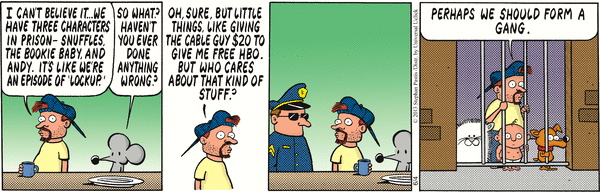 (#1)
(#1)
and today’s:
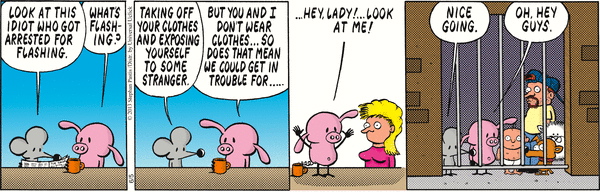 (#2)
(#2)
Extreme Twinkies
June 5, 2013Today’s Zippy combines two recurrent themes in the strip, Hostess snack foods and taco sauce:
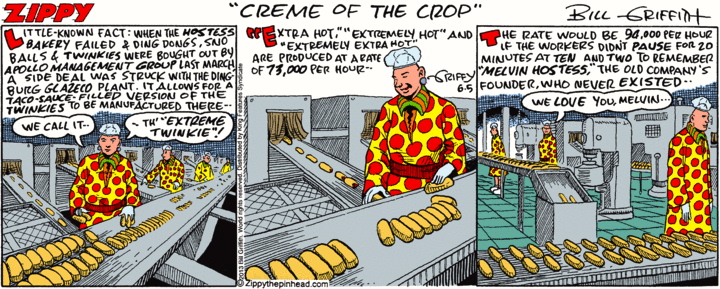
I’ve commented before on Bill Grffith’s “preoccupation with Hostess snack foods”, and devoted a posting to taco sauce in Zippy, starting with “a strip of 6/11/12 that led to a posting on La Victoria products”. Here the two are united, and the figure of Melvin Hostess is added to the mix.