Archive for May, 2012

A topical -mageddon

May 11, 2012

Stephen Colbert on recent gay headline news (Barack Obama endorsing same-sex marriage, North Carolina amending its constitution to ban it), as reported on Talking Points Memo:

Stephen Colbert couldn’t believe it: a sitting president pushed the “rainbow button” and launched “gay-mageddon.”

(more…)

Alison Bechdel

May 10, 2012

On the occasion of Alison Bechdel‘s latest graphic novel, Are You My Mother? (a memoir of her life with her mother), it’s time to celebrate the artist. The book has been reviewed twice in the New York Times (and, of course, many other places), and Judith Thurman did a wonderful profile of Bechdel in the April 23rd New Yorker.

(more…)

Rainbow commas

May 10, 2012

In recognition of President Obama’s endorsement of same-sex marriage, this image from the United Church of Christ:

Two things: the slogan “God is still speaking”; and the rainbow comma. (You might have thought it was a single close-quotation mark, but it’s supposed to be a comma.)

(more…)

The Swiss national anthem

May 10, 2012

Today’s second-hottest political story — the hottest is President Obama’s affirmation of same-sex marriage, which I’ll get to in another posting — is Michele Bachmann’s Swiss citizenship. So this would be a good occasion to talk about the Swiss national anthem.

(more…)

The frugal typographer

May 10, 2012

Annals of silliness: from the Medford [Oregon] Daily News, June 23, 1929, a story about one man’s quest to save space by replacing the word the by a single symbol:

Note the wry conclusion to the jocular piece:

Its general use should prove a great boon to newspapers, facilitating composition and reserving space now given over to “the’s” for more comic strips and letters to the editor.

Maybe Mason was just an eccentric whose ideas never caught on. Or maybe Mason was the invention of a mischievous journalist; notice that we hear nothing about Mason except for his campaign to replace the.

(Hat tip to Ben Truwe, who operated the Medford typography firm ProType for 22 years. The image of the newspaper page is the one he sent me; I understand that it’s not easy to read, even when you click on it to embiggen it.)

(I’m not experienced in dealing with newspaper archives and haven’t been able to find this story, datelined New York, in any other publication.)

times, the verb

May 9, 2012

Heard on the radio: “and times that by [some number]”, where that refers to a number. This is the plural N times (in expressions like 6 times 10) converted to a verb meaning ‘multiply’. About 50 years old, this conversion supplies a short, English-based substitute for the longer, Latin-derived verb. In so doing, it swallows up the historical plural suffix within times, making it now just the final consonant in the verb times.

(more…)

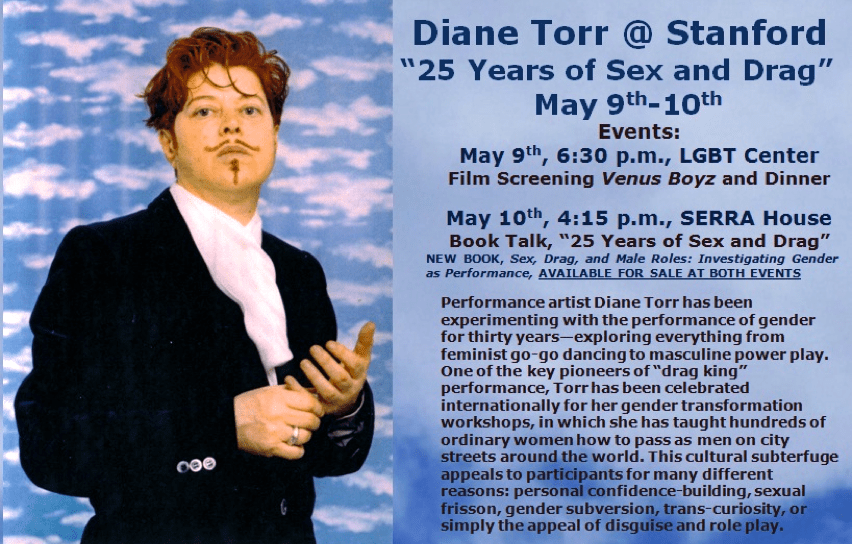
Drag king days

May 9, 2012

… at Stanford. Now playing:

(more…)

Branding Shakespeare

May 9, 2012

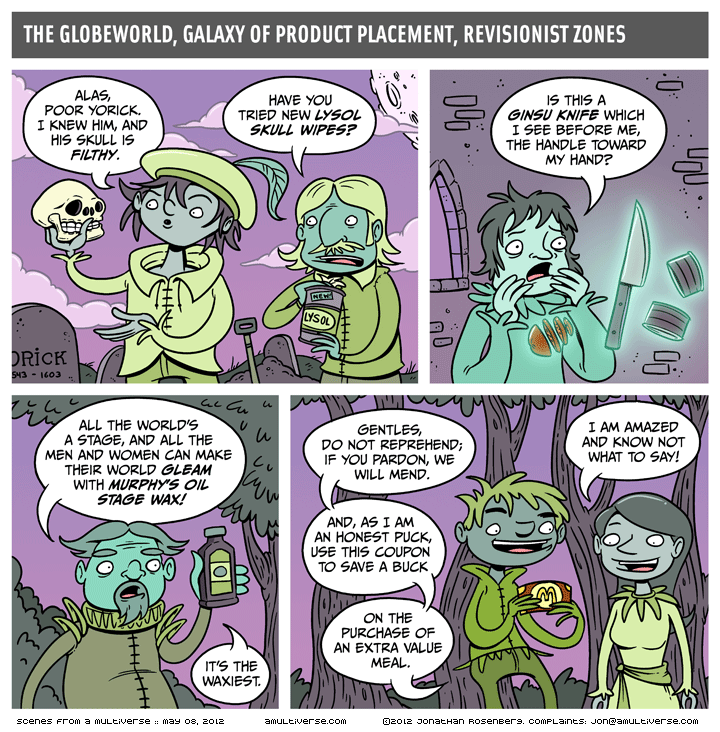
Yesterday’s Scenes From a Multiverse, “A Message From Our Sponsors“, with Shakespearean brands:

Jon Rosenberg’s comment:

If product placement had been as popular in yesterday’s fiction as it is in today’s, what would it look like? Maybe a little like this. Maybe there would be more ads for hog jowls and wagon wheels. I’m not an expert, you know.

The allusions are to real products: Lysol disinfecting wipes, Ginsu knives (as seen on tv), Murphy’s oil soap, and McDonald’s meals (indicated by the Golden Arches symbol). Plus the mangled quotes from the Bard.

(The lines from Midsummer Night’s Dream — “Gentles, do not reprehend: / If you pardon we will mend” — are especially nice: comprehensible, but packed with syntactic features no longer found in current English.)

Bimbos and himbos

May 9, 2012

I recently ran across the portmanteau himbo (him + bimbo), a male counterpart to bimbo. Turns out that bimbo has a complex history and a variety of senses in current English, with this variety of senses reflected in the way himbo is used.

(more…)

More reporting the profane

May 9, 2012

Faced with the task of writing about the new tv series Veep, in which the title character (the vice-president of the United States) and a number of others break into florid swearing, the New York Times has opted for allusive characterization of this talk, without attempting to convey (however indirectly) the actual expressions used; contrast this with the paper’s recent treatment of Samuel L. Jackson (here).

(more…)