Archive for 2011

Tom Seligman

November 2, 2011

No, not (thank goodness) a death notice, but an announcement of Thomas K. Seligman’s retirement (at the end of this year) as director of the Cantor Arts Center at Stanford. A suitably stylish photo of Tom (by Fred Mertz), communicating something of his charm, humor, and passion for African art:

(more…)

Hallowphallicity

November 1, 2011

As we move out of the penumbra of Halloween, friends have sent me phallic images for the season. Here are two notable ones.

(more…)

The coming -ocalypse

November 1, 2011

Going around on the internet, this appeal:

PLEASE re-post if you know someone (or are related to someone) who has been eaten by a panda. Pandas are nearly unstoppable and when hungry, also breathe fire. Some even shoot laser beams from their eyes. 71% of people won’t copy re-post this because they have already been eaten by a panda, 28% are hiding in their showers with fire extinguishers awaiting the coming pandocalypse and the remaining 1% are awesome and will re-post.

Yes, -ocalypse words keep piling up, as portmanteaus spawn a libfix.

Meanwhile, don’t go out in the woods tonight. Beware the panda bears’ picnic.


Early writing

November 1, 2011

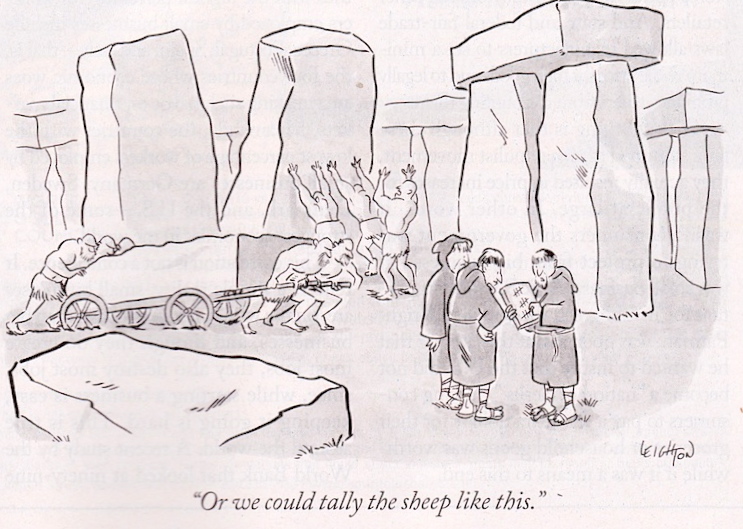
In the latest (October 31st) New Yorker, a cartoon by Robert Leighton about early writing systems:

When I teach about writing systems, the students are always fascinated with the idea that we can learn about long-distant civilizations from what their people wrote. And, eventually, we can. But at the beginning, what people wrote wasn’t love letters, tales of court, imaginative fiction, travel stories, or anything like that. Instead, much more practically, they made records of traded items (grain, animals, other things of value). Tallies, as in the cartoon.

(Not that people tallied things thousands of years ago the way we do now. Or that Stonehenge was a gigantic tally done by huge standing stones.)

textiling

October 31, 2011

As the din of plaints that Twitter is depraving the language of young people, and language in general, rises — see, for example “Up in ur internets, shortening all the words” in LLog, here — it’s worth looking back to other recent dire threats of this sort: texting and IM-ing, cellphone use, and before that, e-mail itself (and back to rock music, movies, tv and radio, the telephone, and, earlier, the telegraph, and so on, including the spread of literacy).

Here, from The Onion of June 14, 2006, is a report on the baleful effects of texting, as it spread from the young to infect even their grandmothers:

Nation’s Grandmothers Swept Up In Textile-Messaging Craze

Sweet old ladies, corrupted by the new media.

for on the desktop

October 31, 2011

A few days ago on ADS-L, Wilson Gray reported this example:

iTunar Desktop is a small iTunes info viewer for on the desktop. (link)

and queried for on.

The short response is that this is just a P (for) with a PP object (on the desktop) — an ordinary construction of English (in The cognac is for after dinner, I took the basket from under the desk, etc.), discussed in the big grammars of standard English (like CGEL). So the structure of

(1) for on the desktop

is

(2) P1 + [ P2 + NP]

and for on isn’t a constituent within (1).

But that’s not the end of the story.

(more…)

work

October 31, 2011

In the NYT Sunday Review yesterday, a piece by Craig Lambert, “Our Unpaid, Extra Shadow Work”, in which the question of what counts as work is central; this is a matter of both categorization and labeling. The beginning of Lambert’s piece:

The other night at the supermarket I saw a partner at a downtown law firm working as a grocery checker, scanning bar codes. I’m sure she earns at least $300,000 per year. Even so, she was scanning and bagging her purchases in the self-service checkout line. For those with small orders, this might save time spent waiting in slower lines. Nonetheless, she was performing the unskilled, entry-level jobs of supermarket checker and bagger free of charge.

This is “shadow work,” a term coined 30 years ago by the Austrian philosopher and social critic Ivan Illich, in his 1981 book of that title. For Dr. Illich, shadow work was all the unpaid labor — including, for example, housework — done in a wage-based economy.

(more…)

Slang books

October 31, 2011

On The Browser site (Writing Worth Reading), a recent interview with lexicographer Jonathon Green (compiler of Green’s Dictionary of Slang, 2010) on slang. After initial remarks —

I see slang as the counter-language. At its heart it’s down, it’s dirty, it’s grubby, it’s tart, it’s essentially subversive. … [it’s] rough, truthful language.

Green recommends five very different books on slang:

A Dictionary of Modern Slang, Cant and Vulgar Words (1859), by John Camden Hotten

Slang To-day and Yesterday (1933), by Eric Partridge

A History of Cant and Slang Dictionaries (4 vols., 2004-2010), by Julie Coleman

The Corner: A Year in the Life of an Inner-City Neighborhood [in Baltimore], by David Simon and Edward Burns (1998)

The F-Word (1st ed. 1995; 2nd 1999, 3rd 2009), by Jesse Sheidlower

For current comprehensive scholarly slang dictionaries of English, I’d recommend the new Green dictionary, which is international in scope, and Jon Lighter’s more restricted but more extensive Historical Dictionary of American Slang (in four volumes, two already published as the Random House Dictionary of American Slang; the project is now under the aegis of Oxford Univ. Press).


Inevitable portmanteau

October 30, 2011

A snowstorm (in the Northeastern U.S.) in October, bringing with it the inevitable portmanteau, as in this CBS news report from two days ago:

Octsnowber? Fall snow storm threatens Northeast

A substitution portmanteau, with the substitution in the interior of the host word: /sno/ (spelled SNOW) for /o/ (spelled O). Substitutions are most commonly at the beginning or end of the word, but this one’s in the middle, involving the accented syllable.


Today’s silly pun

October 30, 2011

To recognize the end of the World Series (of baseball in the U.S.) on Friday, with the St. Louis Cardinals winning over the Texas Rangers in game 7, this punning combination of music and baseball from cartoonist Dan Reynolds:

(From Michael Siemon via Michael Palmer on Facebook.)