Archive for June, 2011

30 years of AIDS

June 8, 2011

(Not about language, but about my life.)

It’s all over the papers, this anniversary, both mournful and hopeful: a case report issued on June 5, 1981, about five young gay men with a rare pneumonia.

One of my good friends at Princeton — a man who managed to pull off being fabulously gay in a homophobic place and time, a man who lit up any space he was in (he once turned up for a party in my room with an antique chamberpot, all porcelain roses, full of martinis) — was one of the first to die, before the disease had a name, before it was even GRID (Gay-Related Immune Deficiency).

And then the plague.

(more…)

Correlative coordinators in parallel

June 7, 2011

Still more on or … or and its kin (previous postings here and here), from OED3. None of them is current, but or … or and nor … nor seem to have lasted the longest, though in decidedly poetic or archaizing texts.

(more…)

Package deal

June 7, 2011

Jon Lighter on ADS-L:

Letterman last night said that Weinergate shows you should “never twitter photos of your deal.”

(more…)

Correlatives

June 6, 2011

Following up on my posting on “Obsolete syntax”, about parallel correlative coordination (in that case, or … or, rather than the modern either/whether… or), some notes on the marking of coordination in English.

(more…)

The Social Network

June 5, 2011

Finally got around to watching The Social Network (a.k.a. The Facebook Movie) this morning. Stunning movie — a tragedy of ambition realized and of friendship betrayed, dark in many places (and visually dark in many scenes), alienating (despite being, in some sense, “about” social connection) — well written, directed, and acted. (The presentation of women in the movie is distressing, but possibly accurate from the point of view of the men depicted in it.)

There’s a lot to be said about works of art based on real-life events. They’re never true in detail to what happened (insofar as that can be known), and since they’re other people’s projections of their own artistic visions onto a found story — their re-workings of that story — they’re often both factually and emotionally false to the original. (But there are so many attractions to a found story.) So you shouldn’t take the movie to be a realistic presentation of Mark Zuckerberg’s progression from Cambridge MA to Palo Alto CA as Facebook rises.

Two linguistic points: Jesse Eisenberg’s portrayal of Zuckerberg’s speech, and the fate of fuck in the extra material on the supplement disk to the main DVD (about the creation of the movie).

In the movie, Eisenberg’s speech style is intense, fast, machine-gun. (This is a definite heightening of the real Zuckerberg — who has even been known to laugh and joke.) I thought this came from the way Eisenberg was directed, but it turns out (as you can see from watching him on the supplement disc to the movie) that this is quite close to Eisenberg’s everyday speech style (though Eisenberg is very much given to laughing and joking, while still being serious about the craft of acting).

Then there’s the bleeping on the supplement disk. Two fucks get through in the movie (“my fuck-you flip-flops” and “the fuck bus”), plus at least one avoidance via freaking; apparently, two non-repeated fucks in a PG-13 movie is one over the regulation limit. (Yes, there are such things.) But on the supplement disk, all the fucks — and there are a fair number — are bleeped out, most entertainingly in an instance of the exclamation fucking shit!, where the final nasal of fucking is preserved, and shit gets by. All the taboo vocabulary besides fuck is untouched, in the film and on the supplement disk.

The ways of taboo avoidance are remarkable.
 

Diplomatic language

June 5, 2011

From Jim Yardley’s “India and Pakistan Fail to Resolve Glacier Dispute at Talks” (NYT, June 1):

“Both sides welcomed the ongoing dialogue process,” declared a statement issued jointly by the delegations. “The discussions were held in a frank and cordial atmosphere, contributing to an enhanced understanding of each other’s position.”

This is the formula for reporting failures of diplomacy. Discussions are fair and frank, the meetings are cordial, people come to understand each other’s positions better, and so on — no matter what actually went on. The distanced, jargonish “ongoing dialogue process” here is especially fine.


A Step Back For Learning Languages

June 5, 2011

Words of one syllable department.

“A Step Back For Learning Languages” is the headline on Jim Dwyer’s “About New York” column in the NYT (on-line May 31, in hard copy June 1). Dwyer reports that

Next week, students across the state will take Regents exams in foreign languages for the last time, as the state is dropping its tests in Spanish, French and Italian.

This will save $700,000 a year, or to put it another way, roughly the cost of policing a homestand at one of the baseball stadiums.

Do not be confused, dear citizens and students: the state still believes that it is important to learn foreign languages and culture before graduation.

Just not $700,000 important.

“With these exams, we actually tested our students’ skills at navigating through conversations,” said John Carlino, who teaches high school German, which was eliminated last year from the Regents testing scheme, along with Hebrew and Latin.

At a time when it seems as if new tests are being devised every week, it is almost quaint to see the state dropping one series of them. Students will still need foreign language for the advanced Regents diploma, but it will be up to each school district to figure out how to rate their proficiency.

“If they don’t have the money to print the exams, will the state have the money to check on what the districts are testing?” asked Mr. Carlino, who is also the executive director of the New York State Association of Foreign Language Teachers.

To pass the current Regents exams, students have to show that they can carry on a conversation, grasp what they are being told and also make themselves understood. They also have to show that they understand the cultures of the places where the languages are spoken. It is not just a matter of filling in the circles on a multiple-choice test.

We don’t need foreign languages. We have English.

Epitomics

June 5, 2011

Attached to (and largely covering) the front of the May 20 issue of Science, an ad labeled “The Rabbit Monoclonal Advantage”, for rabbit monoclonal antibodies offered by the Epitomics company (“Better Antibodies ● Better Science”). I have nothing to say about RabMAbs, as they seem to be known in the trade, but I do have a bit to say about the company’s name.

(more…)

Alligator Goodbyes

June 4, 2011

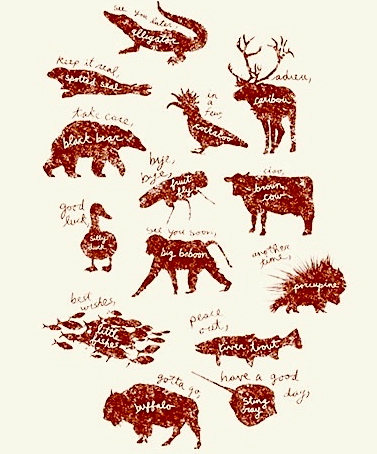
My grand-daughter Opal showed up for breakfast this morning wearing a new t-shirt her mother had found for her on the Threadless site:

By Kacie Mills, the shirt has 14 instances of a verse form that I’ll call the Alligator Goodbye, on the model of “see you later, alligator” (at the top of the shirt).

(more…)

The name game

June 4, 2011

Today’s Zippy:

“Bill Griffith” is an easy shot, but for “Zippy” we do indeed have: Zippy Shares (“online free file hosting”), Zippy Duck (a 6-1/2″ bag that closes with a zipper), and Scooter’s Zippy Pickles (of Pensacola FL). Plus lots of occurrences of the adjective zippy not in proper names.

(My dad’s nickname was Zip — from college days, when his friends said that he had lots of zip — but never Zippy. “Zippy” is a lot sillier than “Zip”.)

(No google hits for “Merwin Webcor”, by the way. Or for “Zip Zwicky”.)