Archive for July, 2010

Notes: euphemisms 7/26/10

July 26, 2010

A description of my Sunday morning, originally intended for e-mailing to friends:

After breakfast, I worked at the computer, filing examples while watching a gay porn flick (Sweat, a “food-fuckers” scene, with three guys of remarkably similar appearance, down to the minimal buzzcuts, having enthusiastic sex with one another, most of it involving foodstuffs, in the cramped and steamy restaurant kitchen where they work). When that had served its purpose – fulfilled its function, done its work, performed its role – I moved on to writing a posting on “bear music” for my blog and watching Visconti’s Death in Venice, eventually posting a note on Facebook about it:

Downer: watching Visconti’s “Death in Venice” (with Dirk Bogarde as Gustav Aschenbach/Gustav Mahler). It ends badly, as you will recall. And not far from the end, there’s a nasty summary of what Aschenbach-Mahler’s life has come to:

“In all the world there is no impurity so impure as old age.”

(Nick Fitch and Lise Menn said things to soothe my distress at this sentiment.)

The material that’s relevant here, which I’ve put in boldface, is a series of four VPs that are rough paraphrases of one another, each serving as a gently euphemistic reference to masturbation; “gotten me off” would have been a slangier and somewhat more direct way of putting things, and larger-scale revisions would have allowed for even more direct and more vernacular language (instead of “watching a gay porn flick … When that had … I moved on to …”: “jacking off to a gay porn flick … When I’d come I moved on to …”).

The version I wrote depended on the reader filling in some crucial background information, in particular that gay porn flicks are a species of functional art, the specific function being to serve as a masturbatory aid (as the video equivalent of “one-handed literature”, or “boner books”) by aiding arousal, so that a gay porn film has served its purpose when the viewer ejaculates (somewhere during the course of the action, not necessarily at the very end; the films are, after all, intended to provide a number of occasions for viewer fulfillment, a number of “happy endings”, every 10-15 minutes).

What I wrote referred to serving a purpose without making explicit what that purpose was. So it was indirect in content. And it didn’t use any sexual vocabulary at all, even euphemistic or medical/technical vocabulary. So it was indirect in form. It would actually have been subtle if I’d used only one reference to function (“served its purpose”, say, which is all I wrote originally) instead of piling on one synonym after another, ostentatiously calling attention to my indirectness.

So many ways to avoid taboo topics and taboo vocabulary, and so many ways to achieve display through concealment.

Notes: categories 7/26/10

July 26, 2010

[This is the first in a series of notes on various topics that I’m posting bit by bit, rather than waiting until I have accumulated a whole battery of related material (which can take quite a long time) before posting on the larger topic. This one’s on categories — folk categories, technical categories, scientific categories, ad hoc categories, etc. — and the associated labels.]

In assembling an iTunes playlist of versions of the American gospel/folk song “How Can I Keep From Singing?” I’ve been bowled over by the variety of Genre labels assigned to the tracks I’ve chosen. When I had 14 tracks on the list (there will eventually be 17, out of the 100+ available), there were 9 different categories labeled in the Genre column:

folk
singer/songwriter
rock
Christian & gospel
classical
jazz
soundtrack
New Age
pop

How does this happen?

(more…)

Like/unlike

July 26, 2010

[This posting doesn’t have much about language in it.  Like my “Music of ruin” posting, it has some recollections in it; but mostly it’s a posting in the Gender and Sexuality category, in the Gayland subcategory.]

Today I going to put together themes from my posting “The Truly Huge” (on gigantically muscular men in gay porn) and my posting “Safe for public consumption” (on an arty Tom Bianchi man-on-man photo that stays just on the good side of the displayable-in-public line).

(more…)

want to?

July 25, 2010

One more cartoon for the weekend, a Zits in which Jeremy doesn’t fathom his father’s intentions in asking him a question:

Dad’s asking a question about Jeremy’s wishes/desires — the referent of the ellipted subject of want is clear enough — and suggesting that Jeremy should go to a restaurant for lunch. But there are still several possibilities for the membership of the lunch-going group, which could include others besides Jeremy, in particular his Dad (who is, after all, right there in the context). (There’s a similar range of possibilities for other suggestion-forms, like “How about going to a restaurant for lunch?” and “Why not go to a restaurant for lunch?”)

The crucial question is: Why is Dad asking this question? In particular: Why has he called me out of the blue to ask this question?

Jeremy is self-centered enough to assume it’s all about him and so doesn’t appreciate that his father might be (indirectly) conveying a wish of his own. Actually, he’s a bit denser than that, since there’s a least a strong presumption in many contexts that suggestion-questions (suggestirogatives?) with unexpressed agent — like “Want to go to a restaurant for lunch?” — are suggestions for joint action.

A few words from Sir Ian

July 25, 2010

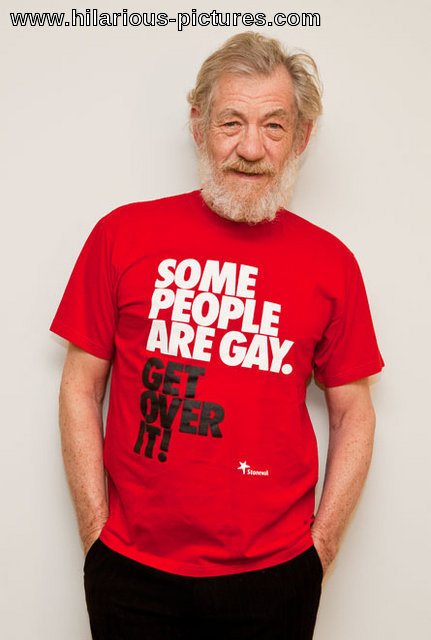
Passed on to me by Mary Ballard: Sir Ian McKellen proclaiming a gay pride slogan (not one I have — yet — on a t-shirt):

Observation: the slogan comes in two parts, together replacing the gay pride slogan of my youth (a few years ago):

We’re here / We’re queer / Get used to it

The in-your-face first part of the older slogan has been replaced by a simple statement of fact (and modest, too, making an existential claim well short of the universal We Are Everywhere), the second part by a more currently fashionable exhortation. (At least, many people seem to feel there’s a fashion for “get over it”. I haven’t tried to collect data on this version as opposed to “get used to it”.)

Observation: I don’t know whether something is intended by the bold color choice (flaming red and black), and if so, what, but it’s an interesting alternative to more traditional pink or lavender.

Observation: yes, that’s a Stonewall shirt, here.

Observation: somebody seems to feel that the shirt is hilarious, a suitable target for mockery. But then the range of images on hilarious.com is pretty wide.

Observation: a number of commenters on hilarious.com identify Ian McKellen as Gandalf, period, as if that’s what he had been knighted for.

Observation: yes, Sir Ian is very old, by which I mean that he’s at least a year older than I am. Ok, not by much, but still more than a year. (Nancy Pelosi is younger than he is, but only by about ten months, which means that by my metric she’s old but not very old.)

Bear music

July 25, 2010

Joan Armatrading was on NPR’s Morning Edition Sunday today, which got me reflecting on her song “Eating the Bear”, from the 1981 album Walk Under Ladders. That led me to follow up the music of ruin (here) by attending to bear music, in particular the source of yet another formula (la, sir, how you do go on!), the one in:

Some days you eat the bear, some days the bear eats you.

(roughly ‘win some, lose some’, but with more of an edge), as in the title of the 1974 album by rock/folk singer Ian Matthews (in a variant with and between the two clauses).

In Armatrading’s version, the clauses are inverted and put in the future:

Some days the bear will eat you, some days you’ll eat the bear.

offering the hope of triumph; in fact, in Armatrading’s song the singer eats the bear, hence the title.

(more…)

How you do go on!

July 24, 2010

Quoting myself: “And old folks do go on”. I knew this was a kind of a distant quote; the original-for-me is “(O(h)) la, sir, how you do go on!”, which I got from my friend The Beeb mumble-mumble years ago in Princeton. It was clearly a quote for her; if she has any idea where she got it from, I assume she’ll comment here or send me e-mail I can pass on. (La Beeb is my daughter’s godmother, which I suppose makes her my godsister, though I guess a woman could also get to be my godsister by sharing a godparent with me.)

The crucial parts of the Beeb Version are the interjection la, the vocative sir, and the core formula how you do go on. Plus the suggestion that the speaker is female (perhaps a servant, a naïve ingenue, or a coquettish woman, but certainly the recipient of male attention) and that the addressee is a man flirting with her. The first three ingredients are in principle independent of one another.

(more…)

The music of ruin

July 23, 2010

I was checking my iTunes to see if I already had a version of the “Turkish March” from Beethoven’s incidental music to The Ruin of Athens, Op. 113 (I’ll get to why I was engaged in this search later). Turns out I had four tracks with ruin in the track name or the album name:

“Ruint”, by Johnny Hodges with Duke Ellington, from Side by Side (see my ruint posting);

“Ruiner”, by Nine Inch Nails, from The Downward Spiral

“Don’t Ruin Our Happy Home”, from the “Odds & Ends” volume of Guilty: 30 Years of Randy Newman

“Ruination Day (Part 2)”, by Gillian Welch, from Time (The Revelator) (Have I mentioned how wonderful I think Gillian Welch is?)

And now one recording of the “Turkish March”, with more to come.

But five tracks scarcely scratch a micrometer into the surface of the ruin phenomenon; it turns out that the word is just huge in the music world.

(more…)

Zippy goes zip-lining

July 22, 2010

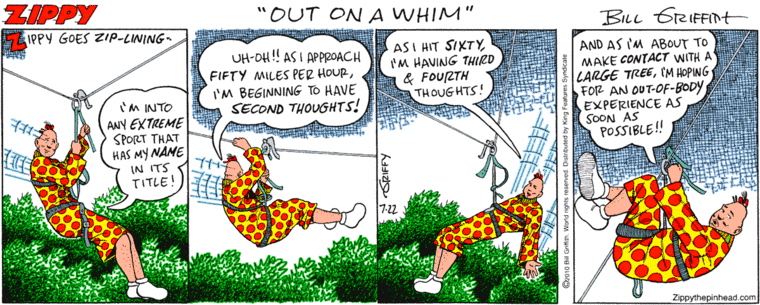
Only Thursday, but here’s a cartoon for the weekend, with Zippy out on the line and going to extremities:

The word zip-lining was new to me, but I’ve seen people doing it in films, and I’ve seen P.D.Q. Bach make a zip-line entrance from the balcony to the stage  (it’s not something that an acrophobe like me would do willingly).

(more…)

Lyrics with variable slots

July 22, 2010

Two sources for this posting: my recent piece on this blog on, among other things, The Mikado; and my recent piece on Language Log (“Back on top”), on my return to the top of the authors’ list there, after some time as Zwicky Arnold, at the bottom.

(more…)