Archive for 2009

Short shot #27: to queen-wave

December 11, 2009

Chris Ambidge writes to tell me about an early Xmas present he got from a friend:

It’s a 20cm tall mannikin of The Queen: with usual hairdo, peach coloured dress & coat, sensible shoes, smile, white gloves, handbag & (of course) pearls. But wait — there’s much more. Her handbag is a solar cell, so put her someplace bright & it works — to cause her up-held hand to queen-wave.

Ah, the back-formed verb to queen-wave, based on the synthetic compound queen-waving ‘waving (one’s hand) like the Queen’. An entertaining survey of years of Queen-waving (from the Onion News Network) can be seen here.

Grammar vs. syntax

December 10, 2009

One more follow-up to my posting on Ned Halley’s Dictionary of Modern English Grammar, this time on grammar vs. syntax. The sub-title of the book says that it’s about grammar, syntax, and style, so that I wondered how Halley distinguished these three things.

Style first. Then grammar vs. syntax, a distinction that crops up in many other places, in particular in discussions of the “grammar and syntax” of some language.

(more…)

Singular, plural, collective

December 10, 2009

A follow-up to my posting on Ned Halley’s Dictionary of Modern English Grammar, about plurals and collectives.

The issue comes up in Halley’s entry on apostrophe (the mark of punctuation), where he writes (punctuation as in the original):

There remains the little problem of where the apostrophe goes according to single [I assume he’s (incorrectly) treating single and singular as interchangeable technical terms] and plural possessive use. But again, it’s simple. If the possessor is single, as in “the girl’s hat” the apostrophe is placed before the ‘s.’ If the possessor is plural, as in “the girls’ school” the apostrophe goes after the ‘s’ because it is, in effect, abbreviating what would otherwise be “the girls’s school.” Remember that collective words, such as children, crowd, and people, are singular, so in the possessive are written as “the children’s party”, “the crowd’s favourite”, “the people’s friend” and so on. [The emphasis is mine.]

This is seriously confused. I’m guessing that, as with single and singular, Halley is confusing characterizations of meaning (reference to an individual, as with single) and characterizations of grammatical properties (allowing an expression to take part in various syntactic constructions, for example subject-verb agreement, as with singular). There are excellent reasons why individuated reference and singular grammatical number should be distinguished — though they are obviously related — and I suppose it’s too much to expect that your typical person on the street would appreciate this point, but it’s utterly crucial for someone who hangs out a shingle saying they’re offering advice on grammar, syntax, and usage (as Halley does).

Here are the facts: the English nouns children and people are grammatically plural —

these/*this children/people [determiner agreement]

The children/people were/*was shouting. [subject-verb agreement]

(and refer to collectivities), but the noun crowd (which also refers to a collectivity) is grammatically singular, as can be seen from determiner agreement:

this/*these crowd of well-wishers

A complication: collective nouns like crowd sometimes show mixed behavior with respect to other sorts of agreement, allowing “notional” plural agreement in certain circumstances. But the facts about determiner agreement are clear, and indeed collective nouns are count nouns and have ordinary plural forms (crowds, for instance).

What sets children and people apart from most plural nouns is that they don’t have the -s suffix of regular plurals. Children is one of a number of irregular plurals, of several types (women, teeth, alumni, and more). People is one of a number of plural-only nouns with no suffix -s (cattle and police are two others). And there are zero-plural (or “base-plural”) nouns as well (like sheep), with the plural form identical to the singular. These are well-known phenomena, described (along with some other anomalies in the English system of number in nouns) in every reasonably extensive reference work on the structure of English. It’s inexcusable that Halley should not know about them.

Grammar, syntax, and style

December 9, 2009

Inspired by Geoff Pullum’s Language Log posting on “the grammar gravy train”, Bradshaw of  the Future has alerted us (here) to the wonders of Ned Halley’s Dictionary of Modern English Grammar: Grammar, Syntax and Style for the 21st Century (Wordsworth Reference, 2005) — a strange and dreadful book.

The back-cover blurb:

Is there a right way to speak and write English? This unique new guide to the language is dedicated to answering the question – in Plain English. Compiled for readers from school age onwards, this is a book of easy reference. It explains the workings of 21st-century English, from the most basic rules of grammar and spelling to the origins of the language in the ancient world, and the curiosities of current slang. Included is latest advice on the abbreviated language of the text message, and how to navigate the treacherous linguistic realms of political correctness.

(Yes, origins in the ancient world. In the introduction (pp. 7-8), we’re told that “English is largely rooted in ancient Greek and Latin, and to grasp this is, I believe, a key to understanding how modern English works, and how we can use it to best effect.”)

The book is an alphabetically arranged list of topics that seem to be united only by Halley’s interest in them, and only a few entries have to do with grammar. Many entries are too brief to be useful, and a fair number are simply wrong.

(more…)

Short shot #26: the tyranny of the style sheet

December 9, 2009

In an op-ed piece (“The Next Surge: Counterbureaucracy”) in the NYT on December 8, Jonathan J. Vaccaro describes the baleful effects of bureaucracy on the conduct of the campaign against the Taliban in Afghanistan; multiple approvals from many different authorities are required before action can be taken. And then:

The red tape isn’t just on the battlefield. Combat commanders are required to submit reports in PowerPoint with proper fonts, line widths and colors so that the filing system is not derailed.

No report, however, of requirements on punctuation, spelling, and the like, not to mention grammar and usage.

spork

December 9, 2009

Today’s Bizarro takes on the spork, a portmanteau implement with a portmanteau name:

The spork manages to be neither a fully satisfying spoon nor a fully satisfying fork. (I enjoy the word, though.) Its virtue is that it allows places that supply eating utensils to get by with fewer of them.

The playpus has not evolved a spork bill, no doubt because its spoon-like bill works so well in scooping up small creatures from riverbeds and catching them while swimming.

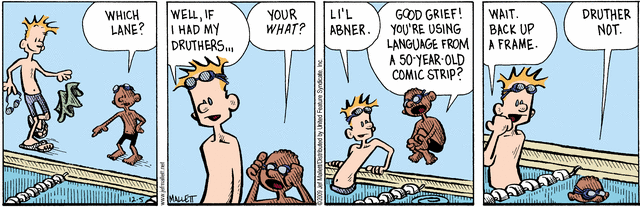
druthers

December 9, 2009

The Frazz cartoon of December 5 (hat tip to Victor Steinbok):

It’s not just Li’l Abner. OED2 has U.S. dialectal druther ‘would rather’ from the 19th century, with the noun variant druther(s), ruther(s) ‘a choice, preference’ (nice quote from Tom Sawyer). It relates the pronunciation to the dialectal variant dern for darn.

Nominal ellipsis

December 8, 2009

In a recent posting I looked at some English constructions (Gapping, Verb Phrase Ellipsis) with verbal ellipsis in them, in light of the claim in some usage handbooks that ellipsis is subject to a formal identity condition, requiring that the understood verbal element be in the same form as the overt one. I find many examples that violate this condition to be entirely acceptable, but apparently some people are pickier than I am.

Then I thought to look at some cases of nominal ellipsis where the overt material and the understood material are in different forms. Things like

I accept the first argument, but reject the other two ___. [understood arguments]

I accept the first two arguments, but reject the third ___. [understood argument]

That was your dream. Kim’s ___ were all nightmares. [understood dreams]

Those were your dreams. Kim’s ___ was a nightmare. [understood dream]

For me, the first two are impeccable. The last two I judge to be acceptable but to require a bit of processing work. Others might have different judgments.

I haven’t come across treatments of nominal ellipsis in the advice literature, but then it’s hard to search for.

Short shot #25: setting a record

December 8, 2009

Reporters often feel that it’s not enough to just report a story, that they need to set the story in some perspective. So instead of writing that it was very cold locally on December 1, and reporting the temperatures for the day, they’ll add that this was the coldest December 1 since 1997.

That’s a made-up story, but here’s a real one, about a school stampede in China’s Hunan province in which 8 were killed and 26 injured. This sad event was described on this morning’s Morning Edition on NPR as “the deadliest school stampede in China since 2002”.

According to Yahoo! News,

Despite harsh punishments aimed at forcing improvements, deadly stampedes continue to occur repeatedly in China’s schools, usually as students are rushing to exams or charging out of class down tight corridors and narrow stairwells.

This story cautiously described the Monday stampede as “among the deadliest since the crushing deaths of 21 children in a northern China middle school in 2002”.

(Early hits on {“school stampede”} include stories on a September stampede in Delhi, India, and a March 2002 stampede in Mecca, Saudi Arabia. Until this morning I hadn’t thought of school stampede as a category of events.)

each other

December 8, 2009

Over on Language Log, a discussion of David Foster Wallace’s recommendations on grammar and usage brought up the “rule” on choosing each other or one another as a reciprocal: each other restricted to two, one another to more than two. This strict differentiation — an aggressive application of the One Right Way idea — has a long history (going back at least to 1785), sketched in MWDEU.

In 1851 Goold Brown pointed out that “misapplications of the foregoing reciprocal terms are very frequent in books” and noted with astonishment that “it is strange that phrases so very common should not be rightly understood”. MWDEU counters that “evidence in the OED shows that the restriction has never existed in practice; the interchangeability of each other and one another had been established centuries before Ussher [in 1785] or somebody even earlier thought up the rule” and gives a pile of citations, from Samuel Johnson and Noah Webster to G. K. Chesterton and E. L. Doctorow. In summary:

We conclude that the rule restricting each other to two and one another to more than two was cut out of the whole cloth. There is no sin in its violation. It is, however, easy and painless to observe if you so wish.

My own practice prefers (but does not require) one of the reciprocals in some contexts, the other in others, for reasons that are not at all clear to me.

But this posting isn’t really about choosing which reciprocal to use. Instead, it’s about a non-reciprocal use of each other.

The context: a friend of mine sends me daily cards, many of which are print-outs of photos, often sexual in content. Recently he’s stumbled on a vein of pictures in which one naked guy has playfully picked up another naked guy; in some of them guy #2 is slung over over one of guy #1’s shoulders, in others, guy #2 is riding piggy-back or riding on guy #1’s shoulders. My friend described these photos as showing “naked guys picking each other up”.

Although the actions depicted are not in fact reciprocal — there is one picker-up and one picked-up, and they don’t exchange roles — I didn’t balk at this way of describing things.

There are, of course, other possibilities: for instance, “naked guys picking other naked guys up” (though this is longer) and “one naked guy picking another up” (this has the same number of words as my friend’s version, but is singular, while we’re talking about a number of pictures with a different picker-up in each one). I’m not saying that there’s anything unsatisfactory about these alternatives, only that they frame things in slightly different ways.