Archive for 2009

Feel-copping

September 15, 2009

For the annals of synthetic compounds, this item from Joe Clark:

Man-pat and side-squeeze no match for teenage feel-copping

with a link to a Toronto Star story of September 12 (“For teenagers, body-to-body contact says it all”) about teenage fashions in hugging and the like: the side-squeeze, the surprise hug, the boyfriend-girlfriend hug, and the male-to-male non-hug the man-pat. There is some concern about kids crossing the line into sexually inappropriate contact, which is where feel-copping comes into it.

(more…)

Blame it on a word

September 14, 2009

Some of the items in the OI! Project lists — see the top items in the survey here — are initially puzzling. For instance, the top item in the IANW (Include All Necessary Words) list — discussed in 12 handbooks — appears in our files as “very + PSP” (past participle), though in my posting I expanded the label to identify the word — much — that is at issue in the handbook discussions. That is, the problem with very surprised, according to some of these discussions, is that it is “missing” the necessary much; the expression should be very much surprised.

I’ll get back to this particular case in a moment. But first, some general comments.

(more…)

Labels

September 13, 2009

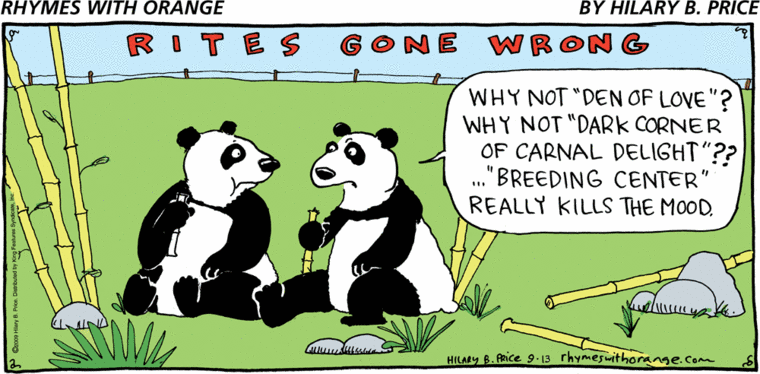
Rhymes With Orange takes on labeling:

The amount of writing on and public discussion of labels, of all sorts, is enormous. There’s constant contention over the way labels frame things — as in the panda’s objection above to breeding center.

Labels in socially sensitive domains — like sex, sexuality, race, ethnicity, religion, and so on — are especially fraught. There’s tension between avoiding giving offense and sounding ridiculous.

A case in point: the language of disability, that is, the language used to describe and refer to people with physical or mental disabilities. I happen to have looked at the Oxford A-Z of English Usage (ed. by Jeremy Butterfield, 2007) on the matter yesterday — with some personal interest, since I have somewhat limited use of my right hand.

(The Oxford A-Z is a small, short paperback that tries to cover not only points of grammar and usage in a narrow sense, but also spelling, pronunciation, punctuation, and more, including word choices in socially sensitive domains.)

First, an entry for differently abled, which the guide (p. 40) says

was first proposed in the 1980s as an alternative to disabled, handicapped, etc. on the grounds that it gave a more positive message and so avoided discrimination towards people with disabilities. The term has gained little currency, however, and has been criticized as both over-euphemistic and condescending. The accepted term in general use is still disabled.

So far so good. I can tell people that I am “somewhat disabled”.

Then comes a longer entry on disability, the language of (pp. 41-43), where (among other things) we are told to try to

avoid using the + an adjective to refer to the whole group, as in the blind, the deaf and so forth. The reasoning behind this is twofold: because the humanity of people with a disability should not be circumscribed by the disability itself (‘the disability is not the person’); and that talking about people with a given disability as a group diminishes their individuality. The preferred formulation these days is ‘a person with …’ or ‘people with …’ as in people with sight problems, people with asthma, or people with disabilities.

So now I am “a person with a disability”, I guess.

I have little patience with these circumlocutions, though I appreciate that there can be subtle differences in meaning and use between different syntactic structures (as in Italiansthe Italians, Italian people, people from Italy).

Next, the guide gives a list of suggested replacements for older terms, saying that

Some of the terms below are better established than others, and some groups with disabilities favour specific words over others. These lists are offered only as a general guide.

Some of the “older terms” — like mongol — are certainly ripe for replacement (though person with Down’s syndrome is not especially felicitous). Some replacements are awkward indeed: non-disabled for able-bodied, partially sighted or visually impaired for blind. And having a disability is suggested as the “neutral term” for disabled. Sigh.

More nounings

September 12, 2009

In my brief treatment of The Ants Are My Friends, I neglected to mention this bit from the book (p. 11):

There are panels throughout [the book] where I’ve put together similar examples or sources of mishear or mis-speak …

This has mishear and mis-speak as mass nouns zero-derived from the verbs mishear and mis-speak (try not to worry about the hyphenation). News to me, but then I’m always coming across new stuff.

Now I see that there are count nounings as well:

In any case, the number of syllables in “if you could close the gimmick” don’t match up with the audio. This is clearly a mis-hear. (link)

Just noticed what I think was a mis-hear: … (link)

At least Mrs. Bush can claim possible senility for some mis-speaks. (link)

SOME MIS-SPEAKS BY SPOKESMEN OF THE LORD (link)

Nouning marches on.

various of

September 12, 2009

Back on August 7, E. Ward Gilman (of MWDEU fame) e-mailed me about Burchfield’s Fowler (billed as the third edition, 1998, of Fowler’s Dictionary of Modern English Usage, 1926):

Quite a few years ago, when I was hoping to be able to write a review of Burchfield’s Fowler, I ran across another curiosity.   It was the pronominal use of “various”, as in “I spoke with various of them”. This use was condemned in the original Fowler, with citations, and in Gower’s edition, with additional citations, but is omitted entirely from Burchfield. I don’t know whether it was omitted inadvertently or whether Burchfield left it out on purpose.

I replied that it was hard to tell: maybe Burchfield just decided the usage was now acceptable;  unfortunately, we can’t ask him (he died in 2004).

Now some further discussion, reproducing some material posted to the American Dialect Society Mailing List back in August.

Both NOAD2 and AHD4 list pronoun uses of various, but with a usage note in each case. NOAD2 calls the pronoun use “colloquial American”, noting that “some traditionalists” insist that various is only an adjective. I see this opinion as denying the possibility of language change, in particular a change in which various developing an pronominal use parallel to several.

(In some postings i’ve called the operative assumption here Originalism — the very silly idea that the original use of a word is its only acceptable use now.)

[Digression 1 about part-of-speech classifications: these sources seem to use pronoun as the part-of-speech classification for  quantifier words used as determiners with of. I’ll play along with that here, with a proviso to come shortly.]

[Digression 2 on this topic: OED2 does not in fact label such uses of several — in several of — as pronominal. Instead, these uses are treated as elliptical uses of the adjective several.  OED2 does something similar for few in few of. But the June 2009 draft revision for many classifies it as a pronoun in many of. I assume that when revisions get to several and few, they will be similarly reclassified.]

[Digression 3 on this topic: on ADS-L, Randy Alexander noted the treatment of these items in CGEL as “fused head” structures: fused
determinative-head (in few, many, several), and fused modifier-head (in various). I am in fact a proponent of this analysis, but chose to formulate my discussion in more traditional terms so as to connect with the dictionary treatments.]

Back to usage advice. AHD4 reports very substantial hostility to pronominal various on its usage panel, with somewhat less hostility towards it with inanimate NPs. The usage note concludes:

It is not clear why this usage should be regarded as an error, since it is analogous to the use of quantifiers such as few, many, and several.

Well, it is indeed analogous, but few, many, and several developed pronominal uses well before various did. The offense of various is that it came late to the party; the doors were closed, and no new items are to be allowed in. Then commenters like Fowler fixed on it as an innovation, and others piled on, as often happens; it became part of the peevelore, to the extent that you felt
that MWDEU had to warn readers that some people view the usage as a
straightforward error, so that you might want to be cautious about using it. (Crazies win, as I said in a Language Log posting a while back.

The case is interesting, because it’s not clear what the fix is supposed to be. The usefulness of pronominal various is that various of can combine with definite NPs, as in various of them and various of these commenters. So if you proscribe pronominal various, then some other partitive construction must be used (several of, a number of), or an indefinite construction must be used (various people, various commenters), or a noun or pronoun head must be supplied for the adjective various (various ones of them, various commenters of these). Each of these work-arounds has its defects, but the first is probably the best; its defect is that the association with variety is absent in the alternative partitives.
The ants are my friends

September 12, 2009

Just finished Martin Toseland’s The Ants Are My Friends: Misheard Lyrics, Malapropisms, Eggcorns, and Other Linguistic Gaffes (hardback in 2007, paperback in 2009), a collection, meant for general readers, of phenomena that should be familiar to readers of this blog and of Language Log: mondegreens, eggcorns, and (non-eggcorn) classical malapropisms. (Key to title: Bob Dylan’s line “the answer, my friends” (is blowin’ in the wind).)

There are many old friends here, attractively presented and engagingly discussed, and Toseland largely avoids the mocking tone that many people talking about mistakes take to those who produce them.

I haven’t checked Toseland’s eggcorn examples to see how many of them are in the Eggcorn Database, or at least mentioned in the Eggcorn Forum, but a quick sampling suggests that most of them have come by the eggcornologists. I have a modest collection of classical malapropisms, but I’m not aiming at completeness there; and though there are some on-line collections of mondegreens, I’m not keeping files on them myself.

Toseland describes himself on his webpage as “an author, ghostwriter, freelance publisher and literary agent”. Ants was the first book published under his own name. It’s now been followed by A Steroid Hit The Earth: A Celebration of Misprints, Typos and Other Howlers (hardback in 2008, paperback in 2009), which I haven’t looked at yet.

Lightweight stuff, but entertaining; it would probably be enjoyed by someone who’s interested in language-y stuff, but not to the point of following linguablogs.

Getting it

September 12, 2009

From The Advocate of October 2009, p. 8:

“Before I wrote this story, I wasn’t a fan of The Real Housewives,” says Jason Lamphier, whose piece on Bravo executive Andy Cohen appears on page 56… “Those women crave attention and drama to the point of self-absorption, but most of us crave that too, if even just a bit. Andy Cohen knows this. He gets the camp factor, and he gets that we get the camp factor.”

The point of interest is the use of the verb get here. It’s not exactly new; OED2 has a sense ‘to understand (a person or statement)’, marked as colloquial and originally U.S., with clear cites from 1907 on, mostly in (not) get it, as in “Oh, now I get it” and “I don’t get it”.

In “He gets the camp factor” (and a great many other examples that can easily be found), the object of get denotes neither a person nor a statement (or situation), but instead an abstract property, and get itself denotes something closer to appreciation than to simple understanding. It’s a subtle extension of the older senses, and an entirely natural one. It might not be easy to determine when the meaning was extended this way.

“He gets that we get the camp factor” has a further extension, to propositional objects of get, in the form of that-complements. Again, this is a natural extension, on analogy with verbs like understand. And again, I don’t know the history of this development.

But I do know that there are two variants with that-complements, one with the plain complement, the other with an it that is sometimes labeled as pleonastic (and sometimes analyzed as involving extraposition of the that-complement). There are huge numbers of hits for both:

Plain:

I mean, I get that you like the guy, but you have to admit, that was pretty strange. (link)

OK, I get that you disagree with Frank’s policies. (link)

With it:

Yes, I get it that you think that people are so retarded that they believe “death panels” means committees convened to kill people … (link)

And I get it that you might not like a few people, but why would you ever put them down or be mean? (link)

This is part of a larger pattern in English, in which a plain clausal complement  (a that-complement or a for-to-complement) alternates with it plus that complement:

I hate/love/like (it) that you can play Scrabble so well.
I hate/love/like (it) for you to play Scrabble so often.

There are more verbs involved in these patterns, and there’s an enormous amount of variation (from person to person, dialect to dialect, verb to verb, syntactic context to syntactic context, discourse context to discourse context). This variation has often been commented on in the syntactic literature, but as far as I know, the details haven’t been studied systematically. (This is one of those cases where it’s no help at all for people to volunteer their judgments on particular examples, since these judgments are often fragile and vary with small changes in the details of the examples. Only studies of actual usage will do, and those aren’t easy to carry out.)

But it’s enough for my purposes here to note that both variants are available for get ‘understand, appreciate’.

Looking like a Communist

September 11, 2009

Anthony Lane on photographer Robert Frank, in the September 14 New Yorker, p. 89:

If Frank didn’t talk to his subjects, how many of them wanted to talk back? A bunch of high school boys in Port Gibson, Misissippi, told him he looked like a Communist and suggested that he “go to the other side of town and watch the niggers play.”

What makes someone look like a Communist? Well, Frank was a Swiss Jew; maybe that was enough.

Lane reports (p. 86) on another occasion, in 1955, when the police in McGehee, Arkansas, stopped Frank as a suspicious person and locked him up: “The patrolmen didn’t like the look of the guy, or the sound of him, or the fifth of Hennessy they found in his glove compartment”.

More on but instead

September 10, 2009

A couple days ago I posted about apparent failures of parallelism in examples like:

Some whales, including the blue whale, don’t have teeth but instead something called baleen.

This is of the form

(1) not S but (instead) NP

and my discussion was built on the assumption that things like (1) — and (2) as well —

(2) not only S but (also) NP

are just examples of ordinary coordination, with the second conjunct “reduced” to a NP.

Although most discussion of coordination assumes that, insofar as possible, all sorts of coordination with and, but, and or are to be related to coordinations of full clauses (with various sorts of “reduction”, that is, suppression of some shared material), this assumption is gratuitous. The alternative is to posit separate constructions in which the conjuncts are stipulated to have different syntactic structures; the semantic relationship between such a construction and a coordination of full clauses is then a matter of the way the semantics of the special construction works.

I was reminded of this alternative analysis when I came across an entirely unremarkable sentence in Scientific American (September 2009, in Davide Castelvecchi’s “Batteries”, p. 73):

It is the electrolyte that makes the battery work, because it allows ions to flow but not electrons, whereas the external circuit allows electrons to flow but not ions.

This has two clauses in it of the form:

(3) S but not NP

the first of which is “it allows ions to flow but not electrons” ‘it allows ions to flow but it doesn’t allow electrons to flow’.

Ah, this is familiar territory (to me, anyway): a type of what’s called “end-attachment coordination” in section 4.5. of CGEL‘s chapter 15, on coordination and supplementation (by Huddleston, Payne, and Peterson). This is the postposing of a coordinate, as in their example

They had found Kim guilty of perjury but not Pat.

(They also give examples with and and or.) Some postposing examples “have the informational status of an afterthought” (p. 1345), but many do not.

They go on to argue (p. 1346f.) that though an analysis that treats such examples as coordinations of clauses (a full clause plus a clause fragment that we might think of as a “reduced” clause) is possible in many cases, there are examples that don’t have a workable analysis in these terms.

Obviously, there are lots of details to work out in getting the semantics right. But if we look at (3) as a special construction involving the coordination of different structures, then the way is open to viewing (1), and (2) as well, in a similar light.

To the next level

September 10, 2009

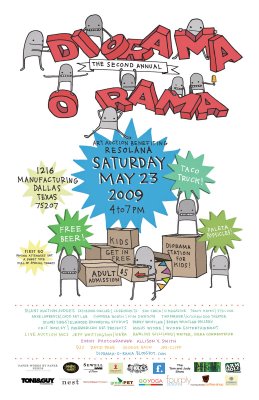
Ann Burlingham writes (under the heading “rama-lama-ding-dong”) to report a sighting of diorama-o-rama, with –o(-)rama attached to diorama (there are several variant spellings), and with roughly the meaning ‘a display or exhibit of dioramas’. Lots of hits, many of them for a Dallas art happening and fundraiser (poster below), which includes of course a display of dioramas, but some for people who’ve assembled displays of their own dioramas (sometimes referred to by the clipped version dios).

Formations in -((o)r)ama (that is -orama, -rama, -ama) are playful in tone, like formations in -((e)t)eria for names of shops (carpeteria and the like; some discussion here). Michael Quinion’s Ologies and Isms: Word Beginnings and Endings (Oxford, 2002) treats them under the heading -orama; there’s an on-line version of the entry here, with a compact history of the formative, from panorama (ca. 1789) through several waves of fashion in innovation: cyclorama and diorama early on, then later inventions like Futurama, Cinerama, sensorama, Scout-O-Rama, and more. Now it’s been taken to the next level with diorama-o-rama.

[A note on Quinion’s terminology.  He refers to the formatives in his book as “affixes”, but they are in many ways more like the elements of compound words than like ordinary derivational affixes. True, they are bound elements (except for a handful, like ism and ology, that have been liberated into use as independent words as well as word-internal morphemes), but they have an accent of their own and have the semantics of elements of compound words.

The formatives in Quinion’s books have a variety of sources. A great many (like thermo-, pneumo-, and multi-) are derived from technical terminology built on Greek or Latin roots. Others (like -ploitation and, yes, -orama) come from creative recutting of other words.]