Another inventory of postings on Language Log and this blog, this time on stranded prepositions.
As before, I’ve omitted postings where the subject phenomenon is mentioned only in passing.
ML, 10/10/03: Quoi ce-qu’elle a parlé about?:
http://itre.cis.upenn.edu/~myl/languagelog/archives/000032.html
stranded Ps in Canadian French
ML, 4/11/04: An internet pilgrim’s guide to stranded prepositions:
http://itre.cis.upenn.edu/~myl/languagelog/archives/000743.html
BP, 6/19/04: What for:
http://itre.cis.upenn.edu/~myl/languagelog/archives/001084.html
chains of stranded Ps
GP, 12/8/04: A Churchill story up with which I will no longer put:
http://itre.cis.upenn.edu/~myl/languagelog/archives/001702.html
BZ (posted by GP), 12/12/04: A misattribution no longer to be put up with:
http://itre.cis.upenn.edu/~myl/languagelog/archives/001715.html
ML, 4/25/05: Better a spectacular blunder than a hint of unseemliness:
http://itre.cis.upenn.edu/~myl/languagelog/archives/002095.html
omitting stranded P
AZ, 5/17/05: Ending with a preposition:
http://itre.cis.upenn.edu/~myl/languagelog/archives/002168.html
a stranded P cartoon
ML, 5/21/05: More on Canadian French preposition stranding:
http://itre.cis.upenn.edu/~myl/languagelog/archives/002187.html
AZ, 6/2/05: Who are you writing to?:
http://itre.cis.upenn.edu/~myl/languagelog/archives/002219.html
a stranded P cartoon
AZ, 6/21/05: The CliffsNotes version:
http://itre.cis.upenn.edu/~myl/languagelog/archives/002254.html
stranded P in the CliffsNotes grammar manual
ML, 6/29/05: If we look, simply, to the French:
http://itre.cis.upenn.edu/~myl/languagelog/archives/002273.html
French as a model for English P use
ML, 6/30/05: The French aren’t really against:
http://itre.cis.upenn.edu/~myl/languagelog/archives/002274.html
stranded Ps in (European) French
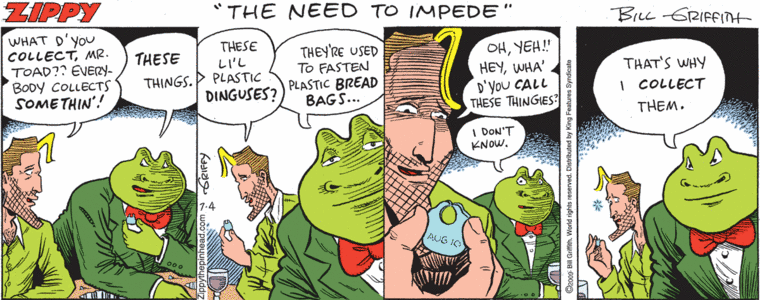
AZ, 7/4/05: That’s American:
http://itre.cis.upenn.edu/~myl/languagelog/archives/002291.html
increase in stranding as an aspect of “colloquialization”
AZ, 7/5/05: Avoidance:
http://itre.cis.upenn.edu/~myl/languagelog/archives/002292.html
including avoiding stranded P
AZ, 7/7/05: Get ’em while they’re young:
http://itre.cis.upenn.edu/~myl/languagelog/archives/002298.html
Ruth Heller on prepositions, for children
GP, 9/20/05: New Yorker search engine stark staring mad:
http://itre.cis.upenn.edu/~myl/languagelog/archives/002485.html
“I’m sorry I couldn’t find that for which you were looking.”
BZ, 11/27/05: Churchill vs. editorial nonsense:
http://itre.cis.upenn.edu/~myl/languagelog/archives/002670.html
AZ, 11/4/06: Grammar on the gay beat:
http://itre.cis.upenn.edu/~myl/languagelog/archives/003734.html
P stranding in Genre magazine
AZ, 11/23/06: Let’s meet at mine:
http://itre.cis.upenn.edu/~myl/languagelog/archives/003811.html
stranding vs. fronting
AZ, 3/3/07: Self-incorrection:
http://itre.cis.upenn.edu/~myl/languagelog/archives/004266.html
“fixing” stranded prepositions
ML, 5/1/07: Hot Dryden-on-Jonson action:
http://itre.cis.upenn.edu/~myl/languagelog/archives/004454.html
ML, 5/3/07: A note of dignity or austerity:
http://itre.cis.upenn.edu/~myl/languagelog/archives/004464.html
combination of stranded and fronted P
ML, 5/4/07: Back to the future, redundant preposition department:
http://itre.cis.upenn.edu/~myl/languagelog/archives/004465.html
combination of stranded and fronted P
ML, 5/14/07: A phenomenon in which I’m starting to believe in:
http://itre.cis.upenn.edu/~myl/languagelog/archives/004493.html
combination of stranded and fronted P
GP, 5/15/07: Could preposition doubling be headed our way?:
http://itre.cis.upenn.edu/~myl/languagelog/archives/004498.html
combination of stranded and fronted P
ML, 5/19/07: Re-doubled prepositions:
http://itre.cis.upenn.edu/~myl/languagelog/archives/004510.html
combination of stranded and fronted P
ML, 8/25/07: Prepositional anxiety and Voldemort’s wand:
http://itre.cis.upenn.edu/~myl/languagelog/archives/004854.html
incorrection of stranded P
AZ, 5/10/08: Contamination:
Dryden’s Rule contaminating stranded to
ML, 8/21/08: Heaping of catmummies considered harmful:
mostly about split infinitives, but with a bit on stranded P
GP, 4/25/09: Room for debate on Strunk and White:
GP response to Colin John re Burchfield’s entry on “preposition at end”
AZ, 5/6/09: Interesting sentences:
“not a good sentence with which to begin a story”
GP, 7/7/09: A “dumb copy editor” story from George Lakoff:
Metaphors We Live By
“Stuck in a Moment You Can’t Get Out Of”
GP, 4/25/09: Room for debate on Strunk and White:
GP response to Colin John re Burchfield’s entry on “preposition at end”
AZ, 5/6/09: Interesting sentences:
“not a good sentence with which to begin a story”
“Stuck in a Moment You Can’t Get Out Of”
GP, 7/7/09: A “dumb copy editor” story from George Lakoff:
Metaphors We Live By