… and, instead of taking the Zzyzx exit, catches a ride with a guy in a SYZYGY car to the end of the road, where one-point perspective takes you (so we are both out in the desert in San Bernardino County CA; and also in the artist’s meta-world, where perspective lines converge in a vanishing point, and that is truly the end of the road). All this in yesterday’s Zippy strip, which is rich in Z, Y, ZY / ZI, and ZYG. plus the occasional antic X:
(#1) Three things: Zzyzx Road; one-point perspective; and the word SYZYGY (the ZYG of which took my mind to the word ZYGOTE; while the concept of syzygy took me to A Midsummer Night’s Dream, which is a wedding-feast of syzygy — of counterparts, contrasts, conflicts, and oppositions)

And then there’s zig; from NOAD:
noun zig: a sharp change of direction in a zigzag course: he went round and round in zigs and zags.
(which can then be verbed to yield to zig ‘to take a zig’, as in my title)
Zzyzx Road. In my 1/26/24 posting “The road to Z”, there’s a section on Zzyzx Rd. and its history. With this photo (to compare to #1):
(#2) Interstate 15 exit sign for Zzyzx Road (Wikipedia photo)
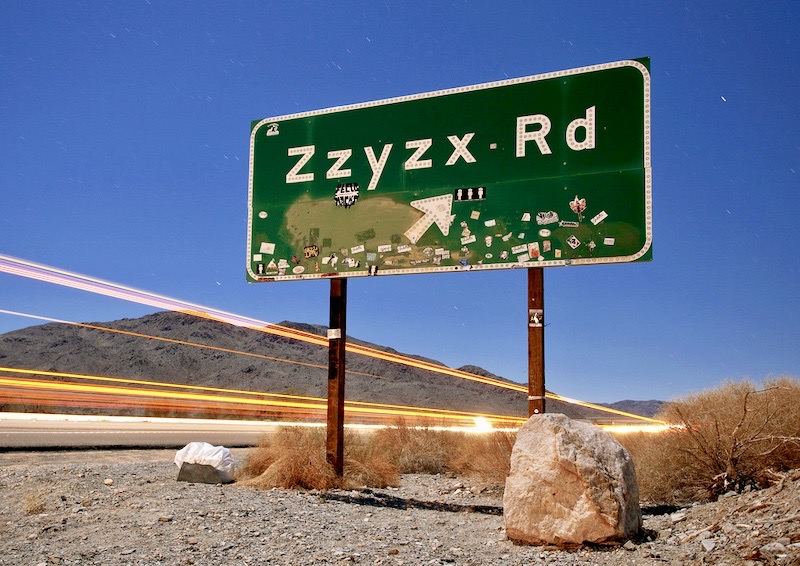
The founder of the settlement if Zzyzx (formerly Soda Springs) intended that the name should be “the last word in the English language”, but of course he was soon outdone by ZZZ businesses and the like.
One-point perspective. From Wikipedia:
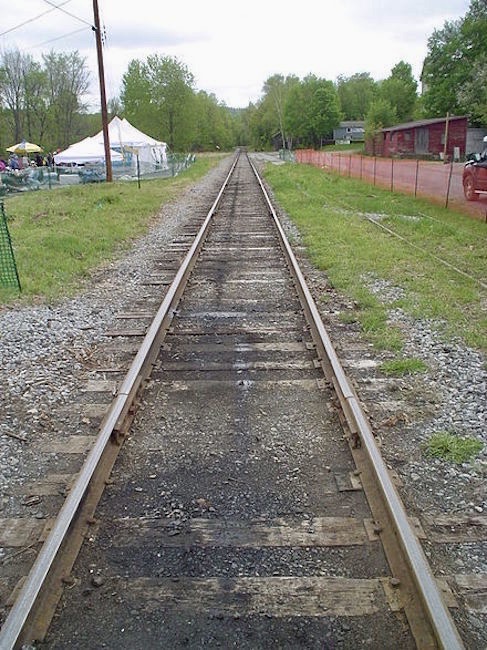
A vanishing point is a point on the image plane of a perspective rendering where the two-dimensional perspective projections of mutually parallel lines in three-dimensional space appear to converge. When the set of parallel lines is perpendicular to a picture plane, the construction is known as one-point perspective …
(#3) A photo demonstrating a vanishing point at the end of the railroad (Wikipedia photo)
SYZYGY. The license plate that puts some ZYG into the affair. From NOAD:
noun syzygy: [a] Astronomy a conjunction or opposition, especially of the moon with the sun: the planets were aligned in syzygy. [b] a pair of connected or corresponding things: animus and anima represent a supreme pair of opposites, the syzygy.
Two things here: the plays on sounds and letters — the /zɪz/ (spelled ZZYZ) in /zɪzɪks/ (ZZYZX) corresponding to the /zɪǰ/ (spelled ZYG) in /sɪzɪǰi/ (SYZYGY) — and sense b of the noun syzygy, the very useful concept of elements coming in pairs, as counterparts (parallels) or, especially, as connected (by similarity or some kind of relationship) but contrastive, especially in pairs of opposites.
The ZYG of SYZYGY. Focus on the spelling. Where else does the letter-sequence ZYG occur? A list of English words with word-initial ZYG (here pronounced /zajg/:
noun zygote: Biology a diploid cell resulting from the fusion of two haploid gametes; a fertilized ovum (NOAD)
— from this, Zygarde, a Pokemon character, its name a portmanteau of zygote + French garder ‘to protect’
the zygomatic bone of the cheek; together with the temporal bone, it makes the bony arch of the cheek (the zygoma)
adj. zygomorphic ‘(of a flower) bilaterally symmetric’
— from this, Zygocactus, a genus of houseplants closely related to, or possibly identical to, Schlumbergera (Christmas / Thanksgiving / crab cactuses), so-called because it’s a cactus with zygomorphic flowers
All of these words have etymologies in which the ZYG bit goes back to the ancient Greek ‘to yoke’ verb); the semantic developments are clearly intricate, but they all involve two things joined together (in a fertilized ovum, in the bony arch of the cheek) or two matching things (the two sides of a zygomorphic flower).
You’ve probably figured out what’s coming next: the ZYG bit of the word SYZYGY also goes back to the Greek for ‘yoke’. Look back at sense a of the noun syzygy, an astronomical term denoting “a conjunction or opposition (of heavenly bodies)”. Yes, a kind of yoking, or joining together.
OED2 has this astronomical usage from 1656 on; then it’s extended metaphorically as a technical term in anatomy, in biological structure, in prosody, and in mathematics; and then (by 1853) generalized conceptually to any connected or correlative things, especially pairs of opposites. In any case, it’s a useful very high-level abstract concept: as I said above, taking in counterparts, contrasts, conflicts, and oppositions.
The wedding-feast of syzygies. For reasons having nothing to do with the Zippy strip in #1, I’ve been re-watching the 1935 Max Reinhardt Hollywood movie of A Midsummer Night’s Dream — it was the last of my video therapy treatments during the last days before the election, when I escaped from all things electoral and from bad days on the medical front with: first, the six seasons of the tv drama Major Crimes; then, the tv drama (two seasons) and film sequel of Looking, about gay men in San Francisco; and, finally, the 1935 Hollywood MND (which I’ve just re-watched twice, for a variety of purposes, and am following it with other film versions of the play (next up was one that managed to have Diana Rigg, Helen Mirren, and Judi Dench in it; tomorrow has Kevin Kline on the program). But for my purposes here, what’s important is the organization of the play, which famously has a play-within-the-play in it (a comic performance of the tragedy of Pyramus and Thisbe), but is also organized with multiple interlocking counterparts, contrasts, conflicts, and oppositions.
At the very top level, the play is about the wedding of Theseus, Duke of Athens, and Hippolyta, Queen of the Amazons (one contrasting couple, but also an opposition between the civil society of Greece and the mythic world of the Amazons); this couple has their counterpart in the King and Queen of the fairies, Oberon and Titania (these fairies are magical beings of great — on occasion, awesome and terrifying — power), and on two couples seeking (against family resistance) to be wed themselves, Hermia and Lysander; and Helena and Demetrius. Meanwhile, the city world of Athens is contrasted with the rustic wild world of the surrounding countryside and its forests, which is the homeland of the fairies and also of the rustic craftsmen who perform as actors in the tragedy of Pyramus and Thisbe. (Since, like The Marriage of Figaro, MND is about the lead-up to a wedding, it’s also a lot about sex, since in the culture of the play’s time, marriage provided sexual access for a man to his wife, with successful breeding expected in short course. That’s why Mozart and Da Ponte’s Figaro begins with the barber measuring the bed that he and Susanna will use for fucking on their first night. And why MND is just packed with only slightly veiled dirty talk: Jack shall have Jill, / Naught shall go ill, / The man shall have his mare [meaning his brood mare, for fucking, so that she will bear him children] again, / And all shall be well (Robin Goodfellow — that is, the mischievous fairy Puck — closing Act 3, Scene 2).
And then through magical mischief in their dreams in the enchanted wood, the couples wake up to fall in love / lust with the first person they they see, so the couplings are deranged, and Lysander and Demetrius now become rivals, in conflict with one another; and similarly for Hermia and Helena, who go on to engage in a slanging match.
Oh yes, the weaver Bottom, from the company of rustic performers (he plays Pyramus, with comic ineptitude), is transformed into an ass (a donkey) and becomes an object of desire too. Well, there’s a lot more, and it is indeed wonderful, but my main point for this posting is now amply made: the play is a gigantic system of interlocking syzygies.
I imagine that Shakespeare would have enjoyed playing with the word syzygy, wrapping it up with words like sizzle and dizzy and whatever else was available to him at the end of the 16th century. But even the astronomical syzygy wasn’t in use yet, not to mention the generalized term, and some really juicy items, like jism and jizz, were still centuries in the future.
November 10, 2024 at 7:29 am |
I can’t resist doing a little name-dropping here: During the summer of 1968, I was on the stage crew of a production of A Midsummer Night’s Dream at the Agassiz Summer Theater on the Harvard campus. Among the cast were a couple of regulars in the Harvard theater world who have since become somewhat more widely known: Theseus was played by Tommy Lee Jones, and Puck by Stockard Channing (then using the name Susan Channing).