An example on the hoof, complete with the libelous myth of gay recruitment:
“These homos are interested in recruiting new members,” Rev. Benjamin Bubar, leader of the fundamentalist Christian Civic League of Maine, told the Bangor Daily News. (“Remembering the Maine Gay Symposium”, link here)
with homo, an abbreviation of the medical-technical term homosexual, the short form derogating gay men — along with such terms as fairy, pansy, fruit, BrE poof(ter), and before some of us homos engaged in reclaiming it, fag(got). I’m comfortable, even proud and defiant, with faggot, but because fairy-boy was the primary verbal abuse directed (inexplicably) at me in childhood, along with (equally inexplicable) accusations that I wanted to be a girl, I’ll never get on good terms with fairy.
Your mileage probably varies. Most people recognize fairy — and homo — as usually intended to be insulting, but open for ironic and playful uses, even full reclamation, as in the Radical Faery movement (for queer liberation, community, and ecological awareness). So, on the homo front, we get a queer-studies colleague of mine, parting from a lunch together with the announcement that he had to get his homo ass back to work. How queer is that?
More to come in this vein.
Background. The OED entry (revised 2018) for homo adj. and noun:
colloquial (often derogatory).
A. ADJECTIVE
Of, relating to, or characteristic of homosexual people (esp. men); characterized by homosexuality; (of a person) homosexual, gay. [1st cite 1923: A certain newspaper critic widely known for his decided ‘homo’ tendencies.]B. NOUN
A homosexual man; (sometimes in weakened sense) a man characterized as weak, affected, or timid, or as otherwise behaving in a way considered inappropriate for a (heterosexual) man. Also occasionally: a homosexual woman, a lesbian. [1st cite 1923: Some ‘homos’ claim that every boy is a potential homosexual.]
(The quotation marks in the 1923 cites are an indication that these usages of homo(s) were perceived by the writers as recent.)
The two homo-s. The formative element homo– has two sources in modern English:
— Latin-derived homo– ‘human being’: the Latin noun with this meaning, NomSg homō, GenSg hominis
from this we get the genus name Homo, of great apes — various hominids, including our species, Homo sapiens
— Greek-derived homo-, the stem of homos ‘same’
from this we get the adj. and noun homosexual ‘of the same sex’ abbreviated as homo ‘gay man’ (see above)
and the adj. homogenized, abbreviated as homo in homo milk; from NOAD:
adj. homogenized: 1 (of milk) subjected to a process in which the fat droplets are emulsified and the cream does not separate: homogenized milk. 2 made uniform or similar: a homogenized society.
Messing with homo ‘gay man’. Celebratory, ironic, and playful uses of the noun, taking the derogatory edge off. As with my colleague and his homo ass. First, two celebratory t-shirts (among many that are available):
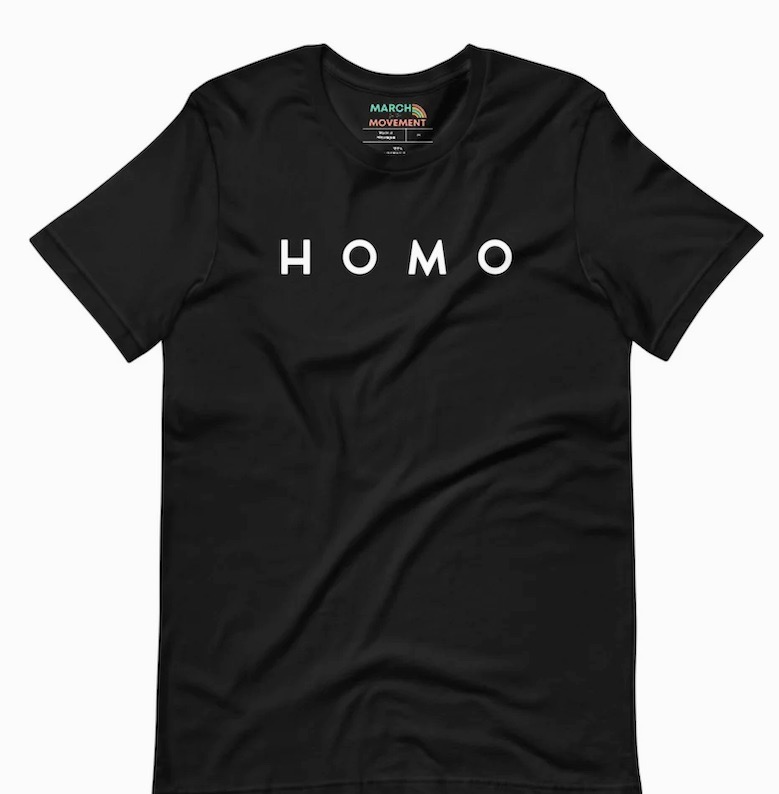
— just plain HOMO. From any sources. This one, in basic black, is from the March for the Movement site:
(#1)
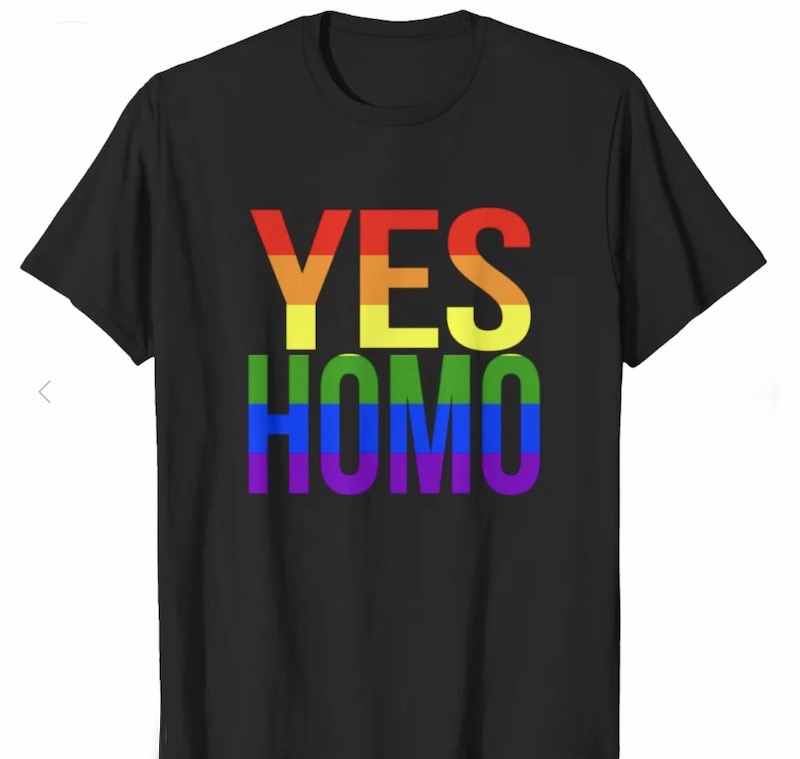
— YES HOMO. A celebratory Yes Homo tee — a riposte to no homo — from the Printerval site:
(#2)
From Wikipedia:
“No homo” is a slang phrase used at the end of a sentence to assert the statement or action by the speaker had no intentional homosexual implications, to “rid [oneself] of a possible homosexual double-entendre”. [It] arose in hip-hop lyrics of the 1990s as a discourse interjection to … deflect any attacks on the artist’s masculinity or heterosexual status.
Two punning t-shirts:
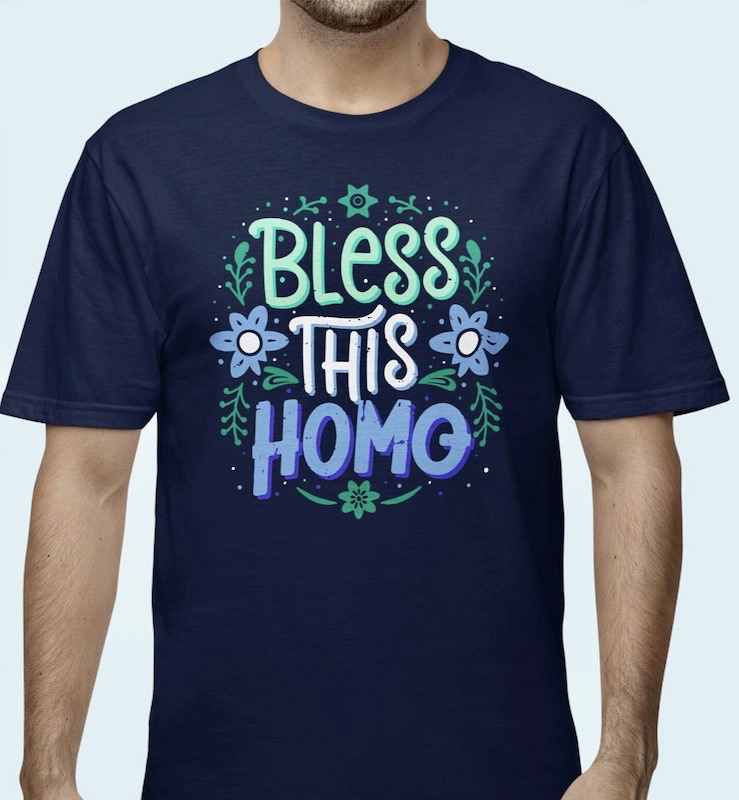
— Bless This Homo. T-shirt by PrideRelics on Etsy. A play on the sign Bless This Home, classically done in cross-stitch:
(#3)
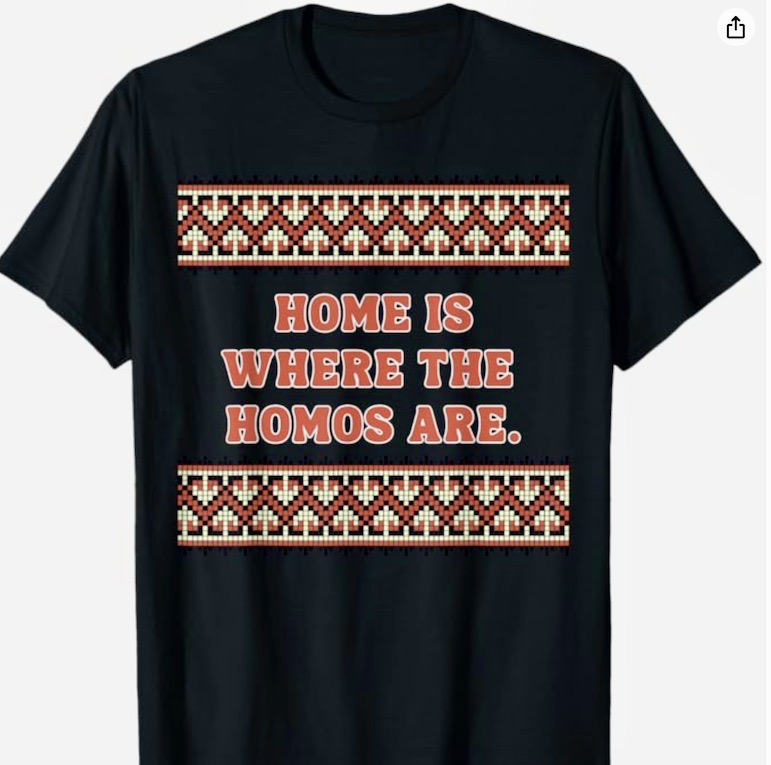
— Home is Where the Homos Are. T-shirt playing with home and homo. Sold on Amazon, here it’s merely listed as “imported”:
(#4)
— Next, a “Historical Homos” podcast (hosted by Bash and Donal Brophy), a look at how “history is gay AF”. Another pun on homes and homos.
— And, finally, a raunchy Lisa Lampanelli comedy routine “Homos Are My Favorite People”, which you can listen to here.
March 19, 2026 at 12:41 pm |
Greek adjective homo- ‘like’ and Latin homo ‘human being’ are etymologically unrelated. In Latin homo ‘human being’ and vir ‘male human being’ are clearly distinguished, like Greek anēr, andr- and anthrōpos and German der Mann and der Mensch.
March 19, 2026 at 1:03 pm |
All true, though I thought it was clear that I was saying that the Latin and Greek stems were etymologically unrelated.
March 20, 2026 at 6:32 am |
While poof(ter) may now be standard BrE, I have some evidence that it was imported from Australia: In one of the later James Bond novels of Ian Fleming (I think it was You Only Live Twice), Bond responds to a tirade from an Australian colleague in which the latter calls him “a pommy poofter” by asking mildly, “What’s a poofter?” This would have been mid-to-late 1960s, I believe; it would appear that by the time of Monty Python (mid-70s?) it had become established in the UK.