(all the way at the end, we get to some sexual street talk, which I think has exactly the right shock value for its context; but if s*cking c*ck offends you, skip the next-to-last sentence)
It starts with Steven Levine — a sparkling vehicle of joy, enthusiasm, and congeniality — roused to anger and protest, as I reported in the 8/3 posting “Two notes on gay moral purpose”:
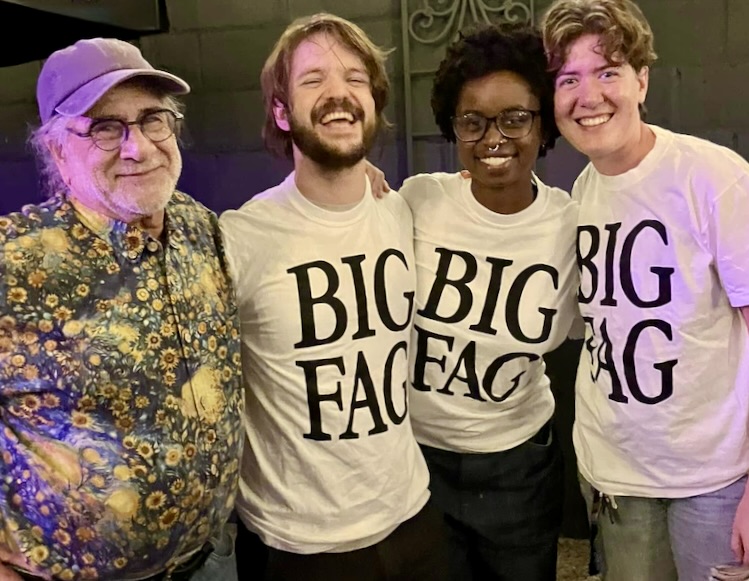
SL breaks out in a combination of, on the one hand, genuine pride in occasions of humane concern and (to put it grandly) moral purpose in the gay world and, on the other, righteous anger at a long-standing tradition in psychology, sociology, and medicine of blanketly treating homosexuality as dysfunction and disease. With, as sideshow, celebration of the raw sexuality in homosexuality — recognizing the physical and emotional pleasures of the associated sexual practices — in the wonderful BIG FAG t-shirts created by Steven (which he’d been distributing with abandon at Amsterdam Pride).
A typical Steven BIG FAG scene:
(#1) All these people came to Steven in the summer, and he gave them a fabulous t-shirt (my apologies to F. Scott Fitzgerald)
An art project and community building experiment. A Facebook reader asks Steven:
— Have you considered putting them up on a print to order t-shirt shop?
To which Steven replies with great earnestness:
— Nope, for complicated reasons. That would be inconsistent with what I’m doing here. This is an art project and a community building experiment. At this point I only give them out at the 19 bar. It’s not a business.
The 19 Bar in Minneapolis MN. Now we’re into the bar. From Wikipedia:
The 19 Bar is a gay bar located at 19 W 15th Street in the Loring Park neighborhood of Minneapolis, Minnesota. Founded in 1952, it is the oldest gay bar in Minneapolis and among the oldest in the United States. The establishment is … a cash-only dive bar that offers a classic jukebox, pool tables and dart boards.
There are gay bars, and then there are gay bars. Veering still further away from our starting point: gay bars cater to the needs of fags, but we have all kinds of needs, so gay bars vary hugely in their purposes and social structures. The Minneapolis 19 Bar is primarily a gay bar of affiliation and companionability, roughly similar to neighborhood bars (and local pubs in the UK). But then we have cruise / trick bars, for linking up. And bars that are portals to backrooms devoted to sexual connections on the premises. And more.
Moral purpose. We veer further now with this depiction of Steven:
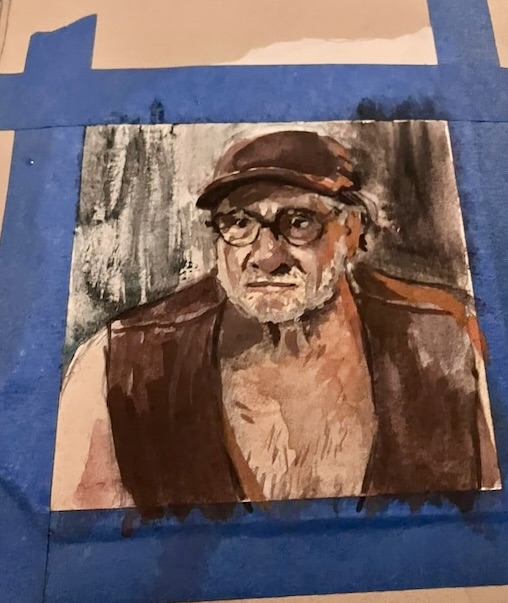
(#2) [SL:] My artist friend Aly Cattlett caught an aspect of me that most don’t see
To which I exclaimed:
— Wow. What everybody sees right away is your astounding gusto in many things; you light up the places where you are. What they will probably not appreciate is that behind that, you are dead serious about what you are doing, that you are pursuing a moral passion, doing what you can to repair the world.
This is where the t-shirts were going. From small gestures, momentous consequences.
No, I am not done yet. Instead, I’ll shift away from my long-time friend Steven, who has brought many good things into my life (among them, singing the Sacred Harp music I’m so devoted to, singing it full power, bringing out its wildness), and move to a very different gay man, in whom sparkling frivolity and sexual abandon turned out to come along with a powerful sense of moral purpose: the poet-plus Frank O’Hara.
From my 6/18/19 posting “Portraits of Frank O’Hara”, about critic Peter Scheldahl’s appreciation of the poet:
O’Hara’s life was measured out in a sort of endless homage to his heroes — the great exemplars of personal and artistic integrity like Pollock, Franz Kline, and especially Boris Pasternak; the revolutionaries of poetic attitude and style like Apollinaire and Mayakovsky, and the forms of emotional identification, the movie stars like James Dean, Carole Lombard, and so many others, whom he celebrated brilliantly without embarrassment and with only the slightest, functional trace of irony.
Nobody expects Pasternak, especially from a poet famous for extolling, in free verse, the restorative power of sucking the cocks of legions of anonymous strangers on a hot summer day (“Une Journée de Juillet”). But his strong sense of moral purpose shines through almost everything in his life.
Leave a Reply