👴 👴 👴 three old men for antepenultimate December (3 days left), also the 5th of the 12 days of Christmas (five golden rings!) and the 5th of the 8 days of Hanukkah (so there’s still plenty of oil)
These have been difficult days — the latest rainstorm came in on a wave of low air pressure, felling me with joint pain and stopping up my ears so that I can barely hear (and I probably won’t be able to get help until sometime in the new year) — so I’m going to just randomly take stuff to post about and run with it, helter skelter.
First up: three seasonal presents from Ann Burlingham, in Pittsburgh, delivered to me yesterday by my grandchild Opal Armstrong Zwicky, who’s in town on break before their last semester at the University of Pittsburgh. In size, from the smallest to the largest:
— (because the woolly mammoth is the totem animal of mine I identify most strongly with — even more than penguins, dragons, and anteaters — and because these are troubling times) a woolly mammoth worry doll, made in Guatemala, only about 2″ long, from the Field Museum in Chicago; the museum store’s tag says:
According to Mayan legend, “If you tell your problems to a Worry Doll, it will take your suffering away and bring you blessings and good wishes in exchange.”
From Wikipedia:
Worry dolls (also named trouble dolls; Spanish Muñecas quitapenas) are small, mostly hand-made dolls that originate from the highland indigenous people of Guatemala.
… In traditional and modern times, worry dolls are given or lent to brooding, anxious, or sorrowful children. They would tell their doll about their sorrows, fears and worries, then hide the doll under their pillow before going to sleep at night. It is said that the child relinquishes their worries to the dolls during the night and by the next morning, all sorrows are said to have been taken away by the worry doll and they can move forward refreshed the next day.
The dolls are small (between .5 and 2″) and human in form; the woolly mammoth doll seems to have been made specifically for the Field Museum, with its woolly mammoth exhibits.
— a 4.8 fl oz container of Trader Joe’s lemongrass coconut body oil (with almond and jojoba oils), from Sri Lanka.
(#1) Lemongrass is the name of several grass species in the Cymbopogon genus, which I used to grow in pots as a lemon flavoring in various Asian cuisines

Definitely useful. I need to oil various parts of my body every day, to help control my dry, flaking skin (some form of psoriasis; I shed skin flakes everywhere). This makes me smell like a coconut dessert, which some people find startling. The Trader Joe’s oil instead smells delicately of lemon.
— a TeeFury LONG, LONG TIME t-shirt, playing on unrequited love in a Linda Ronstadt song (the shirt’s text) and between two characters in the comic strip Peanuts (the shirt’s imagery), all translated into the unfulfilled desire of one bearded man for another:
(#2) Lucius Van Pelt, male and adult, coveting the adult pianist Schroeder, whose devotion to Beethoven endures, still on those little tiny keys; it’s nice touch that the two men are wearing such similar clothes, with the covetee blue on the bottom and the coveter blue on the top

Now, the three ingredients:
the concept of thwarted desire, of unreturned coveting, expressed in the adjective unrequited:
(of a feeling, especially love) not returned or rewarded: he’s been pining with unrequited love. (NOAD)
the song “Long Long Time”. From Wikipedia:
“Long Long Time” is a song written by Gary White which became a hit for Linda Ronstadt in 1970. “Long Long Time” is about a lasting love for someone who never became a lover.
The chorus:
‘Cause I’ve done everything I know
To try and make you mine
And I think I’m gonna love you
For a long, long time
(hence the comma in #2)
and Lucy and Schroeder in Peanuts. From Wikipedia:
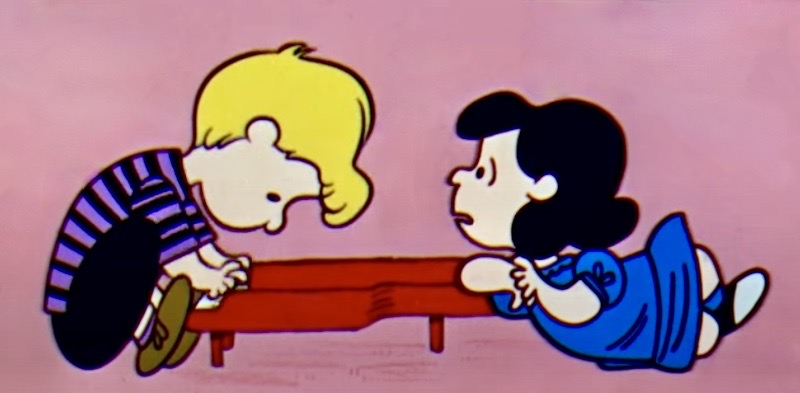
Schroeder is a fictional character in the long-running comic strip Peanuts, created by Charles M. Schulz. He is distinguished by his prodigious skill at playing the toy piano, as well as by his love of classical music in general and the composer Ludwig van Beethoven in particular …. He is also the object of the unrequited infatuation of Lucy Van Pelt, who constantly leans on Schroeder’s piano. Charlie Brown, Frieda, Peppermint Patty, and Snoopy are occasionally depicted leaning on Schroeder’s piano.
But Lucy is the great piano-leaner, as here:
(#3) From the animated movie A Boy Named Charlie Brown (1969): Lucy yearns for Schroeder
And why wouldn’t she? He’s smart, talented, cute, and a famously good friend.
Leave a Reply