Complex ambiguities in the 9/25 comics: a Piccolo / Price Rhymes With Orange turning on the ambiguity of sham; and a Wayno / Piraro Bizarro turning on the ambiguity of tom:
(#1) sham conveying fraud, hence illegality; vs. sham for a decorative pillow cover (being manufactured in a small workshop, though note the suggestion in the title panel that the place might be a cover — ambiguity alert! — in the sense ‘an activity or organization used as a means of concealing an illegal or secret activity’ (NOAD) — but why are these pillow coverings called shams?
(#2) Personified, talking animals: two toms, a tomcat and a tom turkey, presented as characters named Tom, who work for the same company and are encountering one another over coffee, hence Wayno’s title “Breakroom Encounter” (if you’re puzzled by the odd symbols in the cartoon — Dan Piraro says there are 5 in this strip — see this Page)
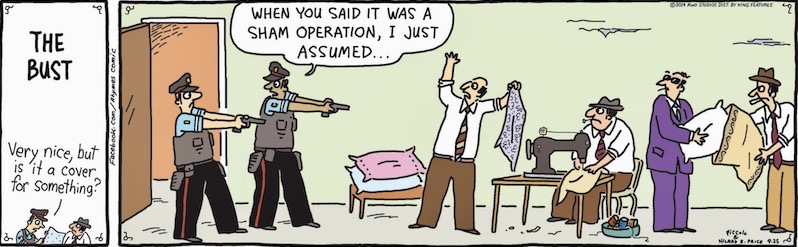
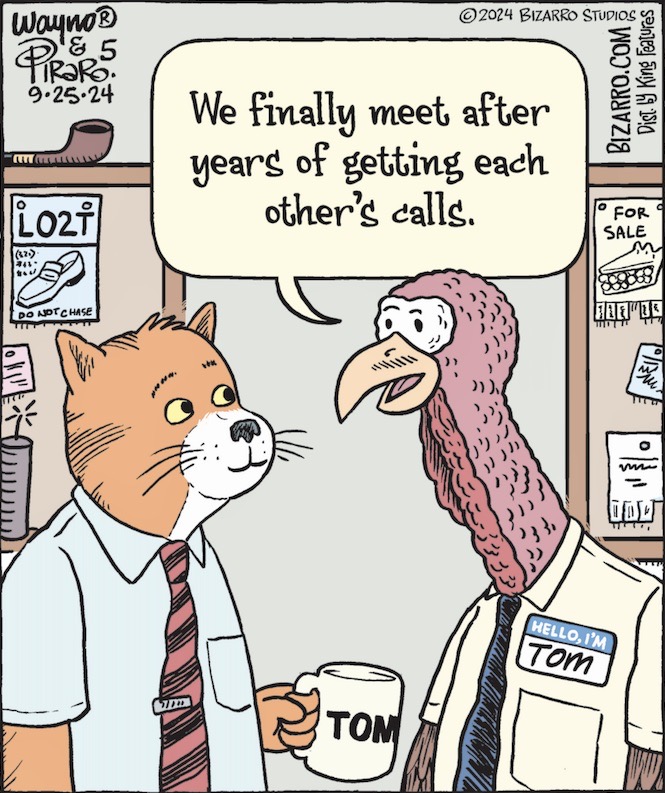
Now into the details.
sham vs. sham. NOAD‘s entries:
noun sham: 1 [a] a thing that is not what it is purported to be: the proposed legislation is a farce and a sham. [b] pretense: it all turned out to be sham and hypocrisy. [c] a person who pretends to be someone or something they are not: he was a sham, totally unqualified for his job as a senior doctor. 2 North American short for pillow sham. adj. sham: bogus; false: a clergyman who arranged a sham marriage.
noun pillow sham: North American a decorative pillowcase for covering a pillow when it is not in use.
It won’t be obvious to most people why the fraud / pretense sense and the pillow-cover sense come in the same entry. In most dictionaries, NOAD included, that signals a common etymology. So it presupposes that the sham of pillow sham is in fact historically fraud / pretense sham; the compound could then be glossed as something like ‘a sham / imitation of a pillow’. But shams aren’t imitations of pillows, they’re imitations of pillowcases. And I don’t believe that English has any other compounds of the form X sham meaning ‘a sham / imitation of an X’ (sofa sham ‘imitation of a sofa, faux sofa, book sham ‘imitation of a book. faux book’), and such coinings don’t strike me as at all plausible.
All this makes the (very well-attested) commercial term pillow sham look not like the source of an abbreviated pillow-cover sham, but like an informative expansion of pillow-cover sham, conveying something like ‘an imitation — merely decorative — cover for a pillow’, so allowing that there might be other English compounds of the form X sham meaning ‘a sham / imitation of a cover for an X’ (sofa sham ‘imitation of a sofa cover’, book sham ‘imitation of a book cover’). Here I don’t have attestations, but the coinings strike me as plausible ones.
But if pillow sham isn’t the source of pillow-cover sham, what might be?
Well, a sham is so-called because it’s not a pillowcase, for putting your head on in sleep; though it looks like a functional pillowcase, it’s merely decorative, meant to show off a pillow when the pillows’s not being used — it’s a sham pillowcase, an expression that can then be beheaded to yield the noun sham. The way prior convictions can be beheaded to yield the noun priors. (There’s a Page on this blog on beheading and my postings about it, with tons of examples.)
tom vs. tom. Here NOAD tells us:
noun tom: 1 the male of various animals, especially a turkey or domestic cat. …
This is just wrong; not various animals, but only two; there are a number of specialized names for male animals — ram, cob, bull. cock, stallion, buck, boar, jack, gander, billy — but tom is used only for turkeys and domestic cats (which have nothing in common beyond being animals), so should be treated as two separate (sub)entries, the way NOAD does for cock, giving separate subentries for (in BrE) ‘a male bird. especially a rooster’ and ‘a male lobster, crab, or salmon’. That is, tom is ambiguous.
A side note. NOAD has an entry for the compound noun tomcat ‘a male domestic cat’, but has none for the compound noun tom (vs. hen) turkey; in fact, as far as I can see, no conventional dictionary has an entry for tom turkey ‘male turkey, gobbler’. The compound tomcat gets a separate entry presumably because it’s spelled solid, rather than separated. But also because it’s semantically specialized, to domestic cats, excluding male wild animals of the cat family (while tom turkey applies equally to male farm turkeys and male wild turkeys; its meaning is entirely compositional).
September 26, 2024 at 9:58 pm |
It seems like “call” is also ambiguous. A turkey call refers to either the different vocalizations of the turkey or devices designed and used to imitate these sounds, while a catcall is a shrill whistle or shout of disapproval. Although it is fair to say that turkeys rarely get catcalls, and vice versa.