Today’s Dan Piraro Bizarro, in three panels: an odd title panel that seems to be mostly about phallicity in the mythic Old West, and two Toto / Tonto confusion panels: the Lone Ranger and Toto (with a glancing allusion to Little Orphan Annie); and Dorothy and Tonto — to which I’ve added a Gershwin song in my title for this posting — to make a rich stew of American pop culture, covering the comics, jokes, movies, radio, tv, and popular music:
(#1) It’s a Sunday panel, so it’s by DP, not Wayno, and it’s a horizontal strip rather than a vertical one-panel gag (if you’re puzzled by the odd symbols in the cartoon — Dan Piraro says there are 7 in this strip — see this Page)
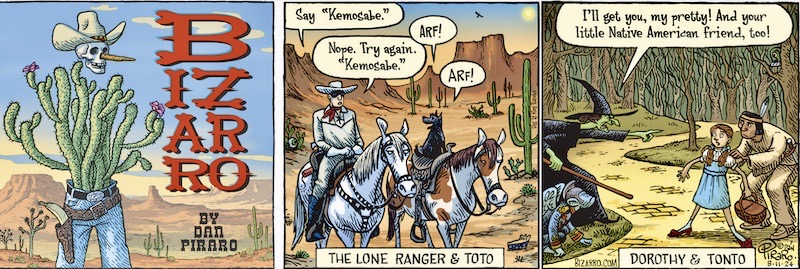
I’ll look at things panel by panel, then comment on my title for this posting — but first I’ll point out that
— the second panel, set in the desert of the mythic Old West, is from the Lone Ranger world, but with the dog Toto (intruding from the Wizard of Oz world) in place of the faithful Indian companion Tonto (Toto in effect punning on Tonto)
— while the third panel, with Dorothy confronting the Wicked Witch of the West (accompanied by one of her evil flying monkeys) on the Yellow Brick Road to the Emerald City of Oz, is from the Wizard of Oz world, but with Tonto (intruding from the Lone Ranger world) in place of Toto (Tonto in effect punning on Toto)
Here I’m carrying over my analysis, in yesterday’s posting “Harry’s scaffolding”, of one type of absurdist cartoon as involving an anchor world and an intrusive world; the second panel of #1 stands on its own as one such absurdist cartoon, and the third is another. The special delight of these panels is that the two absurdist cartoons are converses, conceptual mirror images of one another.
Panel 1, the Bizarro title panel, with phallic ornamentation. In the desert of the mythic Old West, with a grotesque skeleton gunslinger as its central character. Dead-white ten-gallon cowboy hat, jeans with a cowboy belt, plus a gun belt with a holster. And then a little festival of phallicity, with three flagrant phallic symbols: a carrot nose (as on a snowman; noses are somewhat phallic on their own, but carrots are really phallic), a saguaro cactus body (saguaros are little men in several senses), plus, in the holster, not the expected naturally phallic gun, but — preposterous surprise! — an equally phallic banana, an allusion to a mildly dirty joke (in the first panel, the variant: “Is that a banana in your holster, or are you just happy to see me?”).
The joke takes either of two forms:
Are you happy to see me, or is that (just) a banana in your pocket?
Is that a banana in your pocket, or are you (just) happy to see me?
conveying, roughly, ‘you are visibly aroused, I can see your hard-on in your pants’ (or as some anti-nudity laws have it, you are discernibly turgid).
Panel 2, in the Lone Ranger anchor world. The Lone Ranger is the central character, with Tonto as his sidekick; they appeared together in the comics, and then in the movies and on radio and tv. For some discussion of LR + Tonto, see my 9/13/21 posting “Stick to your own kind”, in which they get a whole section.
As for kemosabe in this panel, from Wikipedia:
ke-mo sah-bee (often spelled kemo sabe, kemosabe or kimosabe) is the term used by the fictional Native American sidekick Tonto as the “Native American” name for the Lone Ranger in the American Lone Ranger radio program and television show.
In this panel, we see the LR is trying hard to get Toto to call him kemosabe, but Toto is, alas, a dog, and the best the poor creature can do is bark. For some reason, Dan Piraro has Toto barking with the Arf! Arf! of Little Orphan Annie’s dog Sandy, not with the usual imitative Woof! Woof! (I’m seeing a crowd of cartoon characters, not just Sandy, clamoring for parts in this Bizarro strip. “Equal time for Nancy and Sluggo!” and all that.)
Panel 3, in the Wizard of Oz anchor world. Dorothy is the central character, Toto her (first) sidekick. Dorothy + Toto from L. Frank Baum’s 1900 children’s novel The Wonderful Wizard of Oz but in American pop culture, primarily from the 1939 movie The Wizard of Oz, which is the world we see in the third panel of #1; in that world, the Wicked Witch of the West threatens Dorothy and Toto: “I’ll get you, my pretty, and your little dog too!”
In this panel, it’s Tonto cowering behind Dorothy, not Toto; Tonto’s considerably wilier than the little dog, but it’s Dorothy’s pluck and resolve that leads her to throw a bucket of water on the nasty green sorceress, causing her to melt away in agonized shrieks.
My title. Toto, Tonto, let’s call the whole thing off — a musical allusion, with a linguistic theme. From Wikipedia:
“Let’s Call the Whole Thing Off” is a song written by George Gershwin and Ira Gershwin for the 1937 film Shall We Dance, where it was introduced by Fred Astaire and Ginger Rogers as part of a celebrated dance duet on roller skates.
A song that begins:
Things have come to a pretty pass
Our romance is growing flat
For you like this and the other
While I go for this and that… You say [íðǝr], I say [ájðǝr]
You say [níðǝr] and I say [nájðǝr]
[íðǝr], [ájðǝr], [níðǝr], [nájðǝr]Let’s call the whole thing off
(#2)
and on with other region-, class-, and ethnicity-based pronunciations (for tomato, pajamas, vanilla, oysters, etc.)
You don’t get sociophonetics in popular music every day. It’s not often that I have to resort to the IPA in quoting lyrics, as in #2 — the lyrics sites give you stuff like You say either, I say either, which is baffling if you don’t already know the song — but there it is.
August 12, 2024 at 6:57 am |
I’ve always been under the impression that the joke about the phallic object in the pocket was attributed to Mae West, and that the object in question was a pickle (“Is that a pickle in your pocket, or are you just glad to see me?”). I had supposed that the line actually occurred in one her movies, unlikely though that seems.
My husband and I both struggled for several minutes trying (unsuccessfully) to find the 7th symbol in this cartoon. The Boston Globe doesn’t include the introductory panel, but as far as I can tell there’s no symbol there.
August 12, 2024 at 9:03 am |
As for the symbols: I merely report what DP says and don’t try to validate the count.
But Mae West and the pickle. That appears to be folklore rather than fact. I will now quote from my 2/4/13 posting “Annals of phallicity: or are you just happy to see me?” —
https://arnoldzwicky.org/2013/02/04/annals-of-phallicity-or-are-you-just-happy-to-see-me/
August 13, 2024 at 4:32 pm |
Four symbols in Panel 2, left to right: eyeball in cactus, dynamite under saddle, crown in harness straps, pie on the ground. Three symbols in panel 3 (all of them more distinct in the version on comicskingdom), K2 in the tree bark behind the witch, O2 in the monkey’s wing, UFO in the tree above tonto’s feather.
August 13, 2024 at 4:40 pm
Ah, one more Golden Palm for Helpfulness!
August 14, 2024 at 6:15 am
The K2 was the one I couldn’t find; I saw it, but I was looking at it in the wrong orientation and couldn’t really see the K, so I decided that the thing that looked like a 2 was misdirection. Thanks.