The first of two postings about message-bearing t-shirts. This one is a riff on a tee that I posted about in 2022; its message is the playful 100% Certified Queer, and the label QUEER in it turns out to be a many-layered thing.
The posting to come later focuses on four tees recently acquired or on their way to me soon: three with labels on them — GAY, FAIRY, PANSY — and one with gorgeous pansy flowers, the label being merely implicit.
From my 5/7/22 posting “Flagging your identity”:
I … have, among my various identities, one that I think that I do need to flag, for my own well-being, for the good of some of my worlds, and for the enlightenment of the outsiders: my identity as a gay man, in the larger MMS [male-male sexuality] world (I’ve been working on the flagging for about 50 years; when I started this posting [on 5/6/22] I was going about Palo Alto in rainbow pride gym shorts and one of my flagrant t-shirts — this 100% Certified Queer item:
Too “political” for some contexts?The point is that if I don’t keep announcing it, people rarely take me for gay. So I wear symbols and slogans. A matter of pride for me, and an announcement that we are everywhere, we’re not going away, and though we might seem outrageous, we’re not actually threatening — intended to be a public good, for guys in the MMS world, for people in the larger LGBT+ world, and especially for the outlanders. I realized a long time ago that I was in a position to do this without losing my job or my networks of friends, and in my moral world that meant I should do it. (I don’t expect other people to live by the moral standards I try to hold myself to, by the way.)
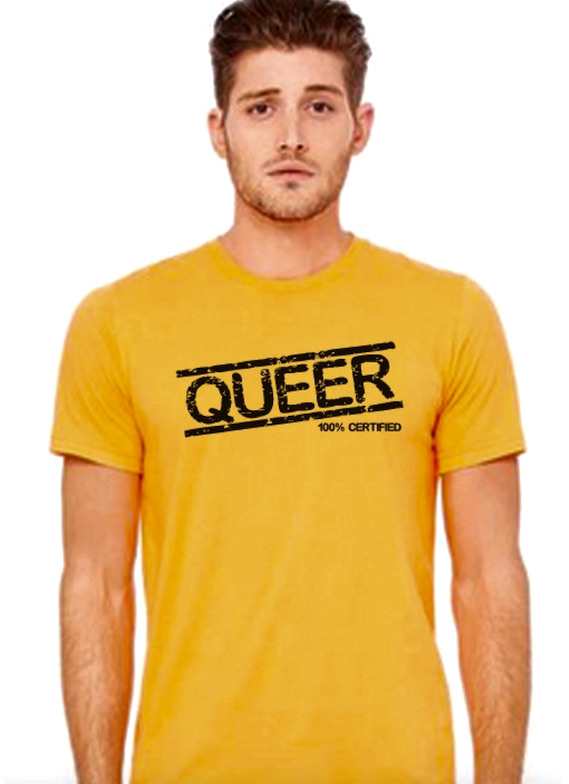
Now: QUEER serves as a neutral label for, roughly, homosexuality, in many contexts (queer studies programs are available at many universities, Stanford among them — see note below), so it would be hard to object to the term as vulgar or offensive in itself. Or as something you would want to conceal about yourself.
But … the label could be see as assaultive, as an aggressive display of “political” (rather than personal) commitments — which would be out of place, in fact offensive, in, say, the dining room and reception areas at the Avant, where I live now. Yes, it’s an issue of immediate, sharply pointed concern to me.
My response is a counter-idea that I suppose is alien to the other residents here, so there would be no point in bringing it up for them: the personal is political.
From Wikipedia:
In the [second wave] feminist movement of the 1960s and 1970s, [the idea] was seen as a challenge to the patriarchy, nuclear family and family values. The phrase was popularized by the publication of feminist activist Carol Hanisch’s 1969 essay, “The Personal Is Political.”
Hey, what works for women works for queer guys like me too. But I don’t think we’ll be changing many hearts and minds. So it’s back to standing up and standing out, every day, in ways small and large, carrying on work that will continue long after we’re gone.
Note: queer studies. From Stanford’s website on Feminist, Gender, and Sexuality Studies, with crucial bit underlined:
Consider questions and issues in feminism, gender, and sexuality through the intersection of race, class, gender, ethnicity, and disability to consider interlocking oppression.
What You’ll Study: The Program in Feminist, Gender, and Sexuality Studies offers an undergraduate major and minor, and an interdisciplinary honors program that is open to students in all majors. The Program encourages work in the arts and supports creative honors theses. Each Feminist, Gender, and Sexuality Studies student builds an individual program of study around a self-defined thematic focus, integrating courses from multiple departments; Feminist, Gender, and Sexuality Studies majors may declare one of four official sub-plans: LGBT/Queer Studies, Arts & Culture, Health, and Global Studies.
Students completing our major will consider questions and issues in feminism, gender, and sexuality through a lens of intersectionality of race, class, gender, ethnicity, and disability to consider interlocking oppression. Courses ask students to consider how gendered constructions of knowledge and social institutions are challenged through social and political activism.
Roughly similar programs are available at many other universities.
Leave a Reply