Spurred by Max Vasilatos’s show-n-tell at the most recent (5/3) soc.motss get-together on Zoom, some material on the S&M graphic artist REX, assembled from material in his Wikipedia entry; the summary paragraph:
REX (1943 – March 2024) was an American visual artist and illustrator closely associated with gay fetish art of 1970s and 1980s New York and San Francisco. He avoided photographs and did not discuss his personal life. His drawings influenced gay culture through graphics made for nightclubs including the Mineshaft and his influence on artists such as Robert Mapplethorpe. Much censored, he remained a shadowy figure, saying that his drawings “defined who I became” and that there are “no other ‘truths’ out there”. REX died in Amsterdam in late March 2024.
The entry continues:
Abandoned at birth, his real name and exact birthday are unknown [AZ: well, not public knowledge]
… While still in his teens he became the protégé of a fashion designer, who paid for two years of study at the School of Visual Arts in Manhattan. He later worked there in fashion illustration and commercial art, a career that brought him to London and Paris in the late 1960s, while maintaining an apartment on Saint Mark’s Place in Manhattan’s East Village. In Paris and London, “his fondest memories … [were] the ‘Cottages’, the t-rooms, the public pissoirs, temples conceived and existing solely to bring relief to the male member, not distinguishing between straight or gay, and unconcerned with superficial conditions like color or religion, or how old or young, how pretty or ugly, how rich or poor the cock is.”
Disillusioned with commercial art, he dropped out for several years but re-emerged in the 1970s as one of the leading figures visualizing the fetish and S&M subculture in New York and later San Francisco. He was much influenced, he said, by his chance discovery of a probably bootleg magazine of the drawings of Tom of Finland, which “irrevocably changed his life.” The depiction of men “having sex with men, passionately and enthusiastically” “spoke to him in a way no lover or anonymous stranger ever had.”
His distinctively styled black-and-white pen-and-ink drawings quickly became synonymous with an emerging S&M graphic idiom that, in addition to Tom of Finland, included Dom Orejudos (aka Étienne and Stephen), Steve Masters (‘Mike’ Miksche, born David Leo Miksche, 1925–1964), and Luger (Jim French, born 1932). The raw sexual energy of REX’s early drawings resonated with a leather scene that was just emerging in Greenwich Village, Chelsea and the meatpacking district …
The elusiveness of all the artists was deliberate because explicit sexual art, particularly homosexual in subject, was illegal, framed in vague language and enforced via contradictory judgments before the Stonewall riots. He said “I signed myself REX because it was non-specific and untraceable in those days by the cops”. Although explicit nudes aimed at gay men would become more permissible, the conservative and homophobic social culture of the era still meant that involvement with gay pornography could have serious consequences.
As a freelance artist, initially working for pornographic series of Rough Trade pulp books (1972) illustrated with 12 images for each story, he produced poster commissions for a number of leather shops and gay bars around the US. His most famous works from this period were created for the notorious and legendary New York sex club the Mineshaft. The three posters and T-shirts he created for the club were sold in the tens of thousands during the 13 years of the club’s existence and featured in the film Cruising (night interiors were filmed elsewhere, but recreated the club’s interiors and include REX posters). His illustrations reflected the sexual activities and extreme end of newly empowered pre-AIDS gay community and celebrated the gay bathhouse culture blatantly and without apology. Other commissions included the 1976 poster for the pioneering sex boutique the Pleasure Chest (a sex shop) which led to his work appearing on early covers for the fledgling S&M-orientated Drummer magazine in 1977 and to advertisements for a brand of poppers, BOLT, in 1980. Commuting between New York and San Francisco, REX also produced posters, catalogues and calendars for The Trading Post, considered the first gay department store (1978 to 1981).
… REX published three 8- by 11-inch, 36-page bound portfolios of his black-and-white ink drawings entitled Mannspielen (Man Games). The increasingly conservative political climate meant newsstands refused to sell them and from the start of the 1980s, his main source of income came from his mail-order business called ‘Drawings by REX’, which issued privately printed, unbound portfolios of hard-core images. Beginning with Icons (1977), a series of portfolios were advertised. Rarely shown or seen in their entirety, these carefully considered and structured sets are diminished in isolation[further explanation needed] or redacted details. Most artists of the era issued photographic prints, not art prints. The only comparable previous works of this type were the commercially made lithographic prints of George Quaintance, who also independently marketed his in the early 1950s.
One of the few prints from these series that I could reproduce hereHis series of 8- by 10-inch, 12-print unbound portfolios were entitled (chronologically) Rexwerk, Uncut, Undercover, Armageddon, Scorpio, Rexland, Legends and REX Sex-Freak Circus. The unbound format proved popular with buyers who had been frustrated by the need to dismantle the earlier bound book format collections to frame their favorite images. Rex’s drawings, made over months, defy the throw-away nature of most pure pornography and are more akin to a graphic novel, gay comics, and the Japanese tradition of shunga prints.
… A hardcover book of fifty drawings (Rexwerk) was published in Paris in 1986 by Les Pirates Associes, a private press run by photographers Ralf Marsault and Heino Muller, and Bruno Gmünder issued a book retrospective ‘Verboten’ in 2012 (the more controversial images were not included in this edition, reflecting more nervousness around the subjects).
A retrospective ‘Persona Non Grata’ was held at the nascent Leslie Lohman Museum of Gay and Lesbian Art’s early Prince’s Street Address in 1994 (REX’s work is held by the Museum), but the complex and compelling imagery of the late 1980s and early 1990s in particular is still largely ignored and invisible in the mainstream art world …
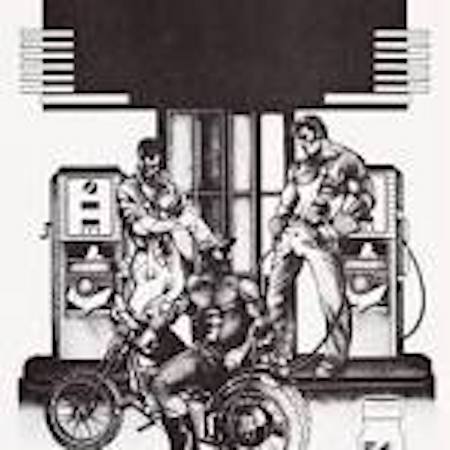
The explicit man-on-man sex acts are a given, but, of course, they can be approached in many ways. REX’s works tend to be more challenging than most, because of their themes of power and domination, degradation, and filth. With an enormous amount of smoking. And little evidence of playfulness or humor. Much of it can be viewed as balls-out performances of fantasies. But then much of it can be viewed as somewhat exaggerated ethnographic report on the S&M practices of the hard-core leatherman community — which seems to be the way Robert Mapplethorpe looked at it.
Leave a Reply