Faced with this judgment on Facebook today about the Spelling Bee puzzle from the New York Times,
(#1) POETITE: not a word (in the Spelling Bee dictionary)
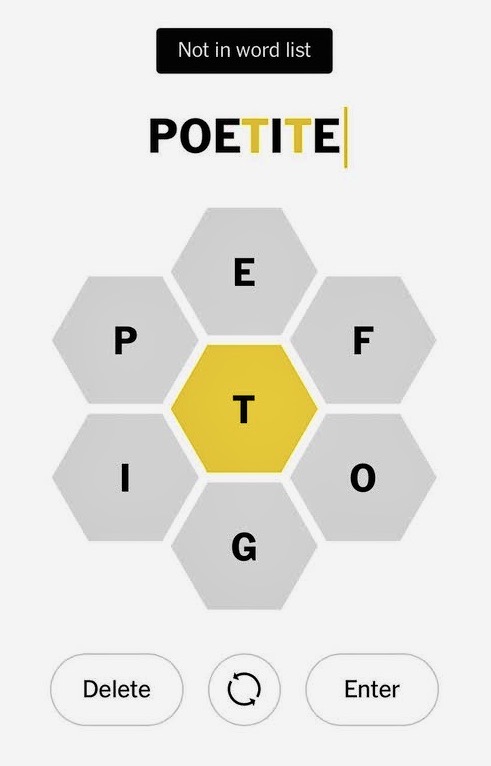
Dennis Baron owlishly protested with word play incorporating a pun on concrete:
It’s the stuff concrete poems are made from.
Well played, Dennis!
About Spelling Bee. From Wikipedia:
The New York Times Spelling Bee, or simply the Spelling Bee, is a word game distributed in print and electronic format
… The game presents players with a hexagonal grid of 7 letters arrayed in a honeycomb structure. The player scores points by using the letters to form words consisting of four or more letters. However, any words proposed by the player must include the letter at the center of the honeycomb. Each letter can be used more than once
About Spelling Bee’s dictionary. POETITE isn’t in it, and, more significantly, it’s not in the OED. It’s a possible word: just as we have the source adjective cupric and the substance noun cuprite, both named for copper; and just as we have have the adjective Adamic ‘having to do with Adam’ and the noun Adamite ‘follower of Adam’; so could we have, in addition to the adjective poetic, a noun poetite ‘substance related to poets or poems’, including a substance made of them or from which they are made or named for them.
But, the thing is, we don’t.
And then Spelling Bee’s dictionary is mighty persnickety. Editor Sam Ezersky uses some standard dictionaries as a rough basis for his puzzle dictionary, but his judgments are strongly personal, and consequently often fiercely disputed. Grievances are sometimes unloaded in Facebook. I have twice posted on this blog about particular complaints:
— on 2/26/24 in “UNVOICING”, which Ezersky did not accept (because it’s not the standard term; DEVOICING is)
— on 5/10/23 on “No clitic allowed”: CLITIC was not accepted (as too technical), but CLIT was (despite its raunchiness)
So I looked at #1, and immediately the wonderful pangram PETTIFOG leapt out of the hexagon. But then I looked up NOAD‘s entry:
verb pettifog: [no object] archaic [a] quibble about petty points [b] practice legal deception or trickery.
Whoops, marked as archaic, so presumably out. But no; Ezersky has several times accepted it.
Playtime. Back to POETITE. Dennis Baron is saying, well, forget dictionaries — let’s play, let’s suppose we do have the noun; poetite could be a substance poems are made of. Well, poems are made of words, and syntactic constituents, and poetic constituents (like lines and verses), and sounds, and prosodies, and figures of speech, and images, and so on, but none of these things is a physical substance, a material you can touch, like aluminum, copper, wood, glass, cotton, silk, brick, or concrete. What would a poem made of silk be like? Or one made of concrete?
Whoa. Concrete poetry!
Some items from NOAD:
adj. concrete: existing in a material or physical form; not abstract.
noun concrete poetry: poetry in which the meaning or effect is conveyed partly or wholly by visual means, using patterns of words or letters and other typographical devices. [an Adj + N composite N]
noun concrete: a heavy, rough building material made from a mixture of broken stone or gravel, sand, cement, and water, that can be spread or poured into molds and that forms a mass resembling stone on hardening.
And then the pun concrete poetry, a N + N compound N. What poetite could mean. Bingo..
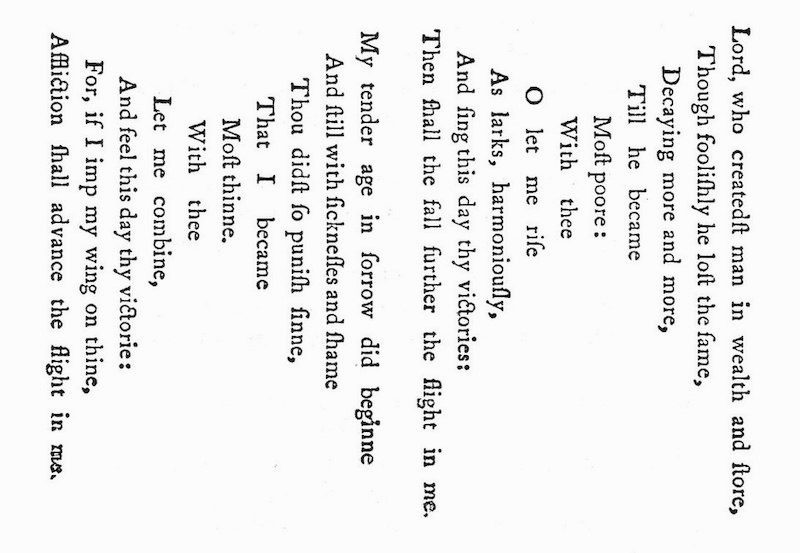
An example of non-poetite concrete poetry:
(#2) George Herbert’s “Easter Wings” (1633), printed sideways on facing pages so that the lines would call to mind angels flying with outstretched wings (from the Wikipedia article)
About the players. The editor, from Wikipedia:
Sam Ezersky (born May 29, 1995) is an American puzzle editor and crossword constructor who is the editor of The New York Times Spelling Bee. He has worked for the New York Times games department since 2017.
And the plugged-in scholar, also from Wikipedia:
Dennis Baron (born May 9, 1944) is a professor of English and linguistics at the University of Illinois at Urbana-Champaign. His research focuses on the technologies of communication; language legislation and linguistic rights; language reform; gender issues in language; language standards and minority languages and dialects; English usage; and the history and present state of the English language.
November 3, 2025 at 6:59 am |
I don’t think I’d encountered the term “concrete poetry” before, at least in this sense. Another famous example, of course, is the Mouse’s tale/tail in Alice’s Adventures in Wonderland.