🐇 🐇 🐇 rabbit rabbit rabbit to inaugurate November; it’s a beautiful bright fall day here in Palo Alto, the day after the costumes and candy of Halloween, and also The Day of the Dead, to honor those who have died before us
This posting is a continuation of yesterday’s “Medicine Day”, a list — an alarming inventory — of the medically significant conditions of my life, very roughly in chronological order. I admitted that the list was surely incomplete, and in fact I was driven to get up in the middle of the night to construct a second list, almost as big as the first.
But I will hold that recital of afflictions off for a bit, to entertain you with a note on one of my grand-child Opal’s favorite Halloween candies and one on yellow-orange marigolds for Mexican remembrances of the beloved dead.
The Nestlé Everlasting Gobstopper. Opal and her mother live in Redwood City, in a neighborhood where they get a fair number of trick-or-treaters. So they needed a stock of candy to give out, a big enough stock to cover the crowd. So there will be some left. So they bought candies they actually like, in fun sizes.
That led us to their deeply favorite candies, especially Opal’s, which took us to Mozart chocolates (which I knew about) and Nestlé Everlasting Gobstoppers (which I didn’t exactly know about, though I knew about fictional Everlasting Gobstoppers). So, on to Wikipedia:
The Everlasting Gobstopper is a gobstopper [AmE jawbreaker] candy from Roald Dahl’s 1964 children’s novel Charlie and the Chocolate Factory. According to its creator Willy Wonka, it was intended “for children with very little pocket money”. It not only changes colours and flavours when sucked on, but also never gets any smaller or disappears. In 1976, the name of the fictional candy was used for a product similar to a normal gobstopper, or jawbreaker.
… The Willy Wonka Candy Company brand was later bought by Nestlé
(#1) An assortment of Nestlé’s gobstoppers… [The Nestlé Everlasting Gobstopper] is like a normal gobstopper or jawbreaker and is composed of several discrete layers. The layers allow for the colour and flavour changing effects described in the book. They are available in a variety of different flavour combinations [outer layer orange, cherry, lemon, watermelon, or grape]

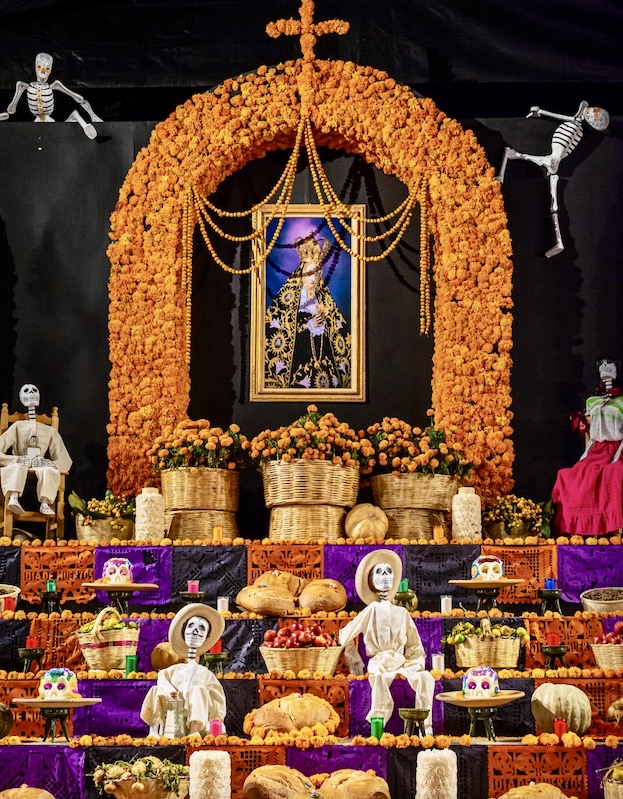
Marigolds for Día de los Muertos. From the Texas Public Radio site, “Why marigolds, or cempasúchil, are the iconic flower of Día de los Muertos” by Vanessa Romo on 10/30/21:
(#2) This Día de los Muertos altar on display at a public shrine in Oaxaca, Mexico, shows several traditional ofrendas, including cempasúchil — the Aztec name of the marigold flower native to Mexico (phoro: Gabriel Perez / Getty Images)[Angie] Jimenez is the altar coordinator [at Hollywood Forever Cemetery in Los Angeles] for the cemetery’s annual Día de los Muertos, or Day of the Dead, festival and oversees the installations of ofrendas put together by families commemorating their deceased loved ones.
… “An altar just isn’t complete without [marigolds]. And if you believe what the Aztecs believed, then your ancestors need the scent to find their way back to you,” she said.
The second inventory. And now to the main event. The ship of medical disorders sails on:
early onset puberty (age 10); dog bite; pinworms; exposure to asbestos fibers; pinkeye; warts; unidentified long-lasting mono-like infection (age 12); unidentified acute intestinal infection, probably an STI; gastroenteritis (stomach flu) a number of times; cracks in fingertips during cold weather; heat exhaustion; septic wounds on two occasions; brown recluse spider bite; *earwax (cerumen) buildup, requiring regular lavage; vasovagal syncope; bedpost fractures; concussion; gastritis with tremors (as a reaction to iron tablets, but also spontaneous); hemorrhoids; *osteopenia; gallstones, with cholecystectomy (gall bladder removal); bleeding ulcer; kidney stone,; anemia (now marginal); *edema in legs (now sporadic); *flaking skin on legs and arms, requiring daily application of coconut oil; weeping sores on left leg; *low body temperature (around 97.6 F); *spontaneous aphonia (loss of voice) or more often dysphonia (hoarseness); *mosquito-bite-like itchy spots, presumably viral
Medical technicians are sometimes inclined to treat my hairy body as a disorder.
I do listen to my body, but it whines a lot.
Leave a Reply