This Chris Hallbeck cartoon came by me on Facebook this morning — a strip packed with matters of science (paleontology, specifically), lexicography and usage (the senses of the noun dinosaur, and the contexts in which they’re used), and pragmatics (the way in which the noun is used in interactions, especially in language about language; in the enforcement of language norms; and, oh alas, in the relevance of things said to the interests of those participating in the speech context):
A Maximumble cartoon from 5/24/14, whose humor turns crucially on the pragmatic foolishness of the (now deceased) professor (in the face of a ravening monster, he stops to insist, irrelevantly in the context, that his companion must use the proper terminology, while the companion flees to safety); and which is based on the usage of the noun dinosaur — for a member of a clade of prehistoric reptiles bearing the zoological taxonomical label Dinosauria; versus, in non-technical American usage, for any dinosaurid creature, resembling the prototypical dinosaurs (many people have seen a family resemblance)
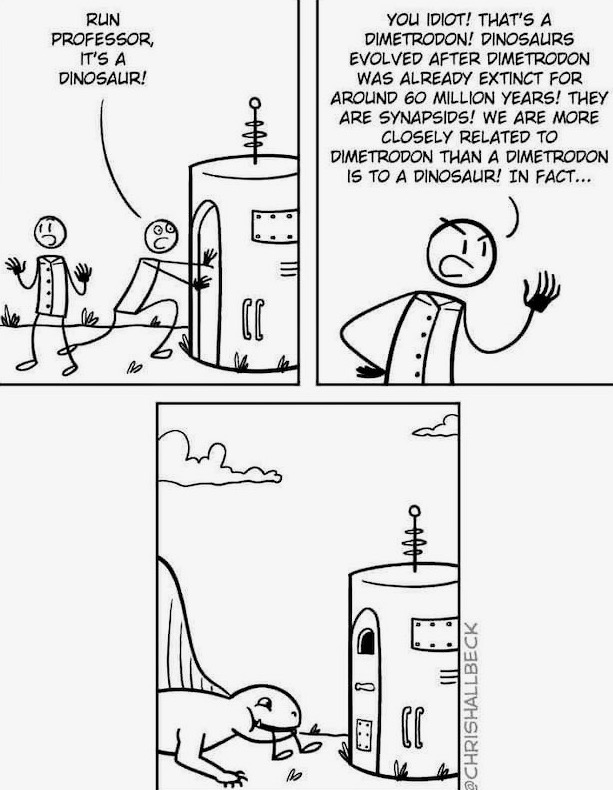
Using dinosaur as a label for a dinosaurid is, straightforwardly, an error in the context of discussions of biological taxonomy. But DINOSAURID is an unlabeled taxon, sad and nameless, but in ordinary speech, always insisting on the labels of biological taxonomy — which would require that we give the proper labels to synapsids, pterosaurs, ichthyosaurs, etc. — strikes me as pedantry. It all depends on the context and the purposes of the participants.
The dinosaur – dinosaurid distinction is roughly like the hemiptera – bug distinction (though reversed in the assignment of ordinary vs. technical uses) — in ordinary English, bug takes in all insects and a variety of creepy-crawly insect-like creatures (spiders, ticks, silverfish, centipedes, millipedes, and others, in a group you might call insectids); but in taxonomic biology, bug refers only to the order Hemiptera, otherwise known to biologists as, alas, true bugs.
Hallbeck’s blog on the dinosaur ‘dinosaurid’ – dinosaur ‘Dinosaurian’ matter just treats the former as an error (because it’s not what paleontologists say when they gather for professional purposes):
This blog is a result of an erroneous claim; one day I referred to Dimetrodon as a mammal-like reptile in front of a vertebrate paleomammalogist. These animals are not at all members of Reptilia; they are Synapsids — four-legged, back-boned animals that span back 315 million years on a completely different evolutionary branch of the tree of life. We even made a video about it: Dimetrodon is Not a Dinosaur.
Since then, I’ve found Dimetrodon partying with members of Dinosauria across the pages of coloring books and frolicking in the aisles of toy stores, surrounded by lifeforms which evolved some 66 million years after those ancient mammalian relatives.
Submit your photos of any number of creatures – Synapsids, Pterosaurs, Ichthyosaurs – that have been tragically mislabeled. For funsies.
The cartoonist (who has some previous mentions on this blog). From the HarperCollins website on Chris Hallbeck, the cartoonist’s antic self-description:
Chris Hallbeck is a roughly human shaped collection of anxieties held together by caffeine and curiosity. He’s been publishing comics on the internet since 2006 with his single panel comic The Book of Biff, followed by his multi-panel strip Maximumble. He was the co-writer and artist for Unshelved at the end of its run which led to co-creating the similarly themed Library Comic. With the addition of his voice and animation, his comics have found an audience of over two million followers across TikTok, YouTube, and Instagram. He lives in Michigan with his wife, two children, and a small worm in the back of his skull that whispers comic ideas to him.
September 21, 2025 at 8:26 am |
From Mike Pope on Facebook about this posting:
Material from the Wiktionary entry: