Yesterday, a brief and multiply allusive birthday poem for my friend Sharon (“A rose for Sharon”, on this blog here), along with the birthday gift to her of a big spathiphyllum plant, which should soon send up some of its sexy flowers. Various associations floated in my mind along with the plants and their symbolic eroticism.
Molly Bloom and her soliloquy of yes, but directed to a woman. And, overwhelmingly, the singer of the Song of Solomon 2:1, a woman who declares that she is (figuratively) the rose of Sharon and the lily of the valleys and goes on into (heterosexual) erotic verse from the woman’s point of view (which can of course be repurposed as directed to a woman), ending with a surprising celebration of spring (in places where winter is the rainy season), suggesting a springtime of her body as well as the season:
My beloved spake, and said unto me,
Rise up, my love, my fair one, and come away.
For lo, the winter is past,
The rain is over and gone.
And from that I’m taken to shapenote music and to factual questions about the plant the rose of Sharon and about Sharon the place from which this plant (and the Sharons of this world) got its name.
Sacred Harp 254. From my 5/13/17 posting “I am the rose of Sharon, and the lily of the valley”, where
I go to shapenote settings of text from the Song of Solomon, in particular #254 in the 1991 Denson Sacred Harp, a setting by William Billings that stretches over six pages in the book (and there are repeats), from “I am the rose of Sharon, and the lily of the valley” (note singular valley, as in the English name of Convallaria) to the celebratory “For lo, the winter is past, the rain is over and gone” — truly appropriate for this time of the year in California
… You can watch a video of the song here, from the 2009 Western Massachusetts Sacred Harp Singing Convention. Note that such videos are records of singings, not performances; we sing for ourselves, not for an audience, and our singing style is loud, often harsh, in a tradition quite different from what’s taught to choirs. In the case of Rose of Sharon, you might find this style jarring, because #254 is clearly an art song, not white gospel music. (I have recordings by the William Appling Singers and Orchestra, by His Majestie’s Clerkes under Paul Hillier, and by the Sine Nomine Singers, all elegant choral performances. But that’s not what shapenote singers are aiming at.)
The plant. From my 3/27/13 posting “Abutilon and its relatives”, on flowering plants in the mallow family, including rose of Sharon:
(#1) Hibiscus syriacusThe name in the Bible might have referred to a number of different plants: Pancratium maritimum (sand daffodil, sand lily, or lily of St. Nicholas), a crocus, a tulip, a tulip-like plant that grows in the hills of Sharon, or a lily. But the name is also commonly used for two different plants, neither of which is likely to have been the plant from the Bible: Hypericum calycinum [St. John’s wort], an evergreen flowering shrub native to southeast Europe and southwest Asia; or Hibiscus syriacus, a deciduous flowering shrub native to east Asia. I had a hypericum shrub in my Columbus garden — very pretty plant with golden flowers, but in the family Hypericaceae rather than Malvaceae. In any case, for me and most people I know, rose of Sharon [now] refers only to Hibiscus syriacus

The place. From Wikipedia:
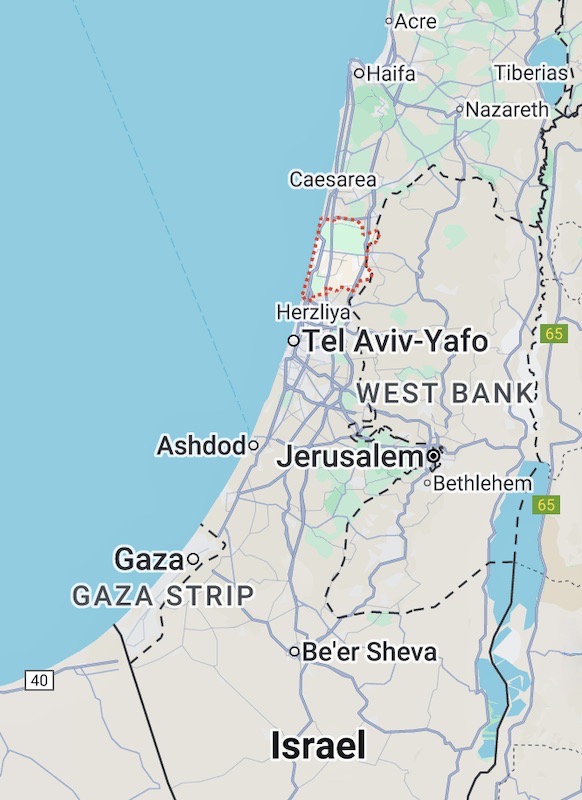
(#2) Map of the Israeli coast, with the Sharon plain outlined by a dotted red lineThe Sharon plain (Hebrew: הַשָּׁרוֹן, romanized: HaSharon) is the central section of the Israeli coastal plain. The plain lies between the Mediterranean Sea to the west and the Samarian Hills, 15 km (9.3 mi) to the east. It stretches from Nahal Taninim, a stream marking the southern end of Mount Carmel in the north, to the Yarkon River in the south, at the northern limit of Tel Aviv, over a total of about 90 km (56 mi). The level of the Sharon plain is connected to the level of the Mediterranean Sea by the Sharon Escarpment.
Parts of the plain are included in the Central, Haifa and Tel Aviv Districts of Israel.
Leave a Reply