(About art, and about some Z-folk (yay us!), but the Z-folk are knee-deep in homoerotic art (yay for Team Sodomite!), and male bodies and man-on-man sex will be discussed in plain language, so this posting is off-limits for kids and the sexually modest)
A Mexican in Paris — Ángel Zárraga, a painter who has brought us yet another remarkable painting of St. Sebastian (I know, I know, when will this rain of Sebastians end?, you cry out; well, not quite yet), the sensuous Votive Offering, more commonly known as (The Martyrdom of) Saint Sebastian:
(#1) I’ll have a fair amount to say about the elements of this painting, but there are endless further questions about them: why the contrapposto stance, why this posing of the saint’s arms, why stars in the saint’s halo? why only one arrow, just barely embedded in the saint’s left nipple, and with handsome black and white checks on its fletching? and on and on; you’ll probably have more questions yourself
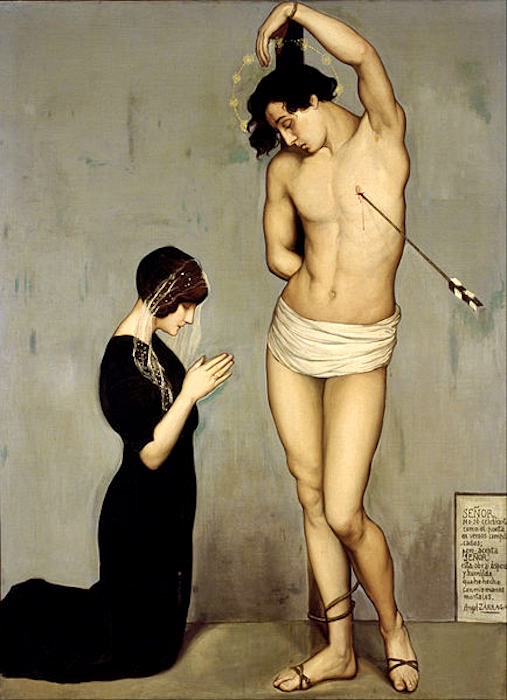
So we see what looks like a a fashionable Parisian woman in Art Nouveau dress, on her knees in devotion before a handsome Italian man with wavy black Romantic hair. He’s Saint Sebastian, dying for his Christian beliefs, from wicked sharp arrows penetrating into his flesh; she’s Saint Irene of Rome, tending to him and healing his wounds. But there’s no agony, no tears, only the striking of poses. There’s no exertion, no fear, not one drop of sweat. Remarkably, there’s not a drop of blood, either, only these two powerfully beautiful people, radiating sensuous elegance.
The inscription in the lower right corner is a genuinely pious and humble dedication by the artist of his work to the Lord; meanwhile, in the work, the body of the saint is framed as itself a votive offering, a gift to God. But let’s face it, this Sebastian is one hot number (and so is this very worldly Irene, in her own way), presenting himself as strikingly unmartyrial, more like something cooked up by Pierre et Gilles. I find it easier to imagine Zárraga’s Sebastian stud-hustling on a city street — well, I have actually seen his brothers in action, though with more clothes on and no arrow — than to see him as a blood sacrifice in the service of Jesus Christ.
A close parallel. For contrast, from the world of depictions of the martyrdom of Saint Sebastian, this equally sensuous (and quite plainly queer) 16th-century painting by Il Sodoma (whose nickname means just what you think it does):
(#2) A beautiful young man with a hot body, his nakedness barely covered — but he bleeds and his face is agonized; only one arrow in his body, but it’s an implement of war, not ornament, and it has pierced all the way through Sebastian’s neck, and there are further arrows embedded in the tree
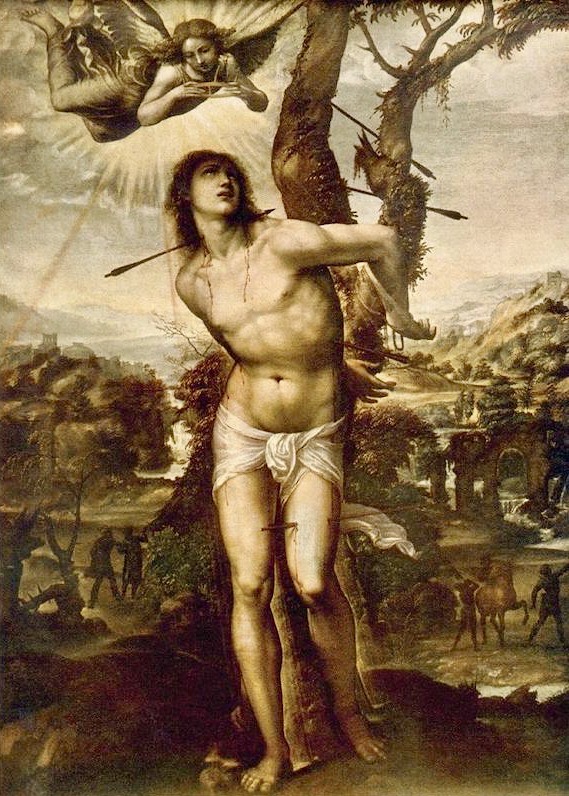
From the Italian Art Society website, “This Day in History: May 3”, by Anne Leader on 5/3/18:
On 3 May 1525, the painter Giovanni Antonio Bazzi, also known as Il Sodoma, received a contract to paint a double-sided banner for the Compagnia di San Sebastiano in Camollia near Siena. His original contract was to paint these two sides for 20 gold ducats. One side honors the company’s patron saint, showing him tied to a tree and shot full of arrows. Sebastian did not die from these wounds, however, and his miraculous recovery led to his adoption as patron saint of plague.
And about Bazzi / Sodoma, from Wikipedia:
Il Sodoma (1477 – 14 February 1549) was the name given to the Italian Renaissance painter Giovanni Antonio Bazzi. Il Sodoma painted in a manner that superimposed the High Renaissance style of early 16th-century Rome onto the traditions of the provincial Sienese school; he spent the bulk of his professional life in Siena, with two periods in Rome.
… Bazzi acquired his nickname of Il Sodoma, as it were “the sodomite”, from as early as 1512. … It is due to the contemporary art historian Giorgio Vasari that Bazzi’s nickname of Il Sodoma has become conventional. According to Vasari’s testimony, Bazzi always surrounded himself with “boys and beardless youths, whom he loved more than was decent”, for which reason he acquired the nickname Il Sodoma. Still, according to Vasari, Bazzi took pride in the nickname and composed stanzas and songs about it.
But Bazzi would have been the insertive partner in these encounters with boys and beardless youths; they serviced his dick — and thereby gained the shame and opprobrium of effeminate sodomy, while Bazzi presented himself, shamelessly, as a prodigious Don Juan, just with non-standard tastes in the objects of his desires.
Background. The story of Sebastian and Irene, from Wikipedia:
Sebastian (Latin: Sebastianus; c. AD 255 – c. AD 288) was an early Christian saint and martyr. According to traditional belief, he was [a captain of the Praetorian Guards, secretly a Christian, who was] killed during the Diocletianic Persecution of Christians. He was initially tied to a post or tree and shot with arrows [AZ: as #1, and other martyrdom representations], though this did not kill him. He was, according to tradition, rescued and healed by [Saint] Irene of Rome, which became a popular subject in 17th-century painting. In all versions of the story, shortly after his recovery he went to Diocletian to warn him about his sins, and as a result was clubbed to death. He is venerated in the [Roman] Catholic Church and the Orthodox Church [with a January 20th feast day on the Roman Catholic calendar].
… Sebastian is a popular male saint, especially today among athletes. In medieval times, he was regarded as a saint with a special ability to intercede to protect from plague, and devotion to him greatly increased when plague was active [and he became a symbol of sacrificial suffering and death during the HIV/AIDS epidemic].
And highlights from Wikipedia on Zárraga:
Ángel Zárraga (y) Argüelles (August 16, 1886 – September 22, 1946) was a Mexican painter. He was a founding member of the cultural organization El Ateneo de la Juventud [the Mexican Youth Athenaeum, later known as the Athenaeum of Mexico].
… In 1911 he moved to France for good, and he only returned to Mexico once at the outbreak of World War II for a short time.
From 1914 Zárraga painted in a Cubist style and after 1921 his work was influenced by Cézanne and Giotto.
Homoeroticism and the artworld. The evident homoeroticism in Zárraga’s art — so apparent in #1 — seems to have gone unremarked in the mainstream artworld and in references like Wikipedia, though we’ll see that other observers have commented on it. Just the pattern I noted a couple of days ago in my posting “Swedish male art from a hundred years ago”:
I … searched … for biographical information on [Swedish painter Owe] Zerge, finding material only on artworld — art sales and auction — sites, all of it talking in bland terms about his artistic styles and his quiet life history in Sweden, and nothing more. Meanwhile, various gay sites have noted the evident homoeroticism in many of his works, citing especially the 1925 Saint Sebastian, a 1919 Model Act, and a 1948 Boy in American Sailor Costume … It could hardly be clearer that Zerge’s sexual imagination — richly manifested in his art — centered on boys and young men, and that he had a long-term affectionate friendship with [his (20 years younger) friend and travel companion Hugo] Holman, who could fairly be characterized as the love of his life. Whether Zerge and Holman were sexual partners is none of our business (unconsummated passions were commonplace a hundred years ago), and there’s no evidence that I can find that Zerge ever did more than, scrupulously, appreciate young, lean male bodies. So I view it as a shame that his substantial body of homoerotic art is not better known and celebrated.
Apparently, the art and religious establishments have been inclined to view a male-focused sexual imagination and affectionate friendship between men as the outward and visible signs of unholy, filthy (perverse and licentious) sexual desires, practices, and identities — things that could not possibly be exhibited by admirably pious, earnest, congenial, and hard-working men, men like the Zerge and Zárraga we know from the public record. But that’s to vastly underestimate the complexity of real imaginations and real lives.
And that’s a great sorrow.
(I would insert material here on the great graphic artist — and admirable fellow — John Singer Sargent, on whose art, life, and sexual imagination I have posted many times, but, alas, he’s an S-person and this is Z Day at my art gallery.)
On the homoeroticism of Zárraga’s Saint Sebastian. From a far corner of the artworld, specifically Yíara Magazine, a student-run, undergraduate feminist art publication based in Montreal, in “The Subversions of Angel Zárraga: From Saint Sebastian to Soccer Players” by Sam Lirette on 5/15/21:
Angel Zárraga (1886–1946) is a Mexican-born painter who spent most of his professional life in Paris. After establishing roots in Cubism, the artist abandoned the style in favour of a more classicist style. Characterized by a desire for a retour à l’ordre, this return to classicism became a recurring theme with European (especially Parisian) artists of the early twentieth century. Particularly, this outlined increasing anxieties concerning the degradation of traditional gender roles, such as the emasculation of men and increased social mobility of women. I argue that Zárraga’s formal shifts do not speak of such anxieties, but rather illustrate an exceptional critique of the aforementioned expectations. I aim to demonstrate how the homoeroticism present in Zárraga’s paintings subverts traditional norms and provides an intensely modern viewpoint, namely through role reversals and a play with sexual ambiguity.
… It is impossible to adequately examine the homoeroticism present in several of Zárraga’s works without first analyzing his 1911 [AZ: or 1912, depending on who you read] painting Martyrdom of Saint Sebastian. As the quintessential symbol for homoerotic desire, Saint Sebastian allows for queer readings within art that depicts him.
Rather than attributing Zárraga’s formal choices to vague instinctual inspiration, in Transatlantic Encounters, Michele Greet explores the artist’s exposure to baroque art and Symbolism as key components behind his oeuvres. This provides a basis for his interest in religious iconography and the idealized athletic body. This combination of religious subject matter and sensuality present in Zárraga’s work, as Rudi C. Bleys states in Images of Ambiente, “proved incompatible with the upcoming movement of socialist muralismo.” We may hypothesize, therefore, that the artist felt an increasing sense of alienation from his home country and appropriately chose to remain in Paris for the majority of his life. His work was seemingly well-received; according to Thompson, Martyrdom of Saint Sebastian was “undeniably the artistic sensation of the salon.” Thompson fails to note, however, the scandal caused by the painting due to its overt sensuality. In fact, his review omits information about the figure of Saint Sebastian and instead points out “the caressing loveliness of the flesh of the kneeling woman.” By focusing on the flesh of the fully clothed woman, Thompson blatantly ignores the overt sensuality and nudity of the male figure, establishing a recurring theme within critiques of Zárraga’s work; art critics seemingly ignore anxiety-provoking aspects, and at times, provide a completely distorted recollection of the work. Bleys, meanwhile, speaks of the female figure “as if she were the transgendered [sic] personification of the artist himself.” He then argues that this is “neutralized” by the inscription found in the lower right corner of the painting, which speaks of the work as a votive painting. This outlandish claim seemingly and aimlessly attempts to ascribe a certain sexuality to the artist. As Greet describes, there is no clear evidence of Zárraga’s homosexuality even if “it is tempting to speculate that Zárraga struggled with a latent homosexuality.” I do not wish to take on an overly-biographical approach by examining the artist’s sexuality, but rather take an iconological approach in order to understand the impact of the homoeroticism present in his works — regardless of whether it was an intentional choice or indicative of the artist’s sexuality.
In Martyrdom of Saint Sebastian, as Héctor Domínguez Ruvalcaba states in Modernity and the Nation in Mexican Representations of Masculinity, the male body becomes an object of admiration. This subverts a long tradition in art history; the female body is not put on display for male viewers. As emphasized by Saint Sebastian’s seductive pose and raised arm, an important role-reversal occurs within this work — the male figure becomes the venerated object. The work demands a mediation between the gaze (and the traditionally masculine act of looking) and the imposed object of desire: the male body. It is in this specific regard that Zárraga’s work may be interpreted as a critique of gender norms. The reversal of roles creates a rather tongue-in-cheek commentary on the increasing anxieties concerning the degradation of such norms, namely the emasculation of men and the increasing social power of women in the public sphere.
An awful lot of citation of sources, and heavy on feminist interpretations of the material, but then it’s in a publication devoted to feminist theory of art. I would certainly unpack the allusion to sexuality by referring at the outset to desires, practices, and identities and going on from there. But this piece does provide a nice critique of the way the mainstream artworld views works like Zárraga’s Saint Sebastian.
Leave a Reply