(Men’s bodies and men portrayed in sexual acts, so not to evereyone’s taste)
Encountered on Pinterest this morning, on the Pace Gallery online exhibitions site, “Peter Hujar: Cruising Utopia” (open from 6/30 to 8/3 in 2020), with this arresting photograph:
(#1) Jay and Fernando [Two Men in Leather Kissing], ca. 1966 (I’m an avowed fan of men kissing men, so this photo was guaranteed to get my rapt attention)

From the Pace Gallery site:
From the 1960s to the early ’80s, Peter Hujar was an iconic presence in New York’s downtown scene.
His celebrated portraits capture the city’s queer pantheon of artists and drag performers, poets and writers, celebrities and deadbeats, strangers and lovers, acquaintances and friends. From East Village icons Greer Lankton and Ethyl Eichelberger to downtown intellectuals Susan Sontag and Fran Lebowitz, from Warhol superstars to legendary artists like Paul Thek and David Wojnarowicz, this exhibition brings together Hujar’s penetrating portraits in a love letter to his city and community.
Cruising Utopia traces the horizons of Hujar’s expansive body of work, encompassing intimate studio portraits, street photography, and striking images of the city itself. Across nighttime streetscapes, desolate parking lots, and crumbling piers peopled with half-naked bodies, Hujar photographed the margins of public space, capturing queer intimacy as it flourished in the post-Stonewall era of the ’70s and early ‘80s. Cruising the city through his camera’s viewfinder, he navigated its porous networks of erogenous utopias, photographing a fabulous and often infamous cast of underground elites who defined New York City’s vibrant counterculture in the decade before AIDS.
Background. On the Pace Gallery, from Wikipedia:
The Pace Gallery is an American contemporary and modern [commercial] art gallery with 9 locations worldwide. It was founded in Boston by Arne Glimcher in 1960.
… [In 1968] the gallery moved to its long-time [primary] location at 32 East 57th Street [in Manhattan]
Hujar and his career. From a long and thoughtful Wikipedia entry, with illustrations from Hujar’s work interpolated:
Peter Hujar (October 11, 1934 – November 26, 1987 [when he died from complications of AIDS]) was an American photographer best known for his black-and-white portraits. Hujar’s work received only marginal public recognition during his lifetime, but he has since been recognized as a major American photographer of the late 20th century.
… Artistc career. In 1958, Hujar accompanied the artist Joseph Raffael on a Fulbright to Italy. In 1963, he secured his own Fulbright and returned to Italy with Paul Thek, where they explored and photographed the Capuchin Catacombs of Palermo, classic images featured in his 1975 book Portraits in Life and Death. In 1964, Hujar returned to America and became a chief assistant in the studio of the commercial photographer Harold Krieger.
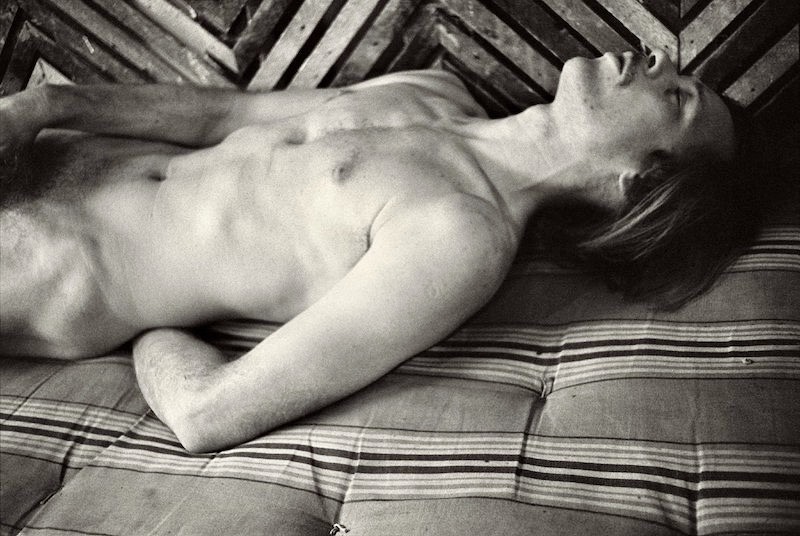
(#2) Paul Thek Masturbating, 1967Around this time, he met Andy Warhol, posed for four of Warhol’s three-minute Screen Tests and was included in the compilation film The Thirteen Most Beautiful Boys that was assembled from Screen Tests.
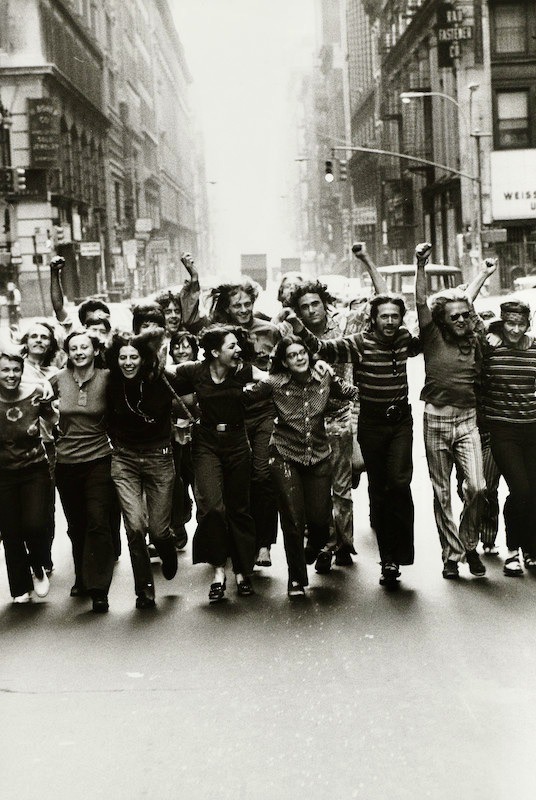
Hujar quit his job in commercial photography in 1967, and at great financial sacrifice, began to pursue primarily his own art work that reflected his homosexual milieu. He was an influential artist-activist of the gay liberation movement; in 1969, with his lover, the political activist Jim Fouratt, he witnessed the Stonewall riots in the West Village. Also at the urging of Fouratt, he took the now somewhat ironic photo “Come out!!” for the Gay Liberation Front, or GLF, but it was the extent of his involvement with the group.
(#3) Gay Liberation Front Poster Image, 1970In 1973, he moved into a loft above The Eden Theater at 189 2nd Avenue in the East Village, where he lived for the rest of his life.
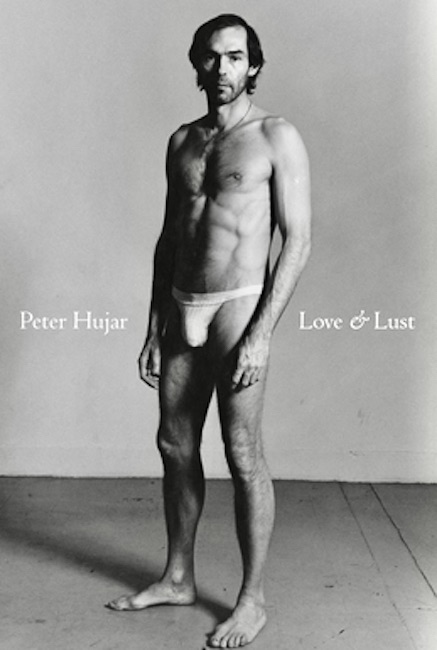
In the late 1970s and early 1980s he frequented the bohemian art world of downtown Manhattan, shooting portraits of the artists there such as drag queen actor Divine and writers, such as Susan Sontag, William Burroughs, Fran Lebowitz, and Vince Aletti. He visited “extremely serious, very heavy S&M bars” and the abandoned West Side Hudson River piers where men cruised for sex. In 1975, Hujar published Portraits in Life and Death, with an introduction by Sontag.
(#4) Self-Portrait Standing (1980), on the book cover for Love & Lust (2014)After a tepid reception, the book became a classic in American photography. The rest of the 1970s was a period of prolific work. In early 1981, Hujar met the writer, filmmaker, and artist David Wojnarowicz, and after a brief period as Hujar’s lover, Wojnarowicz became a protégé linked to Hujar for the remainder of the photographer’s life. Hujar remained instrumental in all phases of Wojnarowicz’s emergence as an important young artist.
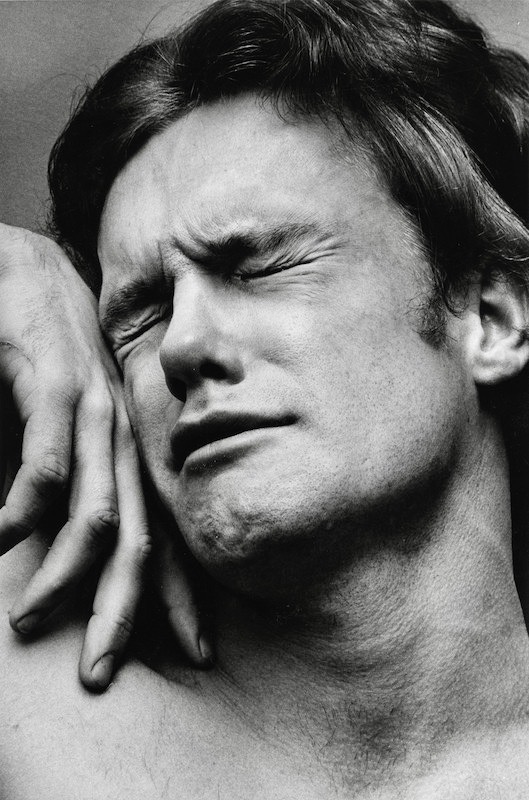
Another artist closely linked with Hujar is Robert Mapplethorpe. Both artists were gay white men who excelled at portrait photography and who made unashamedly homoerotic work that walked the line between pornography and fine art, but they were structural opposites. If Mapplethorpe reduced his subjects to abstract forms, his sitter’s faces to masks, his nude models to sculptures, then Hujar emphasized his sitters’ idiosyncrasies, their irreducible qualities, their human sentience over their fleshy geometry. “Orgasmic Man”, one of Hujar’s more memorable works, is also a key difference between his work and Mapplethorpe’s; never once, in all of Mapplethorpe’s editioned photographs, did he show orgasm or ejaculation nor did he depict the concomitant facial expressions.
(#5) Orgasmic Man, 1969Hujar had a wide array of subjects in his photography, including cityscapes and urban still lifes, animals, nudes, abandoned buildings, and European ruins. His photography, which was mostly in black and white, has been described as conveying an intimacy, suggestive of both love and loss.
Earlier on this blog, my 5/12/24 posting “”A place for us to see each other””, on Stanley Stellar’s “Piers” photographs (joining the West Side piers photography of David Wojnarowicz, Peter Hujar, Keith Haring, and Gordon Matta-Clark).
July 16, 2024 at 6:31 am |
I assume the tease in #2 is Hujar’s, since you generally say explicitly when you modify images to meet WordPress’s constraints. Either way, it’s distinctly hardon-inducing.
July 16, 2024 at 7:00 am |
Yes, Hujar’s, reproduced here faithfully. The general principle is that what is ostentatiously concealed can be more arousing than what is flagrantly revealed.