That’s Hector de Gregorio, whose fantasist digital collage Love of Hermes came past me on Pinterest recently:
(#1) The male figure’s face is (a version of) de Gregorio’s own; the composition is packed with symbols and allusions of many kinds. only a few of which I can identify

Some of the iconography in #1 might be understood from information in the Wikipedia article on the Greek god Hermes:
Hermes is an Olympian deity in ancient Greek religion and mythology considered the [emissary and messenger] of the gods.
… his main symbol is the caduceus, a winged staff intertwined with two snakes copulating [sometimes crowned with a pair of wings and a sphere]
[AZ: Among the many female objects of his love was the love goddess Aphrodite, with whom he fathered the god Hermaphroditus — born a handsome boy, then transformed into a hermaphrodite, with a name compounded of the names of the two parents]
… Hermes also loved [many] young men in pederastic relationships where he bestowed and/or taught something related to combat, athletics, herding, poetry and music
Now, four more of de Gregorio’s dream-like, often highly theatrical, body-focused compositions — two relatively spare ones, two densely symbolic ones. Then some words about the artist.
Absinthes. Two naked men — or perhaps two apparitions of the same naked man — almost mirroring each other’s gestures as they sit at a table, each with a glass of absinthe in front of him:
(#2) Absinthe is a spirit primarily flavored with anise, fennel, and wormwood
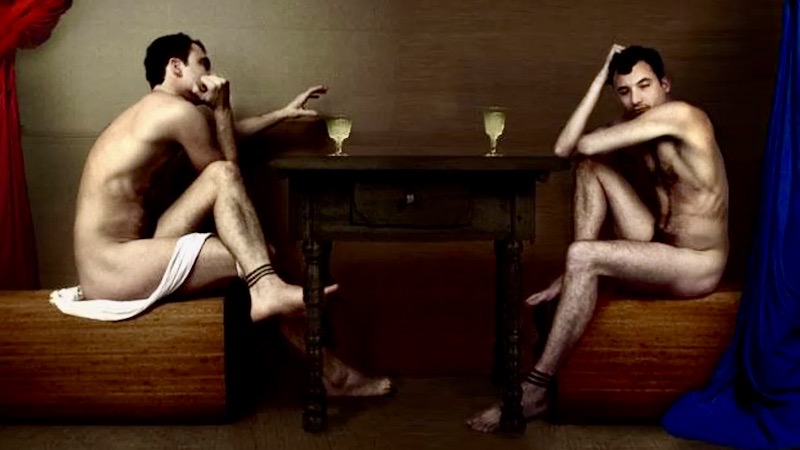
From Wikipedia:
The aura of illicitness and mystery surrounding absinthe has played into literature, movies, music, and television, where it is often portrayed as a mysterious, addictive, and mind-altering drink [because of the wormwood].
(#3) A castrato with the face of the performer Ernesto Tomasini
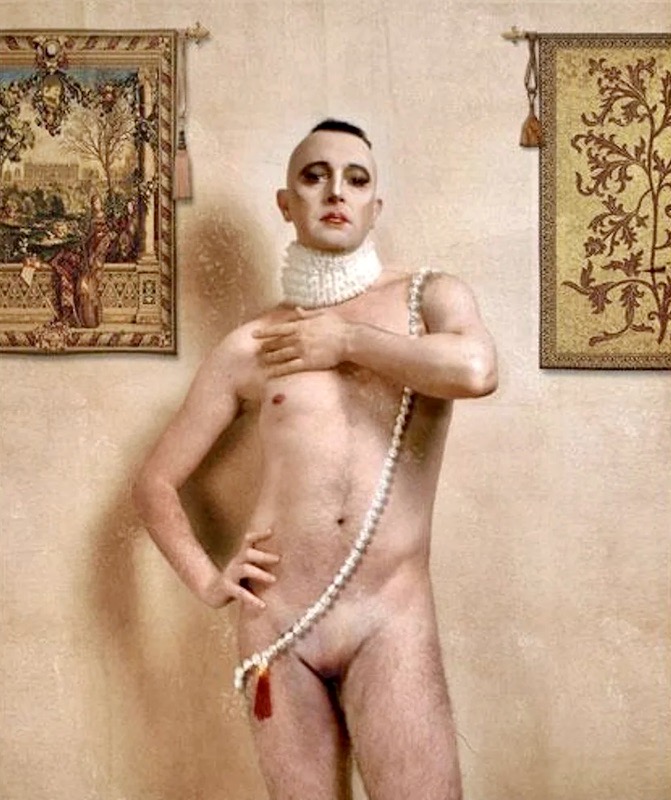
From Wikipedia:
Ernesto Tomasini (born 15 May 1968, in Palermo, Italy) is an Italian actor / singer / writer living in Britain. Best known for his more recent forays into contemporary music, he has also had a 35-year career on the stage.
… Having made some early experiments in the late ’90s with a production called The Other Woman, in 2002 Tomasini started to create (in various capacities) his own shows and first attracted attention with an appearance at the Edinburgh Festival with True or Falsetto? A Secret History of the Castrati. Written by Time Out critic Lucy Powell, the show was a sell out hit not only in Edinburgh but also in London for two seasons and on international tours, in three different languages. … Tomasini’s style of performance – an operatic, dark and twisted blend of Italian Cabaret, avant-garde performance art and thought-provoking Vaudeville – has been described “as shocking as it is moving”.
… [As for his singing career, the] Italian newspaper La Repubblica called him a “prominent figure in avant-garde circuits with his seducing high voice reminiscent of those belonging to evirated [AZ: emasculated, castrated] singers”.
(#4) I think the reference in this phantasmagorical collage is to palos santos
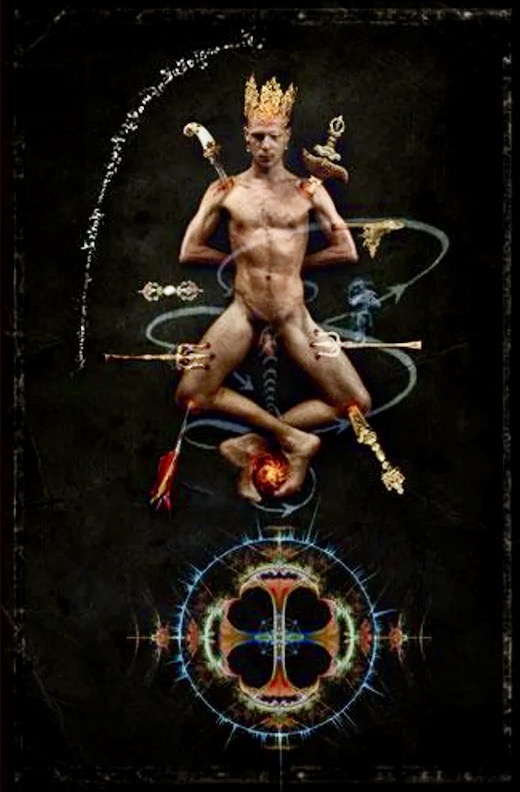
From Wikipedia:
Bursera graveolens, known in Spanish as palo santo (“holy stick [or tree]”), is a wild tree native from the Yucatán Peninsula to Peru and Venezuela.
… The tree belongs to the same family (Burseraceae) as frankincense and myrrh. It is widely used in ritual purification [by burning the sticks, as incense] and as folk medicine for stomach ache, as a sudorific [to cause sweating], and as liniment for rheumatism.
(That’s the palo of Palo Alto ‘tall tree’, < Latin palus ‘stake’, as in English palisade and impale.)
(#5) A grotesque image of human / bunny sacrifice
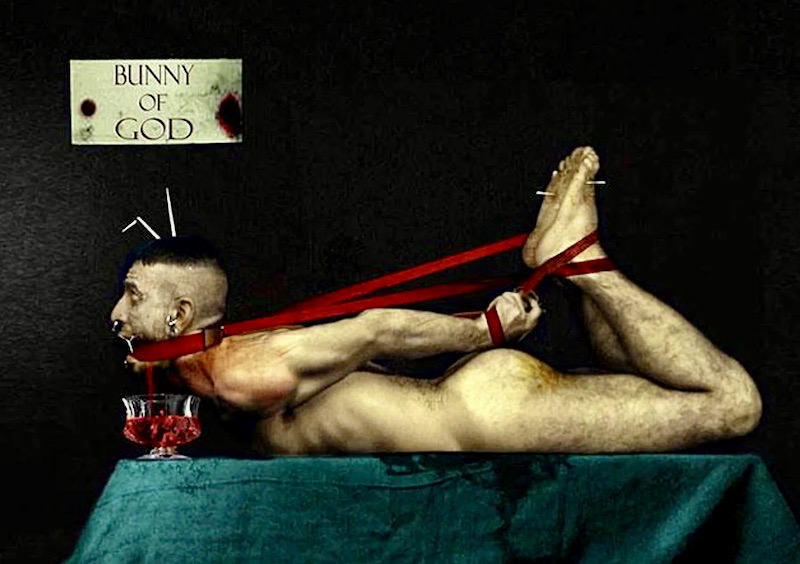
From Wikipedia:
Tu’er Shen (traditional Chinese: 兔兒神), or Tu Shen (Chinese: 兔神), is a Chinese deity who manages love and sex between men. His name literally means “rabbit deity”. His adherents refer to him as Ta Yeh (Chinese: 大爺).
In a folk tale from 17th century Fujian, a soldier [Hu Tianbo] is in love with a [very handsome] provincial official, and spies on him to see him naked. The official has the soldier tortured and killed, but he returns from the dead in the form of a leveret (a hare in its first year) in the dream of a village elder. The leveret demands that local men build a temple to him where they can burn incense in the interest of “affairs of men”.
… A slang term for homosexuals in late imperial China was “rabbits”, which is why Hu Tianbao is referred to as the rabbit deity, though in fact he has nothing to do with rabbits
About the artist and his works. First, from the Enter Art Foundation site on the artist:
Hector de Gregorio. Valencia, Spain. Lives and works in London.
Artist statement: The work of the London-based artist Hector de Gregorio is dramatic, theatrical, luscious, allegorical. In his own phraseology he terms it as “Static Cinema” and at least at first glance it does appear remarkably so. It is like taking in a grand costume drama, a late medieval / early renaissance theatrical story, full of twists and turns, vendettas and tragedies. But there is much more going on here than nice costumes and theatrical poses.
Hector’s work consists of pieces of a whole, they are vignettes of larger happenings, of the possibility of bigger and greater lives. They are rooted in larger narratives, ones that we cannot see clearly and fully, but that we know are there, that we can imagine being there.
Hector’s artwork is extraordinary. Although these are technically digital collages, the artist starts with conversations with the sitter, goes through graphic and literary research, builds a story around the sitter, and even makes the costumes when needed. Photographs are then taken in order to create the final digital piece.
And then from the LGBTQ+ Advocate magazine, “Artist Spotlight: Hector de Gregorio: De Gregorio’s mythological portraits disturb and seduce at the same time” by Christopher Harrity on 2/5/14:
Hector De Gregorio’s portraits started popping up in the Facebook feed and the Tumblr dashboard like missives from a new ecstatic church, but a church with all the big-time emotions of Catholicism and none of the finger-wagging restraints. So we sought out his work. We like no restraints.
Working in a layered and time-consuming series of mediums to create his portraits, the process of planning and the creating becomes a works of art in itself. Research, costume design, photography, painting, collage, and digital enhancement all create operatic works of ecstatic moments.
The London artist has exhibited widely, with shows in London, Berlin, Milan, New York, Miami, and Chicago.
We asked Hector de Gregorio to describe his work and process:
I always find it rather difficult to describe my own work because it combines a barrage of styles both technically and stylistically. Photography, painting, digital imaging, and craft are riddled together to produce images the are at once approachable and cryptic, alluring and unsettling, antique and contemporary.
The inspiration feeds from visual popular languages such as medieval market storytellers, tarot cards, illustration, cartoon strips, devotional art, or advertising — for they contain a synthesis of narrative and visual impact.
I like to create a visually simple and attractive composition to draw the viewer in at first glance and then introduce a character or narrative. The characters I present are embodiments of their own mythology, baring the attributes or immersed in a fragment of their own story. They are, so to speak, “mythological portraits” of the sitter, as the work is — sometimes literally — tailored to the person am working with. I also make the costumes for the image when required, for they are visualizations of aspects of the sitters themselves that get represented but NOT exposed.
I was raised in a family of tailors and often babysat in a nunnery. Being a custodian of the relics and “wardrobe” (antique handmade attire) for the saints’ sculptures, I soon picked up a sense of awe and fetish towards theater, costume, and mythology. I immersed myself in an imaginary world, both real and fantastical.
This bewildering and exquisite combination of materially representing abstract expressions of the “soul” led me to explore the idea of mythological experience as a real thing, a way to represent figuratively abstract but felt-experienced concepts like impermanence, eternity, love’s energy, the space behind a mask.
Leave a Reply