Yesterday’s (4./17) Wayno / Piraro Bizarro cartoon shows two snowmen conferring:
Left Snowman reassures Right Snowman that the frozen confection that they are eating in a cone (“fruit-flavored crushed ice” (NOAD)) is not in fact snow — that would smack of, ick, cannibalism — but instead sno, a substance that merely resembles snow (Wayno’s title for the cartoon is Faux Cone); it’s just a sno cone / sno-cone (if you’re puzzled by the odd symbols in the cartoon — Wayno says there are 3 in this strip — see this Page)
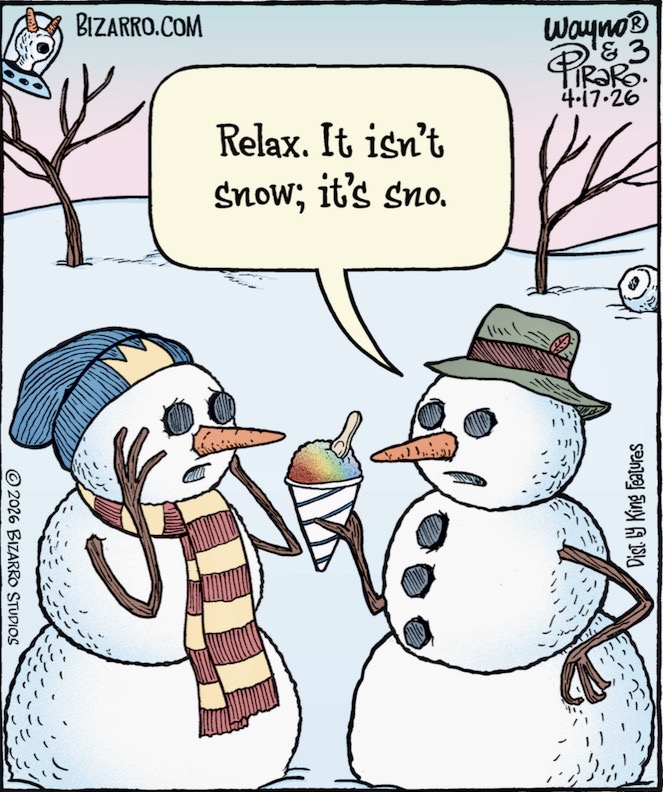
Using sno cone (or sno-cone or snocone) makes it formally clear — by the special spelling of the first element — that this is a Resemblance compound, in which the first element is to be understood as denoting not some model thing but something merely similar (perhaps simulated, imitation, or fake, but in any case not genuine). The respelling of genuine snow as resemblant sno is a perceptible (in this case visible) disclaimer of genuineness and indicator of mere resemblance.
Similarly, creme for cream that’s merely dairy-like, krab legs for imitation crab legs (made from fish), and Froot Loops for a fruit-flavored breakfast cereal without fruit in it.
[Digression: special spellings for other purposes. At least two other cases: merely ornamental spelling (as in the spellings of Häagen-Dazs, Cheez-it (a cheese cracker) and Cheez Whiz (processed cheese sauce and spread); and spellings picking out a distinguished subtype (Chikin for a South Korean style of fried chicken).]
Indicating mere resemblance. Respelling is one strategy for indicating mere resemblance. Another is to borrow a term from another language: surimi for imitation crab legs. Still another, much subtler, is to use a compound with a creative head element: crab sticks for imitation crab legs (crab sticks are, in fact, fish sticks of a kind).
The ambiguity gambit. But most commonly a realistic compound is simply pressed into service as a resemblant one; the expression is then ambiguous, and whether the compound is genuine or not has to be figured out from the context.
So: snow cone (or snow-cone or snowcone) can be either either a realistic compound — a Material compound (‘cone of snow’) — or a Resemblance compound (‘cone (of some material) resembling snow’ — in particular, a sno cone).
Then, from earlier postings on this blog, two (of many) postings reporting on an ambiguity between a realistic compound and a Resemblance one.
— my 11/14/19 posting “Chart pie” considers pie chart as a Resemblance compound (‘chart resembling a pie’) or an Object compound (‘chart of pies’, that is, ‘diagram charting various pies’)
— from my 5/16/22 posting “bingo”:
The N + N compound N bingo ball is subsective — a bingo ball is a ball (‘a spherical object or mass of material’ (NOAD)) — and Type O, with one of the ordinary, conventional, semantic relationships between its head and modifier — it’s a Use compound (‘a ball used in / for bingo’), similar to tennis ball (referring to a ball used in or for the game of tennis) or walker ball (referring to a ball used on or for the assistive device the walker; entertainingly, walker balls are often just adapted tennis balls).
(Having the mind I do, I entertain fleeting thoughts of bingo ball as involving instead the head noun ball ‘testicle’ in a Resemblance compound ‘ball like the ones used in bingo’, so referring to a hard, shiny testicle, perhaps with a number and letter printed on it. “Poor Jimmy, he’s got bingo balls” (and maybe also joo joo eyeball and feet down below his knee).)
April 19, 2026 at 6:36 am |
My understanding has always been that some of these respellings are designed to allow the name to be trade-marked; you can’t trade-mark a common noun (“snow”, “cheese”, etc.)
April 19, 2026 at 7:16 am |
My understanding as well — but not all the respellings are in fact trademarked (“sno”, in particular, seems not to be).