In the 8/22 Bizarro strip, Wayno presents us with Johnny Peso, an intricately constructed Mexican-Spanish and Mexican-culture counterpart to Johnny Paycheck as a performer on the Grand Ole Opry stage. If you don’t know about Johnny Paycheck and the Grand Ole Opry, you’re doomed; the cartoon will be incomprehensible. If you know who they are, you’ll get the joke; and the more you know about them, the more you’ll see in Wayno’s cartoon (I suspect there are still more things that I’ve missed). And then there’s a lot to say about the way Johnny Peso introduces himself. The cartoon:
(#1) The joke in the cartoon comes the two bilingual puns: Spanish peso punning on English paycheck, Spanish olé punning on English vernacular ole; the puns are, in addition, what I’ve called (semiotically) satisfying puns (if you’re puzzled by the odd symbols in the cartoon — Wayno says there are only 2 in this strip — see this Page)

And then there’s a lot more.
Johnny Paycheck and the Grand Ole Opry. On the outlaw cowboy Paycheck, from Wikipedia:
Johnny Paycheck (born Donald Eugene Lytle; May 31, 1938 – February 19, 2003) was an American country music singer and songwriter. He is a notable figure in the outlaw movement in country music.
(#2) The standard p.r. photo of Johnny Paycheck, with his custom-made extra-wide cowboy hat (I don’t know what the source of the photo is)

The Mexican Johnny Peso has the mustache, and has a remarkable hat to match Johnny Paycheck’s, but it’s a big sombrero. In fact, Johnny Peso looks like a guitarist in a mariachi band. From Wikipedia:
Mariachi is a genre of regional Mexican music dating back to at least the 18th century, evolving over time in the countryside of various regions of western Mexico. The usual mariachi group today consists of as many as eight violins, two trumpets and at least one guitar, including a high-pitched Mexican Vihuela and an acoustic bass guitar called a guitarrón, and all players take turns singing lead and doing backup vocals.
And then on the Opry, from Wikipedia:
The Grand Ole Opry is a regular live country-music radio broadcast originating from Nashville, Tennessee, on WSM, held between two and five nights per week, depending on the time of year. It was founded on November 28, 1925, by George D. Hay as the WSM Barn Dance, taking its current name in 1927.
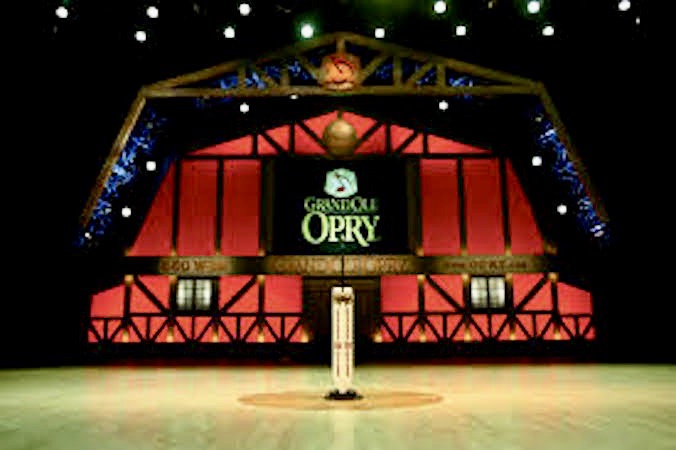
A montage of the Grand Old Opry stage, showing features reproduced in the cartoon:
(#3) The cartoon has the barn structure but lacks the circle in center stage
The puns: phonological similarity. First, the initial syllable of Spanish peso is very similar to the initial syllable of English paycheck (though differing in phonetic details). And the first syllable of the Spanish interjection olé (well, ¡olé!) is phonologically similar to the English vernacular adjective ole ‘old’ in Grand Ole Opry — plus, olé and ole are orthographically very similar.
The puns: semantic similarity. The peso is the basic monetary unit of Mexico, and Spanish ¡olé! is an interjection used to cheer on or praise a performance, especially in bullfighting and flamenco dance. So both both peso and paycheck evoke money, while both olé and ole opry evoke the celebration of performance; there’s then a semantic similarity of the Spanish pun to the English model that matches the phonological similarity. See my 8/30/23 posting “herd it / heard it”, on (semiotically) satisfying puns, in which a phonological similarity of pun to model is matched by a semantic similarity.
Johnny Peso greets his audience. And introduces himself: Hola, yo soy Johnny Peso ‘Hi, I am Johnny Peso’. Well, you can introduce yourself either by providing your name (My name is Spartacus) or by providing your identity (I am Spartacus) — though either one of these acts can perform the function of the other, depending on the context and the wiles of the speaker.
Mexican Spanish has at least two forms for providing your name (N) and at least two for providing your identity:
NAME 1: me llamo N
NAME 2: mi nombre es N
IDENTITY 1 soy N
IDENTITY 2 yo soy N
In each pair, the first form is everyday talk, while the second is, as I understand things, more formal, and possibly smelling of English influence (though it also seems that there’s some complexity here),
In any case, Wayno has Johnny Peso using IDENTITY 2 (which sounds stiff and Englishy to me; I would have expected a Mariachi player to use NAME 1, unless he was someone with a reputation, in which case he’d use IDENTITY 1 — but then, what do I know?).
August 24, 2025 at 2:06 am |
Are you sure it isn’t a reference to Johnny Cash?
August 24, 2025 at 6:07 am |
A point also made on Facebook by David Preston. Yes, surely peso is a rough (metonymic) translation of cash, so Johnny Peso would be a Mexican Johnny Cash. But I made a case in this posting that Johnny Peso is a Mexican Johnny Paycheck. The answer is that in the world of cultural allusion, both things can be true. I’ll expand on this idea in a separate posting.
August 24, 2025 at 9:16 am |
Well, I’d say me llamo (though I’m not a native speaker).
August 24, 2025 at 9:31 am |
I hope not to have set off random people posting about what they’d say. Because the issue is way way beyond what most of us could undertake to examine, because there are so many linguistic, sociocultural, and discourse-structural dimensions to the question.
August 24, 2025 at 11:48 am
But now David Preston has cut the Gordian knot. See his latest comment.
August 24, 2025 at 10:39 am |
I think the reason for the ‘yo soy’ form is that “Hello, I’m Johnny Cash” is not only something of a catchphrase, it was the name of one of his albums.
August 24, 2025 at 11:42 am |
Bingo! So Johnny Peso definitely is Johnny Cash (and IDENTITY 2 is just a straight word-for-word translation from English). But he’s also clearly Johnny Paycheck. He’s an artistic creation, so he can be both.