On Easter egg quotations — the light hand — vs. ostentatious allusions — the hammer — in the Economist. From the issue of 3/15/25 in the Culture section, a review of Righting Wrongs, by lawyer Kenneth Roth of Human Rights Watch, with main headline
How to shame a dictator
(vague echoes of titles whisper in your head) and just one section head (in bold face)
The gripes of Roth
(clang clang clang and you groan at the outrageous pun).
And now I’ll riff on these two allusions. But first, the background.
Easter egg quotations and ostentatious allusions. From my 4/13/19 posting “Easter egg quotations”:
From my 1/25/19 posting “Pythonic curtain line in the Economist”:
The Economist is ridiculously fond of this sort of jokiness, dropping allusions left and right (unattributed of course), to both high and low culture, to idioms, proverbs and sayings, and so on. In the Vaccine X story, the sting is in the tail
— in the very last sentence: “All this may then eliminate the fear, surprise and ruthless efficiency of unexpected viruses”, a quotation from the Monty Python “Spanish Inquisition” sketch.
If you catch the quotation — not every reader will — that doesn’t contribute substantively to your understanding, but it does provide a kind of side pleasure, not unlike that afforded by Easter eggs in video games and the like. So I’ll refer to them as Easter egg quotations.
For the most part, the Economist deploys allusions ostentatiously, as jokes that are meant to be seen as jokes. The Vaccine X allusion to Monty Python, however, can be read straightforwardly and literally, merely asserting that unexpected viruses elicit fear and surprise and are ruthlessly efficient. It could pass by without your noticing. If you recognize the allusion, that’s a bonus, a little gift to you, and you might even feel a bit of pride in your knowledge of culturally significant texts.
On to the light hand and the hammer.
An Easter egg quotation. How to shame a dictator provides an echo of at least two titles, represented in this assortment of fiction and film titles, all of the form How to Verb Determiner Dragon (where the Verb half-rhymes or fully rhymes with shame):
How to Train Your Dragon, a 2003 fantasy novel by Cressida Cowell (first in a series)
How to Train Your Dragon, a 2010 animated fantasy film loosely based on the 2003 novel
How to Train Your Dragon, a 2025 fantasy film, a live-action remake of the 2010 animated film
How to Tame a Dragon, a 2021 fantasy novel by Lila Mina
A groaner pun. The ostentatious allusion gripes of Roth is to the title of the 1939 John Steinbeck novel The Grapes of Wrath, with a remarkable 1940 film version directed by John Ford; two imperfect puns yoked together — gripes (with /aj/) ‘complaints’ punning on grapes (with /e/), Roth (with /a/) the surname punning on wrath (with /æ/) ‘anger’.
The grapes in Grapes of Wrath is an almost irresistible target of semantic word play. From my 7/3/10 posting “The figs of fear”:
(#1) New Yorker cartoon by J.B. Park

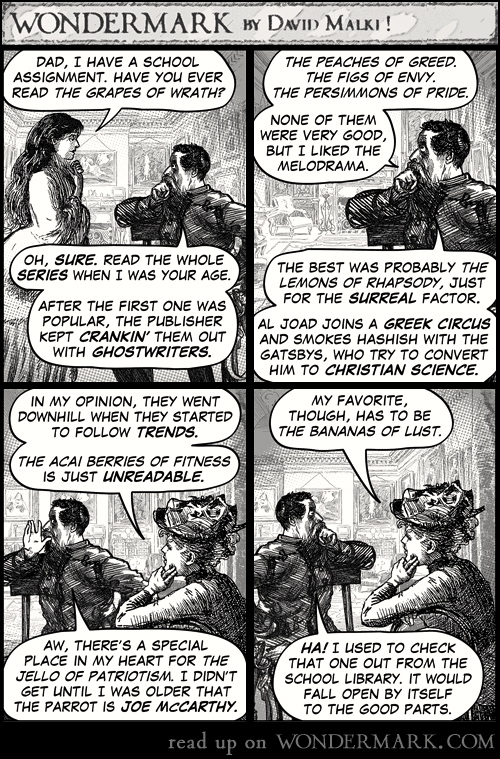
And from my 12/8/12 posting “The fruits of abstraction”:
(#2) A Wondermark cartoon; I’m especially fond of The Bananas of Lust
April 6, 2025 at 3:41 pm |
I always thought “How to Drain Your Dragon” would be an excellent title for a watersports film/video.
April 6, 2025 at 3:44 pm |
😀 😀 😀
April 6, 2025 at 7:04 pm |
Given the typical completeness of your explanations, I was a little surprised to see no mention of Alexander Portnoy in your article, as that is definitely a segment of connective tissue in the background of that pun.
April 6, 2025 at 8:23 pm |
The Grapes of Wrath was so transparently the model that it didn’t occur to me that the Gripes / Complaint of (Philip) Roth on Alexander Portnoy might be an additional resonance. But now I see it might be.