🐅 🐅 🐅 three tigers for ultimate March, the day on which the tigers eat the lambs that the month proverbially goes out as; my posting for this morning begins with tigers, but only so I can slide into the real topic:
the hybrid portmanteau ‘a portmanteau (name) for a hybrid (creature)’ — as in the names liger (lion + tiger) ‘hybrid of a male lion with a tigress’ and tigon (tiger + lion) ‘hybrid of a male tiger with a lioness’, as opposed to unmixed names for hybrids, like mule ‘hybrid of a male donkey and female horse’ and hinny ‘hybrid of a male horse and a female donkey’. Hybrid portmanteaus are iconically satisfying: intimate name-melding (through the combination of word-parts) signifies intimate creature-melding (through mating).
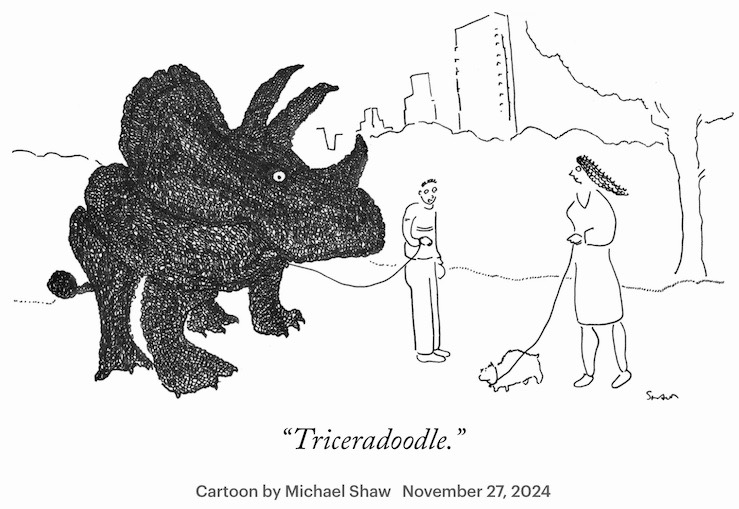
From this beginning, I will rapidly descend to the hybrid portmanteau triceradoodle (the creature is a preposterous hybrid of a triceratops and a poodle) and eventually to the double hybrid portmanteau composite Gerberian Shepsky (an actual dog breed, a hybrid of a German shepherd and a Siberian husky)
In the hybrid portmanteaus liger and tigon, the melded organisms belong to distinct (but genetically close) species. But in fact the term hybrid has been extended in three ways:
— to any organism (plant or animal) that is the offspring of parents belonging to different kinds, including varieties or breeds, not just species (such organisms are sometimes called crosses — or in the case of animals, crossbreeds — rather than hybrids; but the evidence in OED3 (2025) shows that hybrid has long been used to cover crosses as well as hybrids in the strict sense); in a little while, I’ll get to the labradoodle and the cockapoo and their hybrid portmanteau kin, all of them involving crossing poodles with other breeds
— to a (mythical) animal with parts taken from various animals, otherwise called a chimera; here falls the triceradoodle
— also to anything made by combining two different elements, to any mixture (NOAD‘s example: the final text is a hybrid of the stage play and the film)
The Michael Shaw cartoon. From the 12/9/24 issue of the New Yorker (it’s been sitting on my desktop for a while; my life is a shambles):
(#1) The triceradoodle is a hybrid of a triceratops and a poodle; its name is a combination of tricera– (from triceratops) and the libfix word-part –doodle ‘poodle cross’
About the artist, from Jane Mattimoe’s “A Case For Pencils” (“A peek inside the pencil bags of New Yorker cartoonists”) on Michael Shaw from 5/3/16:
Bio: Michael Shaw toils by day as a creative director for Xavier University and cartoons by night. His cartoons have appeared in The New Yorker Book of Literary Cartoons, The Complete Cartoons of The New Yorker, and The Rejection Collection I and II. His work has also appeared in The St. Louis Post-Dispatch, Harvard Business Review, Prospect magazine in the UK, cocktail napkins, assorted textbooks, MSNBC’s now moribund Ronan Farrow news show and an episode of Sixty Minutes featuring Bob Mankoff
Only one posting in this blog about his work, from 6/22/11, “It doesn’t always stay in Vegas”.
On doodle dog ‘poodle cross’. The labradoodle (from the 1950s), a cross between a Labrador and a poodle, and the cockapoo (from the 1960s), a cross between a cocker spaniel and a miniature poodle, were the first of these poodle crosses. The noun labradoodle — labrad(o)- (from Labrador) + –oodle (from poodle) — was then reanalyzed as labra– + –doodle, giving rise to the libfix –doodle ‘poodle cross’, an alternative to –poo (and with the variant shape –oodle); –doodle then becomes a free-standing lexical item doodle as in Why is everyone breeding doodles?, doodle breeds, and doodle dogs.
And a profusion of types of doodle dogs. From the petMD site, “The 16 Most Popular Types of Doodle Dogs” by Victoria Lynn Arnold on 9/29/24:
You may have seen some of the most common types of doodle dogs that have gained popularity in recent decades. Every doodle dog is a little different, based on the type of Poodle parent (Standard, Miniature, or Toy Poodle) and the breed they’re mixed with.
Her examples, with the contributing non-poodle breed:
labradoodle, goldendoodle (golden retriever), bernedoodle (Bernese mountain dog), cavapoo (Cavalier King Charles spaniel), ausiedoodle (Australian shepherd), sheepadoodle (Old English sheepdog), yorkiepoo (Yorkshire terrier), schnoodle (schnauzer), shih-poo (Shi Tzu), boxerdoodle (boxer), Irish doodle (Irish setter), whoodle (soft coated wheaten terrier), cockapoo (cocker spaniel), shepadoodle (German shepherd), maltipoo (Maltese), chipoo (chihuahua)
A double hybrid portmanteau. In my e-mail this morning, from Michael Vnuk in Oz (in Adelaide SA):
You may already know this, but according to Wikipedia a Gerberian Shepsky is a:
Cross of a German Shepherd and a Siberian Husky; it has the German Shepherd’s upright ears and coat colour and the Siberian Husky’s thick coat, marginally wider face and mask.
I did not know this already, but it’s fabulous news.
Gerberian = German + Siberian
shepsky = shepherd + husky
Double your pleasure / Double your fun. Meanwhile, seeing Gerberian Shepsky out of context suggests to me something of Shep’s, or from Shep, that resembles, or is otherwise connected to, Gerber; I dunno, maybe Shep’s baby food.
April 1, 2025 at 6:47 am |
I recall seeing the variant tiglon for the tiger-lioness hybrid; I don’t think I’d encountered tigon before, although obviously it makes more sense, since -lo- doesn’t occur in either parent’s name. (On the other hand, by that logic, the -d- in poodle hybrids not involving Labradors is entirely spurious, but there it is.)
April 1, 2025 at 6:58 am |
The variant tiglon is well attested; its virtue is that it has more lion in it.