A Mark Thompson cartoon in the 1/20/25 issue of the New Yorker offers a foxy goulash of cultural forms: cartoon memes, joke forms, story formats, and conversational routines:
(#1) The Dog in Bar cartoon meme (with a fox instead of a dog), the Walk Into Bar joke form (a fox walks into a bar,…), the Fox Eludes Hound(s) story format, and the Tell Them I’m Not Here conversational routine
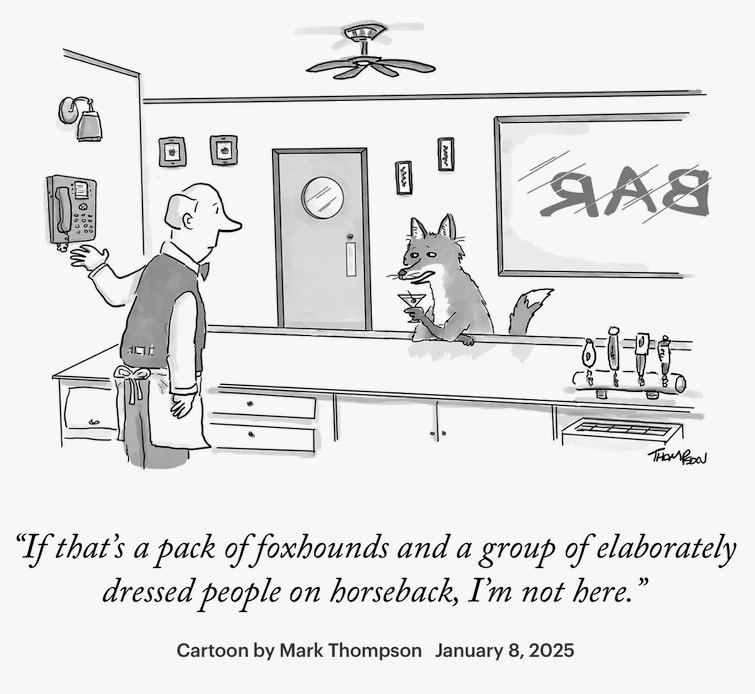
At the top level, this is a variant of the “Tell Them I’m Not Here” routine, in which one person uses a third person to avoid speaking with a second person. A version in which a child is so used by a parent, so that the parent can avoid interacting with someone at the door or on the telephone:
[sotto voce] Tell them Mommy / Daddy isn’t here / home
And there’s the common bar version, in which the classic instance (adaptable for many other circumstances) is:
If that’s my wife, (tell her) I’m not here
which is what we see, absurdly, in #1. Very rarely does a pack of foxhounds and a group of elaborately dressed people on horseback phone a bar in pursuit of a fox. (Are there bars where fugitive foxes are known to lie low from the hunt? Like, foxhole bars?)
At the bottom level, this is a Walk Into Bar joke — a fox walks into a bar (and instructs the bartender to tell callers that he’s not there) — realized in a Dog in Bar cartoon, in which the basic comic point is that there’s a creature (canonically, a dog, but it might be a cat or octopus or fox or whatever) having a drink in a bar; what makes it comic is the tension between the two identities of the drinker at the bar, as both a human being (with all the concerns that occupy human beings) and at the same time a creature (with all the species-particular concerns that occupy it, like where the next bone will come from, or how to elude a foxhunt).
In the middle are (culture-specific) story formats, particular tales that flesh out huge themes: the journey that brings self-knowledge; the contest or trial of initiation, providing entry to some group or status; the gathering of a group of disparate participants into a common enterprise; the flight from danger to safety. More particularly, flight-from-danger stories of the (clever) fox eluding the (hapless) hounds. I do suspect that a fox using a phone-answering bartender as the agent of his escape is a genuinely novel riff on the formula.
(Here I confess that I’ve studied #1 40 or 50 times so far, and it still makes me laugh. Which is why I’m writing this posting.)
Now for more details. I’ll start in the middle. With flight-from-danger stories of clever creatures eluding hapless pursuers. For which the classic instance in modern American popular culture comes to us from Warner Bros. cartoons: the clever Road Runner outwitting the hapless Wile E. Coyote.
As it turns out, Warner Bros. also went down the fox-outwits-hound path. From Wikipedia:
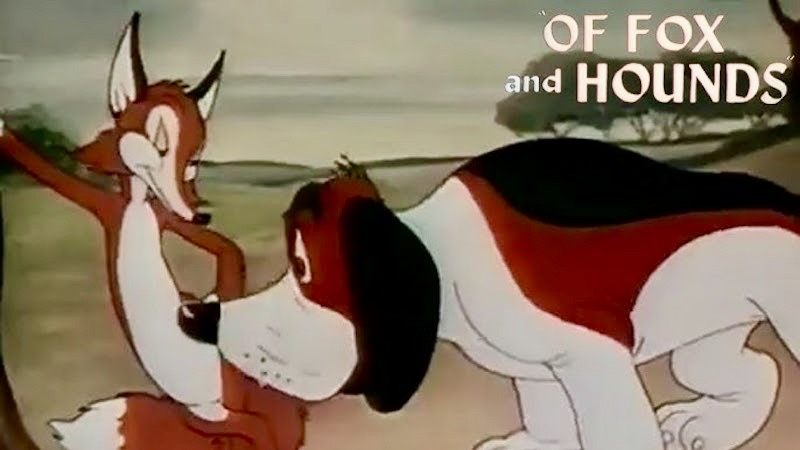
(#2) George the Fox and Willoughby the DogOf Fox and Hounds is a 1940 Warner Bros. Merrie Melodies directed by Tex Avery. The short was released on December 7, 1940, and introduces Willoughby the Dog. Avery performed the voice of Willoughby, and Mel Blanc voiced George the Fox and the bear’s yells. The short is an attempt to duplicate the success of the 1940 Bugs Bunny short A Wild Hare by giving another anthropomorphic animal the same unflappable demeanor.
… The film focuses on a sly fox, George, and a lovable but dim-witted hound, Willoughby, who repeatedly asks George where the fox went, never suspecting that his “friend” George is the fox. Invariably, George the Fox tells Willoughby that the fox is on the other side of a rail fence, which is actually at the edge of a steep cliff. Willoughby’s line, “Which way did he go, George? Which way did he go?” … became a catchphrase, as did “Thanks a lot, George, thanks a lot!”
Now to the bottom level: a Walk Into Bar joke realized in a Dog in Bar cartoon.
From my 8/13/17 posting “Reduced coordination, joke memes, and sociocultural categories”:
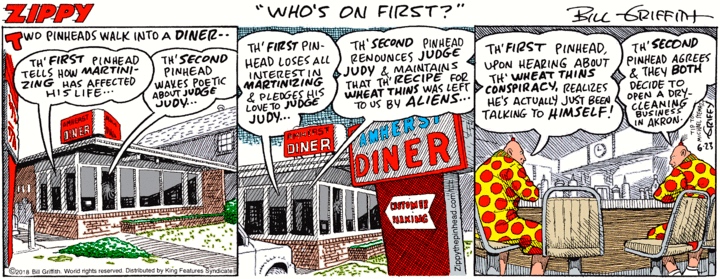
The only requirement [of the Walk Into Bar format] is the set-up, which has one, two, or three characters (the bar-goers) going into a bar (mostly commonly the verb used is walk, in the jocular simple present tense, though go and other verbs of motion are possible, as is the simple past tense); sometimes the set-up specifies more about the bar-goers — what they look like, what they have with them — or about the bar and its location. The follow-up typically involves conversational exchanges between the bar-goers and the bartender or other patrons of the bar, or else a series of actions on the part of the bar-goers, these exchanges or actions incorporating a pay-off joke.
An example from my 6/23/18 posting “Return to the Amherst Diner in Winchester VA”:
(#3) Two Pinheads walk into a diner …
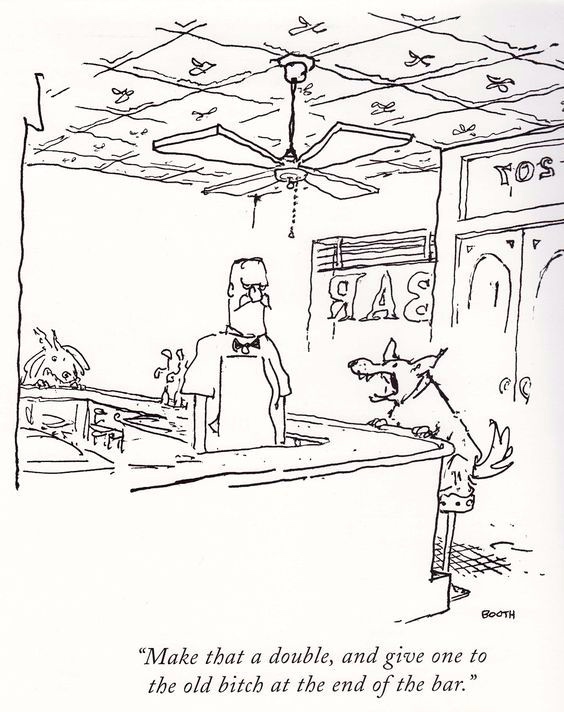
And from my 1/19/18 posting “More George Booth”, this Dog in Bar meme cartoon by Booth:
(#4) This is:not only a
[ Booth ] [ Dog in Bar ] cartoon,
but also a
[ Booth Dog ] [ in Bar ] cartoonfeaturing the celebrated feisty Booth dog
And, finally, back to the top level, “Tell Them I’m Not Here”. Here I recalled the opening of an old American radio show. From Wikipedia:
Duffy’s Tavern is an American radio sitcom that ran for a decade on several networks (CBS, 1941–42; NBC-Blue Network, 1942–44; and NBC, 1944–51), concluding with the December 28, 1951, broadcast.
… In the familiar opening, “When Irish Eyes Are Smiling,” performed either solo on an old-sounding piano or by a larger orchestra, is interrupted by the ring of a telephone and Ed Gardner’s New Yorkese accent as he answers, “Hello, Duffy’s Tavern, where the elite meet to eat. Archie the manager speakin’. Duffy ain’t here — oh, hello, Duffy.”
Owner Duffy was never heard nor seen, either on the radio program or in the 1945 film adaptation or the short-lived 1954 TV series.
Duffy, in short, was never there.
As I recall, on more than one occasion, Archie had to lie on the phone about the whereabouts of one of his customers.
January 22, 2025 at 5:05 pm |
Tangentially, the Walk Into Bar joke serves as a template for a trove of illustrations of good and bad grammar (I’m sure you’ve seen these, I have posted them on FB), e.g. “A bar was walked into by the passive voice.” and “An oxymoron walked into a bar, and the silence was deafening.”
A comprehensive list can be found at
https://www.grammarbook.com/blog/commas/walks-into-a-bar/
January 23, 2025 at 10:27 am |
And this brings up a joke that is like an earworm to me, three strings walk into a bar….