🎁 Boxing Day 🎁 — also St. Stephen, with his feets uneven — coming a day late, because life has been very difficult for me, and postings have piled up so high I’m not sure I can ever get to them, so I’ve picked something I know I can get done, so that this dark, rainy, and excruciatingly painful low-air-pressure day will not be a total loss
I bring you an e-mail message from Victor Steinbok on 12/25, about this ad for Spice Tribe (website here), a San Francisco-based on-line spice store dedicated to mindful cooking:
(#1) VS wrote: Facebook has offered another example of what I used to refer to as parenthetical ambiguity. Is it [aged anchovy] [salt] or [aged] [anchovy salt]. From a culinary perspective, the latter makes no sense (aging salt doesn’t change it). But that doesn’t mean there’s no built-in ambiguity.
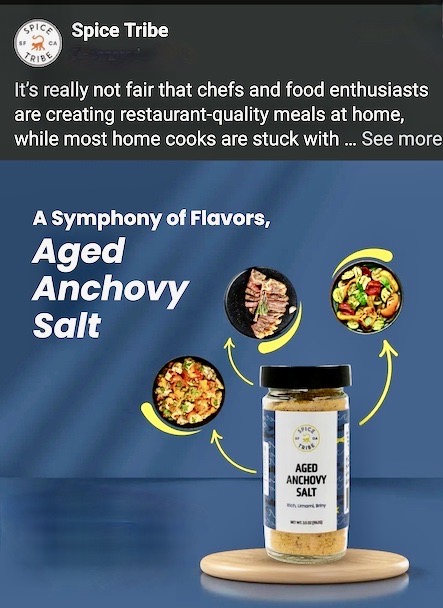
On Boxing Day, I responded. An elaborated version of my reply:
A nice example of structural ambiguity, with two different parsings for an expression; a textbook example is:
OLD MEN AND WOMEN
[ OLD ] [ MEN AND WOMEN ] vs. [ OLD MEN ] [ AND WOMEN ]And I posted recently on:
GREAT PUMPKIN PIE
[GREAT ] [ PUMPKIN PIE ] vs. [ GREAT PUMPKIN ] [ PIE ]which has a lot of lexical ambiguity going on in it too.
I’m happy to see AGED ANCHOVY SALT, as an illustration of the general principal of ubiquity — (potential) ambiguity is everywhere. But listeners and readers mostly sort through things rapidly, using background knowledge, the context of discourse, and their assessments of the intentions of those who produced the discourse. This process isn’t perfect, but it doesn’t have to be; for ordinary human purposes, it merely has to be good enough most of the time.
So people live happily with the possibility of [aged] [anchovy salt] — because they don’t even notice it. Well, yes, Victor and I notice it, because we’re approaching the ad in #1 as linguistic data for analysis rather than as ordinary language for use.
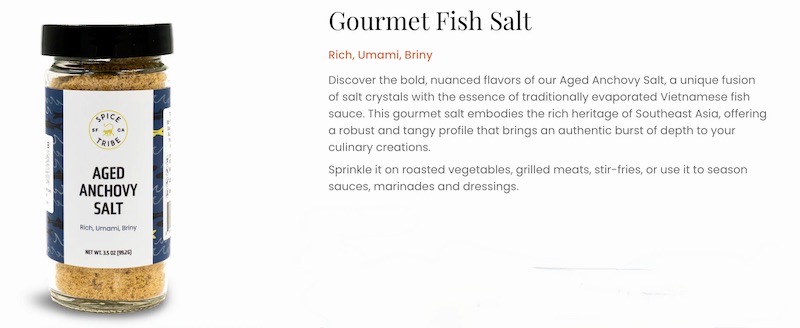
But what is anchovy salt? The expression anchovy salt is a N + N compound, and clearly subsective: anchovy salt is a kind of salt. But what’s the semantic relationship between the modifier N anchovy and the head N salt? Anchovies are small fish customarily preserved in salt and oil, so anchovy salt could be a Use compound — referring to the salt used in the production of commercial anchovies — or possibly a Source compound — referring to salt extracted from anchovies. In fact, it is neither, but an Ingredient compound, referring to salt infused with the flavor of anchovy sauce: it’s flavored salt, like flavored water, the parallel in the taste world to scented items, like scented candles:
(#2) From the Spice Tribe catalog
December 27, 2024 at 6:00 pm |
I observed St. Stephen’s day by dropping in on my favorite local rock shop, which shares space with a cannabis dispensary, where languidly obese young men watch over the rocks when the owner, who has a day job, isn’t there.
St. Stephen, after all, was the first man in the New Testament to get stoned. (See Acts 6.)
December 27, 2024 at 6:33 pm |
😀😀 Once again, I exhibited heroic restraint, alluding to Good King Sauerkraut (and his feets uneven) but steering clear of the more flagrant “first to get stoned”. Now Bob has stepped in to fill the humor breach…
December 28, 2024 at 8:02 am
I enjoyed a chuckle over the King Sauerkraut reference; a nice way to start the post.
December 28, 2024 at 8:49 am
To Robert Coren: feets uneven has always struck me as a masterstroke of Okefenokee Swamp talk.
December 27, 2024 at 6:57 pm |
I was gifted a bottle of “smoked garlic sea salt”, which I love. It comes with the same dilemma, taking the compound “sea salt” as a single element: is it smoked [garlic sea salt], or [smoked garlic] sea salt?
http://spanishbit.com/images/gsalt1.jpg
The label doesn’t provide any more helpful information in this regard.
December 27, 2024 at 7:04 pm |
In this case, both parsings are real-world possible (though I’m not sure how you’d tell them apart).
December 28, 2024 at 8:01 am |
My intuition is that it’s the garlic that is smoked, not the salt. But, as Arnold says, either is equally plausible (or implausible).
December 28, 2024 at 11:09 am |
The web site is not much more help:
– – –
Our Smoked Garlic Sea Salt is loaded with Garlic.
Other “similar” garlic salts are loaded with salt then some garlic.
– – –
followed by usage suggestions and the true statement “A little goes a long way.”
https://www.garlicfestival.com/smokedgarlicseasalt
I went back to the label to see if the ingredients list was any help: not really. “Sea salt, garlic & natural flavors,” the last of which I assume is the source of “smoke”.