From Ellen Kaisse in e-mail to me on 10/4 (yes, the blog mill grinds very very slowly on Ramona St.): a nice ambiguity from the Seattle Times, in the first sentence of the story:
[what EK wrote, with some bracketed amendments by me:] I read striking as an adjective meaning ‘notable’ and modifying language rather than the intended reading where striking is [the nominalization of] a verb with language as its direct object [AZ: the nominalization (together with language and a very long relative clause modifying language) is itself the direct object of the verb approved]. It was only the headline that alerted me that my first reading was the opposite of what was actually approved.
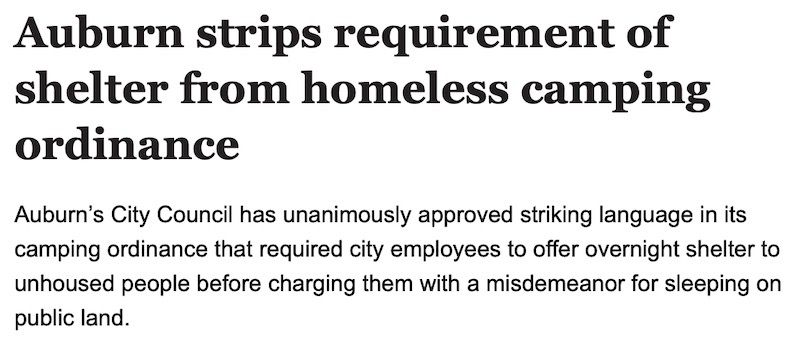
Now if you ask an ordinary person what’s gong on with that sentence, they’ll tell you that it’s ambiguous, and they’ll provide some attempt at a paraphrase (as a sufficient account of the ambiguity), but they’ll simplify things somewhat by disregarding that long relative cause and, in effect, localizing the source of the ambiguity in the expression striking language, telling you that in the Auburn City Council sentence this expression means two different things, ‘notable language’ or ‘removing language’ (from something), and maybe they’ll go on to localize the source even further in the word striking, saying that striking in striking language can mean either ‘notable’ or ‘removing’ (from something).
Ask a linguist, like Ellen or me, and even our briefest answer will go immediately to localizing the ambiguity in specific words that are the crux of the matter. We’ll identify the lexical items involved and supply some relevant properties of the words — what syntactic category they belong to (EK refers explicitly to adjective (Adj) and verb (V) and implicitly to noun (N)); perhaps what derivational and inflectional categories they belong to (implicit in our references to nominalization). And then, especially, we’ll tell you something about the syntactic constructions in which the words are related to one another (we’ll refer to modifying / attributive adjectives, to verbs with direct objects, and so on). Our very brief comments are laden with allusions to the structure of English — its morphology and syntax — as well as to its lexicon.
The linguists’ view is that the lexicon, morphology, and syntax of the language work together in such a way that a stretch of phonological material can convey two different meanings; when we confront an ambiguous expression, we see it not as a brute fact (as if people somehow memorize how phonological substance and semantics are paired with one another, expression by expression), but as the consequence of the system of the language. Surprise! There are two ways you can end up with striking language, two ways the expression can be analyzed. (There are, in fact, more than two; but there are at least the two EK told us about.)
Now I’m going to wade hip-deep into the system of English involved in striking language (and some similar expressions). Not to tell you everything, but to tell you just enough to show you that the system is both big and complex. Therefore, challenging. And therefore, wonderful to figure out. Contemplating stuff like this makes me happy.
The lexical resources: the verbs strike; well, five of them, from a very much longer list in NOAD (note that NOAD gives some syntactic information in its entries — here, whether a verb combines with a direct object or not):
— 1 [with object] [a] hit forcibly and deliberately with one’s hand or a weapon or other implement
— 1 [with object] [d] come into forcible contact or collision with
— 3 [with object] [a] (of a thought or idea) come into the mind of (someone) suddenly or unexpectedly
— 6 [a] [no object] (of employees) refuse to work as a form of organized protest, typically in an attempt to obtain a particular concession or concessions from their employer
— 7 [with object] cancel, remove, or cross out with or as if with a pen
(I’ll refer to these as the “(the) verb strike 1a, 1d, 3a, 6a, 7″)
Inflectional forms. English has an assortment of finite inflectional forms of verbs (used in tensed clauses), plus three main non-finite forms (used elsewhere): in one tradition, these are labeled BSE, PRP, and PSP; the abbreviations suggest common uses for them, but all three are multi-functional (BSE and PRP stunningly so), and the labels should be viewed as arbitrary triliterals. For jump verbs, the three forms have the shapes jump, jumping, jumped; for shake verbs, the shapes shake, shaking, shaken; and for strike verbs, the shapes strike, striking, struck.
The phonological shape of the PRP form is straightforward. It’s the –ing form, period: [ɪŋ], with the stylistic variant [ɪn] (spelled –in’). For all verbs, even be, have, and do.
The multi-functionality of PRP. Obviously important to striking language. The uses of PRP are variously verbal, adjectival, and nominal. In fact, Geoffrey Pullum and I have catalogued 25 syntactic constructions employing PRP (the gerund participle, in our article’s terminology), in “Gerund participles and head-complement inflection conditions” (in Peter Collins & David Lee (eds.), The clause in English: In honour of Rodney Huddleston (John Benjamins, 1999), available on-line here). Some items from that list:
adverbial VPs with go and come (go fishing, come dancing), progressive verbs (am watching, is singing), verb complements to intransitive verbs of temporal aspect (keep looking, start running); prenominal modifiers (a sleeping dog, screaming children); bare nominal gerunds (starting the car is never easy), nominal gerunds with genitive / possessive determiner (my doing this, your having broken it), gerunds with accusative subject (I hate them doing that), action nominals (the continuous burning of the Amazon jungle)
Derived V-ing words. PRP is an inflectional form of verbs. But what abut the non-verb uses of the form? Where do they come from?
They’re the product of derivational morphology, in this case without any affix, so by “zero derivation”, or direct conversion, adjing (giving adjectives like striking) and nouning (giving nouns like striking). So, from NOAD:
adj. striking:
— 1 [a] attracting attention by reason of being unusual, extreme, or prominent: the murder bore a striking similarity to an earlier shooting | [with clause]: it is striking that no research into the problem is occurring. [AZ: 1a is an adjing of the PRP form of the verb strike 3a]
— 1 [b] dramatically good-looking or beautiful: she is naturally striking | a striking landscape. [AZ: 1b is a (metonymic) specialization of 1a: ‘attracting attention because dramatically good-looking or beautiful’]
— 2 [attributive] (of an employee) on strike: striking mine workers. [AZ: 2 is an (attributive) adjing of the PRP form of the verb strike 6a, understood as in progressive aspect — ‘who are striking / on strike’]
noun striking:
— the action of striking: substantial damage was caused by the striking of a submerged object. [AZ: an ing-nominalization of any number of verbs strike — a nouning of the PRP of those verbs — in a number of uses: here the action nominal, with the direct object marked by of, in the NPs the striking of a submerged object (verb 1d) or the striking of language from an ordinance (verb 7); but also, notably, the nominal gerund, as in the NPs striking a submerged object or striking language from an ordinance]
A striking fireworks display. Let’s take a look at a different head noun modified by striking: (fashion) models, the plural of this noun from NOAD:
noun model: … 4 [a] a person employed to display clothes by wearing them: a fashion model. [AZ: the word evokes a frame involving runway shows, fashion designers, and modeling agencies]
I then give you … drum roll … 9 distinct meanings for the phrase striking (fashion) models:
— verb 3a, progressive aspect: it is now striking models that they need to ask for more pay
— verb 1a, progressive aspect: the angry designer was striking models with his closed fist
— verb 1d: progressive aspect: random objects were striking models when the tornado hit the agency’s offices
— verb 7, progressive aspect: the agency was striking models left and right from its current list of employees
— adj 1a or 1b, based on verb 3a: very striking models are coming down the runway
— adj 2, based on verb 6a: the striking models are going without pay, but the scabs are being paid
— noun, based on verb 1a, nominal gerund: striking models, especially in the face, is against the agency’s guidelines for its designers
— noun, based on verb 1d, nominal gerund: striking models during the tornado at the agency was the cause of a desk breaking into pieces
— noun, based on verb 7, nominal gerund: striking models from the current list is bad business
No doubt there are still more meanings for striking (fashion) models. (Of course, if we can entertain other meanings of the noun model — NOAD has 8 senses other than the one above — then the number of meanings explodes.)
October 19, 2024 at 4:35 pm |
Why no “stricken”?
October 19, 2024 at 4:51 pm |
“stricken” is available as an alternative to “struck” only for a few senses of the verb STRIKE (senses 2 and 7 in NOAD, in things like “grief-stricken” as an alternative to “grief-struck”). Not for the core senses of STRIKE: *I was stricken in the face by goons, *I was stricken by the beauty of the painting, etc. (I believe that “stricken” was the older form, but was mostly replaced by the somewhat more regular “struck”, for which the PSP shape = the PST (tense) shape.)