(Definitely faggy content, which will not suit everyone, but nothing I’m obliged to keep kids away from)
On Pinterest this morning, this arresting cover of the magazine The Young Physique (men’s fitness and muscle-building for a gay male audience), from 50 or 60 years ago:
(#1) A symphony in fluffy pinkness, showing the model’s callipygian charms (glutes are good)
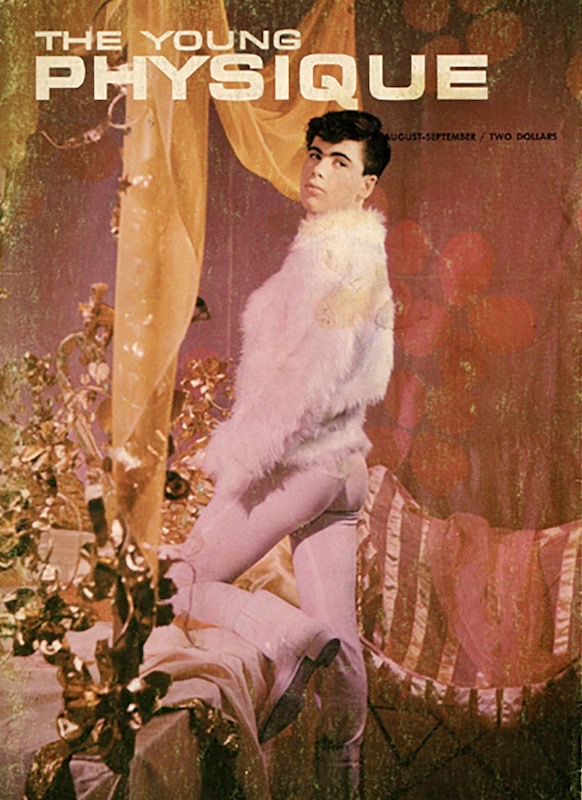
The Young Physique was a large-format color magazine founded in 1958 by Joe Weider; it featured drawings by gay artist George Quaintance, and creative sets designed by the gay photographer James Bidgood, sometimes (as here) magazine covers photographed by him
One more Bidgood Young Physique cover:
(#2) A naked young man, apparently providing incidental music in a sumptuous male harem; his thighs are gorgeous (the better to hold you, sir, in the heat of passion) (from the May-June 1966 issue)
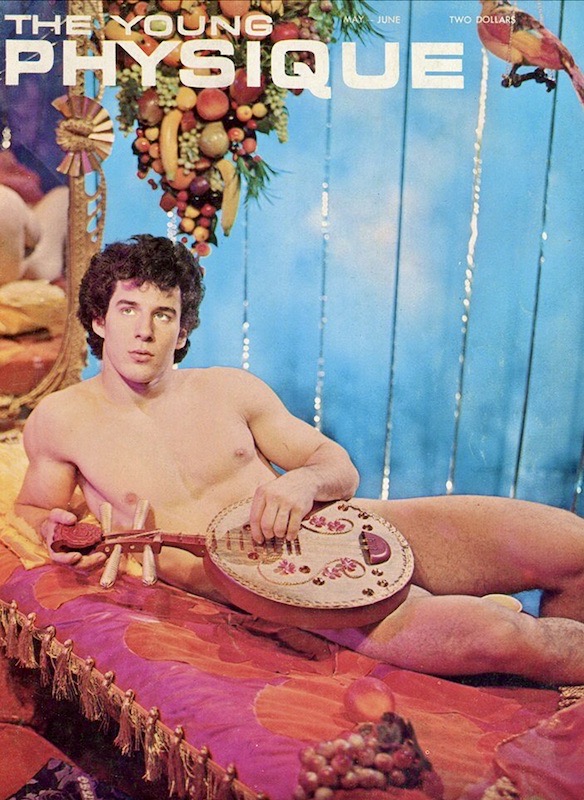
Something of a surprise, amidst all those oiled muscle-hunks posing competitively.
Pink Narcissus. From my 5/13/18 posting “Gay butterflies”, on butterfly symbolism:
1 fragility, femininity, effeminacy
2 flamboyance
3 fickleness
4 metamorphosis,”powerfully, viscerally, symbolic of coming out”
∴ 5 gay sex, mansex, sex between men
with a final section on Bidgood’s film Pink Narcissus — “flamboyant gay erotic fantasies, suffused in fag pink and butterfly imagery”
About Bidgood. From Wikipedia:
James Alan Bidgood (March 28, 1933 – January 31, 2022) …, was an American filmmaker, photographer and visual and performance artist, known for his highly stylized and homoerotic works.
… His interests led him to photography and film and it is for this work that he is most widely known. His photographs are distinguished by an aesthetic of high fantasy and camp, inspired by an early interest in Florenz Ziegfeld, Folies Bergère, and George Quaintance. He wanted to bring artistry to gay male erotic photography, believing that the genre at the time he started out had not been pushed to its limits.
… Bidgood released the film Pink Narcissus in 1971, after filming in his small apartment from 1963 to 1970. The film is a dialogue-free fantasy centered around a young and often naked man. The film took seven years to make, and Bidgood built all the sets and filmed the entire piece in his tiny apartment. He later removed his name from the film because he felt editors had changed his original vision. Consequently, the identity of the film’s creator was only a matter of speculation for nearly three decades after its release
… Bidgood died from complications of COVID-19 at a Manhattan hospital, on January 31, 2022, at age 88. [AZ: The butterfly was finally swept away in the pandemic]
Bidgood is often credited as inspiration for photographic artists, including Pierre et Gilles and David LaChapelle. He was also an inspiration for and once collaborated with designer Christian Louboutin
About George Quaintance. When I went to add some links here to my postings about GQ, I discovered there apparently aren’t any. So now the briefest of notes. From Wikipedia:
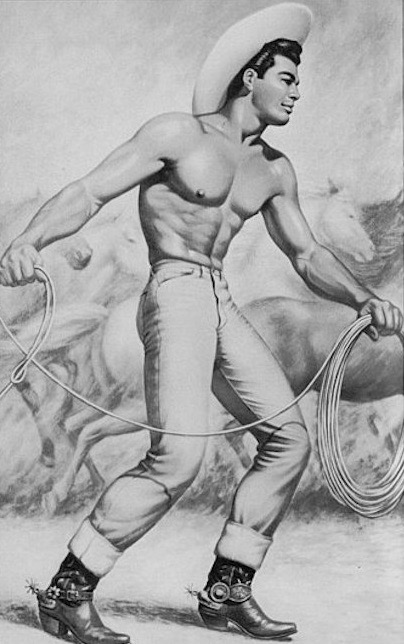
George Quaintance (June 3, 1902 – November 8, 1957) was an American artist, famous for his “idealized, strongly homoerotic” depictions of men in mid-20th-century physique magazines [meanwhile, the handsome GQ’s presentation of himself was famously faggy]. Using historical settings to justify the nudity or distance the subjects from modern society, his art featured idealized muscular, semi-nude or nude male figures; Wild West settings were a common motif.
(#3) Red Dust, a Quaintance painting with a signature Wild West setting, from a 1955 issue of Physique PictorialHis artwork helped establish the stereotype of the “macho stud” who was also homosexual, leading him to be called a “pioneer of a gay aesthetic”. He was an influence on many later homoerotic artists, such as Tom of Finland.
Leave a Reply