From the Economist‘s 8/24/24 issue, under the characteristically jokey head Beneath the (ap)peal, the informative subhead
South Asia’s long love affair with mangoes
(yes, about the appeal of the fruits in South Asia, incorporating –peal as a pun on peel ‘outer covering of a fruit or vegetable’)
Which stopped me in my tracks, because I would have written mangos rather than mangoes. It turns out that there’s real variation on this point; both mangos and mangoes are well attested (and have occurred in postings on this blog, though all the instances of mangoes are in quoted material, not from my hand). And, entertainingly, published lyrics for the song titled “Mangos” (made famous by Rosemary Clooney) come in two different versions, from different sources: one with mangos, one with mangoes.
A little point in spelling, which has been taken up in the advice literature on English usage, but with little regard to actual usage; advisers are inclined to go by their impressionistic judgments — often impressions developed from long experience in working with novice writers, but they’re not the product of a systematic study of practice, and they’re often colored by the adviser’s personal preferences. I’ll look at two of these pieces of advice, both from the Grammarly website (from Wikipedia: “Grammarly is a Ukraine-founded cloud-based [commercial] typing assistant. It reviews spelling, grammar, punctuation, clarity, engagement, and delivery mistakes in English texts, detects plagiarism, and suggests replacements for the identified errors” — but it also offers some free resources on the net, including notes on spelling and grammar).
But first, I’ll provide a little bit of background on how there came to be -S and -ES spellings for the /z/ noun plural suffix, and will make a brief speculative attempt to account for the fact that these alternative spellings are available only for nouns whose spelling ends in the letter O (call them O-nouns); otherwise, nouns whose spellings end in a vowel letter have only the -S spelling: COMMAS, BANANAS; CLICHES, RESUMES; TAXIS, KIWIS; TUTUS, ZEBUS (not COMMAES, CLICHEES, TAXIES, TUTUES).
Then, I’ll look at the two Grammarly treatments (both going back to 2022, but the first one was deleted from the site while I was preparing this posting!). The earlier one was ignorant of variation, which turns out to be quite substantial, not just a mango thing, and maintains there’s no general rule. The later one maintains (incorrectly) that -ES is the general rule, and (bizarrely) recognizes variation only for the noun volcano (though variation is attested for a fair number of O-nouns: remember the spelling MANGOES, and consider MOSQUITOES and HOBOES).
Finally, I offer this analysis of the spellings -S ~ -ES arising from actual data (depending on information in NOAD entries):
-S is the default variant, used for about 30 -S-only O-nouns in my sample, like bimbo (plural spelled BIMBOS, not BIMBOES); and — crucially — used for freshly borrowed or coined O-nouns (if I tell you there’s an Amazonian bird whose name is spelled AKHO, you’ll spell the plural AKHOS, not AKHOES),
with a small number (8 or so) of -ES-only O-nouns (like potato, plural spelled POTATOES, not POTATOS),
and with variation (-ES in addition to -S) attested for roughly 20 O-nouns; I judge several of these -ES plurals to be unacceptable — BUFFALOES, HALOES, GECKOES — but they are in fact attested, which would seem to indicate that the variation is spreading (I’m an old man, with rather old-fashioned practices in my English usage).
The mango(e)s song. But before any of this, the song “Mangos”, to go along with the Economist story:
Then step inside my shady nook
And you’ll find mango(e)s and papayas, anything your heart desires
From Wikipedia:
“Mangos” is a 1956 popular song written by composer Dee Libbey and lyricist Sid Wayne.
It was first introduced in the musical revue Ziegfeld Follies 1957.
It was recorded by Rosemary Clooney, and is a follow-on to her earlier hit “Come On-a My House” in style and subject matter.
The title spelling seems to be invariable, but the spelling in the lyrics depends on which source you look at.
Why two spellings? And why just for O-nouns?
The noun-plural suffix in older English was spelled -ES because it was in fact a syllable, with an unaccented vowel in it (spelled with an E); this is parallel to spelling the past tense suffix -ED. The vowel in both suffixes was generally elided, but was preserved to avoid certain consonant clusters, as in (for the plural) crotches (with the suffix still spelled -ES) and (for the past) patted. The past suffix is still spelled -ED, even after congenial consonants (as in JUMPED) and after vowels (as in MOOED), where the suffix vowel is elided. But the spelling of the noun plural suffix was in general adjusted to reflect the pronunciation: the noun spellings are JUMPS and MOOS.
The -ES spelling was kept for the plurals of some O-nouns, however, presumably because the spelling OE represents /o/, so that the spellings -O -S (in the plural of zero and mango) and -O -ES (in the plural of potato and mango) would both represent /oz/, and the only common noun-final vowel letter exhibiting such a relationship is O standing for /o/. (I’m dismissing the few examples of word-final U standing for /u/ here.)
The earlier Grammarly account. It begins with some background discussion saying that the plural of a noun is generally spelled -S — but -ES when it represents a syllabic pronunciation, as in crosses, crushes, crotches; and -ES for nouns like city /sɪti/, which are spelled with a consonant letter + Y (representing /i/), in which case the Y is replaced by I, giving a plural spelling like CITIES /sɪtiz/. Then:
Exceptions to the rule: words ending in –o
An exception is words ending in –o. Some of these words take –es in the plural, while others simply take –s.
For example, potato becomes potatoes, and hero becomes heroes. But photo becomes photos, and piano becomes pianos. There’s no hard-and-fast rule here, so it’s best to learn these as you encounter them.
(followed by various zero / invariant (moose /emoji), irregular (children), learnèd (foci), and borrowed (Festschriften) plurals)
This assumes there’s no generalization to be had, even with some exemptions, when in fact the rule is that an O-noun almost always has a plural spelled with -S (with only about 8 exceptions. spelled only with -ES). And it totally misses the variation: -ES as an alternative spelling.
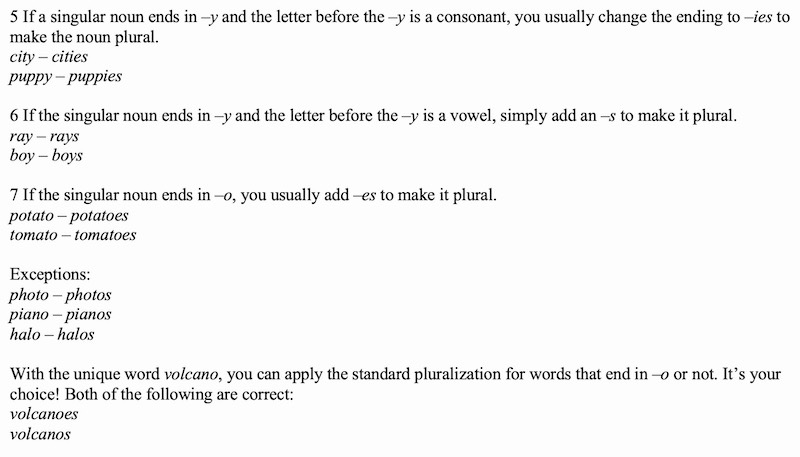
The later Grammarly account. “Plural Nouns: Rules and Examples”. This is a step backwards, since it takes -ES to be the default spelling for the regular plural of O-nouns. I’m guessing the author (listed as Matt Ellis, for a version dated 10/18/22) was impressed by the many -ES plurals he came across in his work counseling students, and found these spellings congenial, not realizing that he was looking at spellings that coexist with the -S spelling.
In any case, he treats three O-nouns that he believes to be -S-only as exceptions; in fact, two (photo, piano) are, while the third (halo) turns out to be variable. More spectacularly, he reports volcano as the only variable O-noun, which is simply preposterous (I hear your agonized cries of mango! mango!).
A section from his account:
(#1) Grammarly on -S vs. -ES
What are the facts? I started my investigation by assembling a big list of O-nouns, using a reverse alphabetical dictionary of English: a huge list of English words listed in reverse alphabetical order (arranged according to the last letter, then within each section of that list, according to the next-to-last letter, and so on). So: bimbo comes before avocado; commando before cameo; dado before dildo; dildo before commando; and avocado before dado. From the O-final section of this list, I extracted all the nouns of some frequency that I could find (discarding technical vocabulary, antique words, and the like), some 60 or so of them. (I probably missed some, but I’m assuming that such errors were randomly distributed; if I had a very long time, I would do the extraction slowly, item-by-item, and have at least one other person do their extraction independently of me, but I did the best I could in a morning’s work.)
I then went to my on-line NOAD and looked up the plurals it lists for every one of these. The plurals are the ones the editors had citations for; I was surprised at some of the plurals cited, but I didn’t substitute my intuitions and tastes for the attestations summarized in NOAD. This process yielded three lists, ordered below by size, from smallest to largest:
(#2) Within each list, items are in reverse alphabetical order; the third list is not only the largest, but it is also the list into which fresh borrowings and coinings go — the default, or general case
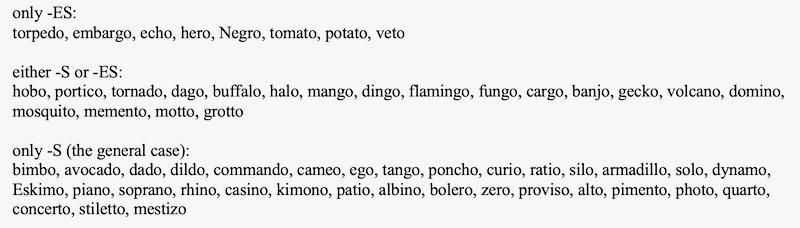
It is true, as I noted above, that the list of variable O-nouns seems to be in the process of expanding, for reasons that are unclear to me. Since variation is inclined to pick up sociocultural and discourse significance, it would be an interesting exercise to investigate some of the contrasts in the middle list (like hobos vs. hoboes) to see how they are actually deployed by users of English — but that’s a project much much bigger than the resources I have available to me.
September 18, 2024 at 6:45 pm |
OED2 has “pl. mangos, mangoes” – I don’t know if that means they prefer the first spelling, like my mother’s old Funk & Wagnalls did. I often have wondered about this plural.
In Inclusive Language do you say and write “persongo”?
September 18, 2024 at 7:16 pm |
The order of variants (spellings or pronunciations) isn’t necessarily significant in Oxford dictionaries. You have to find the fine print and read it, for each dictionary. (I *think* NOAD has stuff ordered by frequency.)
As for persongo, why would you replace mang? Or, for that matter, the man in mantle or mansion?
September 18, 2024 at 8:23 pm |
For many years I believed mango(e)s were green vegetables, because my mother, unfamiliar with such an exotic fruit, used the name instead for the common green bell peppers she brought home from the grocery.
September 19, 2024 at 5:27 am |
Not your mother’s individual use, but a well-known feature of west midands AmE (from Ohio through Iowa), where green / sweet / bell peppers are also sometimes called mango peppers (or occasionally mangles). I’m familiar with the usage from living in central Illinois and central Ohio from 1965 through 1998 — where I had to get used to the “mangoes” on sale in the supermarkets.
September 19, 2024 at 6:31 am |
Those of us of a certain age are thinking of Dan Quayle right now.
September 19, 2024 at 7:02 am |
Indeed. It was hard not to digress onto that excellent vegetable the potatoe. Well:
two toes : one toe :: two potatoes : X
yields
X = one potatoe
right?