Two days ago on this blog, David Tanner, a representational painter who works in a variety of forms (portraiture, still lifes, landscapes, nudes), but with special attention to men and male bodies. Now, also encountered through Pinterest, Cornelius McCarthy (1935 – 2009), nonrepresentational but definitely figurative: intensely focused on the male body (single men, couples, groups — often with matter-of-fact penises in the compositions, but no sexual acts, or even bodily contact), in a series of styles, most notably in a cubist-influenced period that then developed into the late style of the painting that caught my eye on Pinterest:
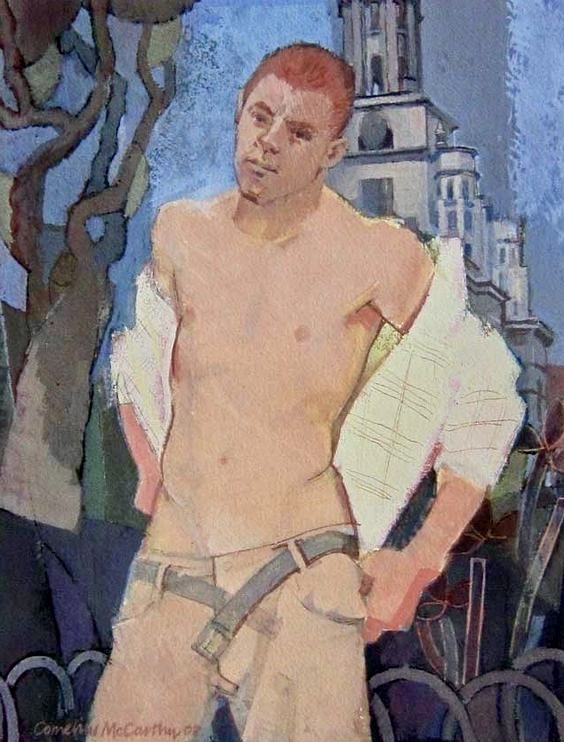
(#1) Moonlit Park (2008); exposing the body is a recurrent theme in the late paintings, as is the Catholic church in the background
More art to follow. Then some information about McCarthy from the ultrawolvesunderthefullmoon website of an anonymous artist I’ll call Ultrawolf, who supplies basic information (from Wikipedia), plus some awkward commentary on the art. And finally, a bit about Ultrawolf and some about the artist Keith Vaughan, who was an influence on McCarthy.
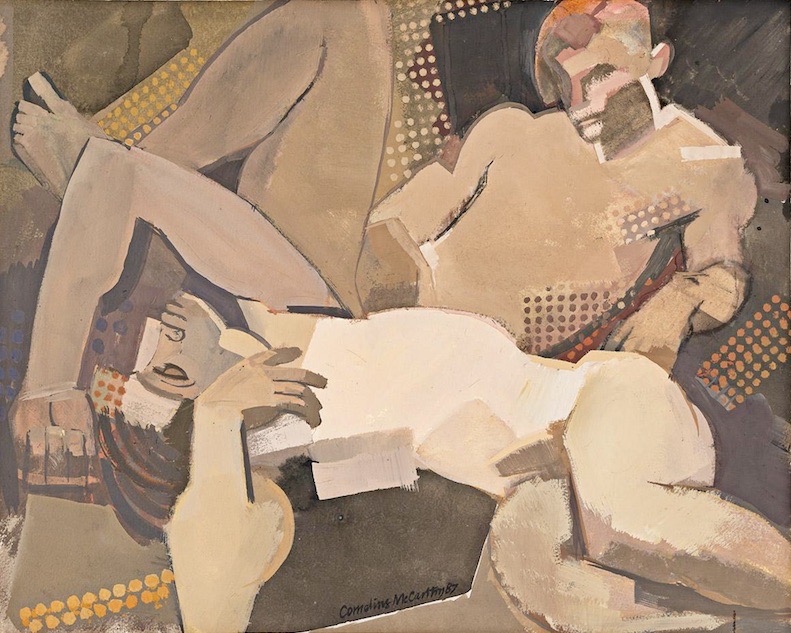
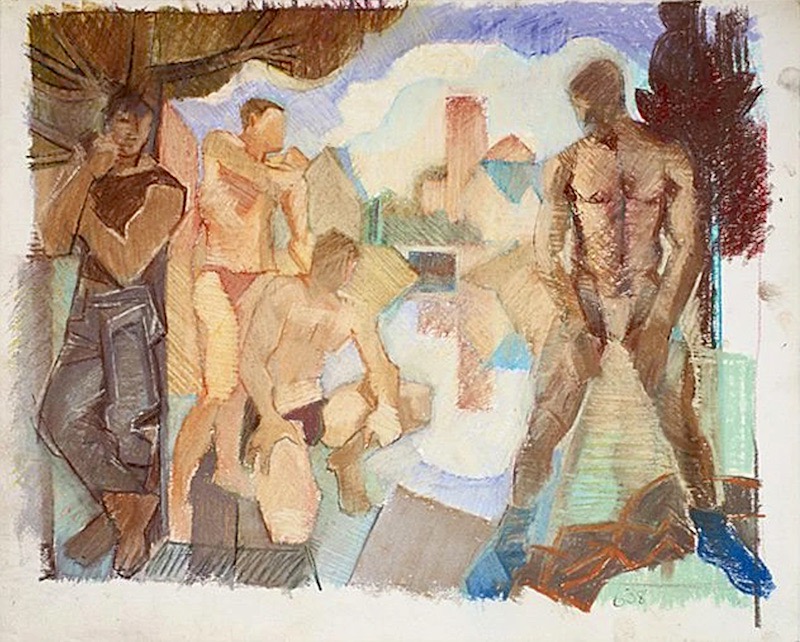
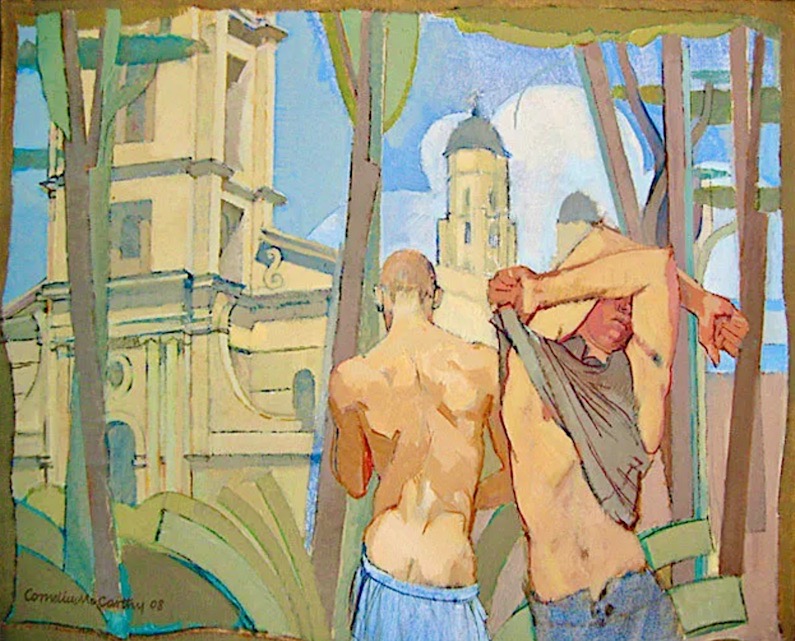
Three paintings. Two from the cubistic years, plus one more late painting to go along with #1.
(#2) Two Boys in a Dark Room (1987)
(#3) Four Boys Bathing (1999)
(#4) The Great Façade (2007)
From Ultrawolf on McCarthy. On Ultrawolf’s website on 5/23/20:
Cornelius “Neal” James McCarthy was born in 1935 into a family of Irish Catholic and Eastern European immigrant stock.
McCarthy’s earliest artistic influence was probably through the artifacts and images used to promote Catholic devotion with which he grew up. Through these he became familiar with the compositions of the masters of the Italian Renaissance. Formal study was completed in the 1950s at Goldsmith’s School of Art, London, followed by a tour of Italy visiting all the principal art collections and monuments.
McCarthy was greatly influenced by the work of Pablo Picasso after seeing the first post-war exhibition in London in 1960. Later he was influenced by British artist Keith Vaughan. Always painting, McCarthy developed his own style, alternating between a near cubist approach [and a] soft, almost two-dimensional handling of the paint strokes. He painted both individual portrait-like images as well as groups of men, clothed and unclothed.
… In 2007, the book “Cornelius McCarthy” was published by Adonis Art in London, with introduction and commentaries written by American actor Peter Dobson. Now widely regarded as a true master of paintings depicting the male form, Cornelius McCarthy is widely collected in England, the rest of Europe, and especially the United States.
He died unexpectedly in November of 2009.
About Ultrawolf. From his website, which he describes as A Gay-Oriented Collection of Art Works, Literary Quotes, Songs, Films, and Male Images, this statement:
I am gay artist, who received training at the Rhode Island School of Design, and now, a retired high-end fine art framer living in Maryland, USA. My interests and studies in life run a wide gamut from art to history and from the scientific to the esoteric. I have been building this blog of images and texts for the last eight years. My wish is that my posts pique the interest of viewers and encourage them to experience more.
About Keith Vaughan. First from Wikipedia:
John Keith Vaughan (23 August 1912 – 4 November 1977), was a British painter. His work is held in the collections of the Government Art Collection, National Galleries Scotland, National Portrait Gallery, Tate and Victoria and Albert Museum in the UK.
… He worked in an advertising agency until World War II, when as an intending conscientious objector he joined the St. John Ambulance; in 1941 he was conscripted into the Non-Combatant Corps.
Vaughan was self-taught as an artist. His first exhibitions took place during the war. In 1942 he was stationed at Ashton Gifford near Codford in Wiltshire, and paintings from this time include The Wall at Ashton Gifford (Manchester Art Gallery).
During the war Vaughan formed friendships with the painters Graham Sutherland and John Minton, with whom after demobilisation in 1946 he shared premises. Through these contacts he formed part of the neo-romantic circle of the immediate post-war period. However, Vaughan rapidly developed an idiosyncratic style which moved him away from the Neo-Romantics. Concentrating on studies of male figures, his works became increasingly abstract.
Vaughan is also known for his journals, selections from which were published in 1966 and more extensively in 1989, after his death. A gay man troubled by his sexuality, he is known largely through those journals.
Then, in my 6/11/19 posting “Come frolic and cavort in the water”, there’s a section on Vaughan and his photos and a painting in a 2017 exhibition Keith Vaughan: On Pagham Beach. From that exhibition:
(#5) Keith Vaughan, Figure Throwing at a Wave, 1950
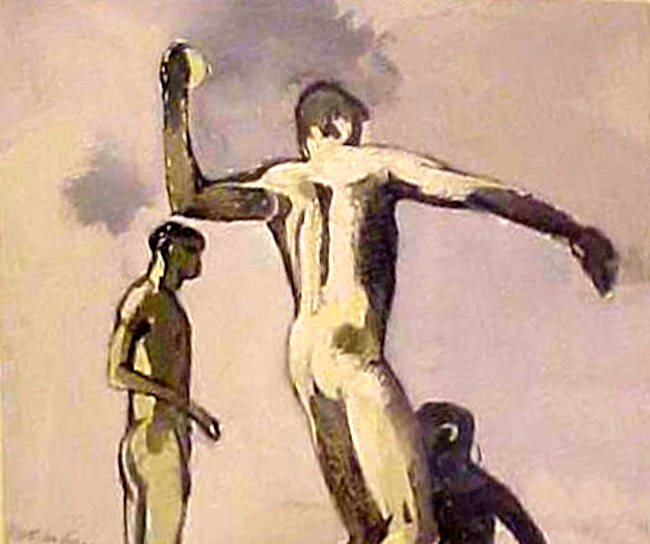
The exhibition reconstructed a playful day at the beach for Vaughan and some friends, who could frolic and cavort in the water — naked, free, and gay, briefly outside the strictures imposed on them by the British culture and laws of the time, and the diet of guilt and shame fed to them by the church.
Leave a Reply