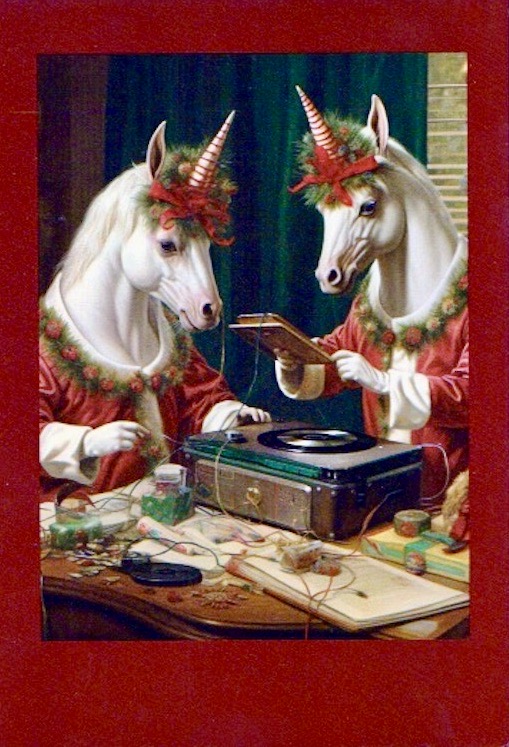
… decked out in red and green, in lovely Christmas smocks; also throughly wired and wielding gear, both vintage (what appears to be a record player) and modern (iStuff), along with Christmas gift boxes:
(#1) A delightful card from Dean and Tim Allemang; on the back it has the Walgreens logo:
(#2) So it’s a Walgreens card, but after much searching on 12/11, I couldn’t find it anywhere on their site (they are demons about their photo cards, but hopeless about everything else)

Then on 12/12, Erick Barros labored on my behalf to find any trace of the card on the net, with no success at all.
Meanwhile, I wrote Dean to applaud the card and report on our fruitless searches, asking if he knew anything about the artist or the composition. And got a surprising answer.
Dean confessed:
I, with the help of some AI, am the artist. The theme came from my husband, who is very find of unicorns, and has recently picked up the nostalgic hobby of collecting and playing vinyl records.
This is the aspect of AI art that has me very excited; I can make passable commercial grade images of very special themes for Christmas or other occasions. If I really had the time, I could make an individual card for everyone on my list.
And I responded:
Fabulous. You’d driven Erick Barros to distraction, trying to find evidence of it anywhere on the net. It is truly wonderful, not to mention passing strange (I mean, the wire coming out of the left unicorn’s nostril!). So that is a record player. Some of the rest is a pleasant mystery. (Oh yes, the smocks, the delightful smocks.)
Sex, sexuality, and, gender. Dean’s intentions were surely to show a same-sex couple, two male unicorns. I’ll get back to that, but first some background.
The European tradition: male. In one of the unicorn traditions, the unicorn’s horn is an obvious phallic symbol, and that comports with the unicorn’s attraction to virgins, in whose laps it will lie down, charmed and captured. And confined, as in the celebrated unicorn tapestries (in the Cloisters in NYC). From the Metropolitan Museum’s site on The Unicorn Rests in a Garden (aka The Unicorn in Captivity, from the Unicorn Tapestries, 1495-1505):
(#3)
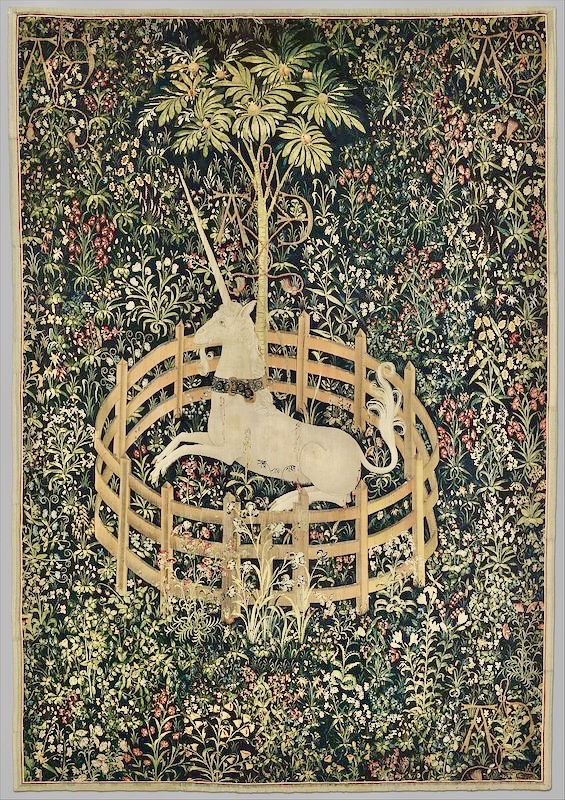
The museum’s commentary:
The seven individual hangings known as “The Unicorn Tapestries,” are among the most beautiful and complex works of art from the late Middle Ages that survive. Luxuriously woven in fine wool and silk with silver and gilded threads, the tapestries vividly depict scenes associated with a hunt for the elusive, magical unicorn.
“The Unicorn Rests in a Garden” may have been created as a single image rather than part of a series. In this instance, the unicorn probably represents the beloved tamed. He is tethered to a tree and constrained by a fence, but the chain is not secure and the fence is low enough to leap over: The unicorn could escape if he wished. Clearly, however, his confinement is a happy one, to which the ripe, seed-laden pomegranates in the tree — a medieval symbol of fertility and marriage — testify. The red stains on his flank do not appear to be blood, as there are no visible wounds like those in the hunting series; rather, they represent juice dripping from bursting pomegranates above. Many of the other plants represented here, such as wild orchid, bistort, and thistle, echo this theme of marriage and procreation: they were acclaimed in the Middle Ages as fertility aids for both men and women. Even the little frog, nestled among the violets at the lower right, was cited by medieval writers for its noisy mating.
Note: the unicorn, or rather The Unicorn, is male.
Unicorns and rainbows: queer / female / ungendered / gender non-binary. From the Wikipedia entry:
By the beginning of the 21st century, unicorns became a queer icon, second only to the rainbow flag, symbolizing queerness. The rainbow flag, created by American artist Gilbert Baker in 1978 as a joyous symbol of the diversity of the queer community, became prominent during the gay rights protests of the 1970s and 1980s. Unicorns, which were intrinsically linked to rainbows since the Victorian era, [then] became symbols of the queer community.
The entry goes on to say that in some circles, unicorns are understood to be female. This is outside my experience, but I have met people who think of unicorns as ungendered, or of non-binary gender.
It’s Just Stuff. Time for my every-other-week mini-lecture about symbols, which is that they’re just stuff, without intrinsic meaning; they can express any number of meanings, evoke many different associations, in different sociocultural and historical contexts. But unanchored to context, they lack any meaning at all. A unicorn is just a mythical, or fabulous, horned equine, often seen as of great power and great beauty. Anything beyond that is a reading in context.
The queer male reading. As it happens, my experience leads me to see unicorns as queer male symbols: powerful, playful, and sexually hot, all in one package. Traveling in an aura of rainbows. I suspect that Dean’s take isn’t very far from mine, so let’s go back to look at his digital confection, in #1.
The two unicorns aren’t identical. The one on the left has a larger head and more muscular neck; the one on the right is smaller-boned, with a thinner nose and a smooth, unmuscled neck.
At this point, given the normative-sexual culture that we’re embedded in, most people will leap to a gendered reading of these differences, will see the unicorn couple as male and female, respectively (despite the fact that they are dressed and adorned identically, and both have small, delicate hands). I will resist this interpretive leap — because I am a small-boned man, with a unmuscular neck and no Adam’s apple, and was partnered with a man who was much larger-boned and more muscular, so I see in #1 a wonderfully transformed image of my man Jacques and me. It’s all in the context, including the context of my experience.
Now, of course, others will see other things in #1. But Dean made the unicorns extraordinarily similar, and we have to respect that. He made them extraordinarily similar in their bizarreness, but with sweet individual differences. Like a real couple.
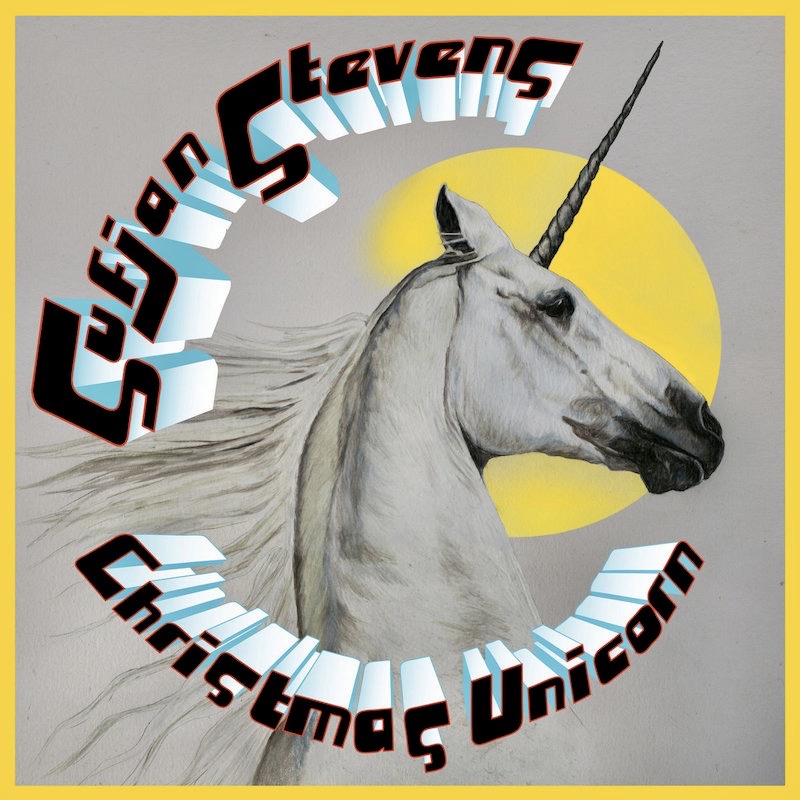
But wait! There’s more. At this point, I was moved to look at what was out there in the world of Christmas unicorns. It turns out to be a huge world, mostly jam-packed with a cuteness that sets my teeth on edge; I’ll spare you the examples. But I did stumble on something of genuine interest — not actually to my taste, but it has an enormous, enthusiastic following, and I understand the enthusiasm even if I don’t share it. This is Sufjan Stevens’s “Christmas Unicorn”, a song from the compendium Silver & Gold, in the 2010 album Christmas Unicorn: Songs for Christmas, Vol. X, where it’s the 9th and final track. It’s long and complex, 12:30 in the official audio, which you can listen to here.
(#4) Cover art for the song: a bit romantic in tone, but not at all cute
(#5) What I see as the central point of the song; it can be read out of context as a comforting “free to be you and me” message to a child who feels that they’re different, while in context I see it as a wider message of unity-in-diversity in a complex jangling world (the interpretation of the song is, however, a matter of considerable wrangling)
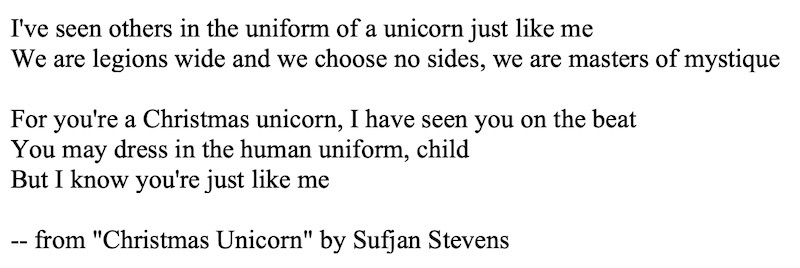
Now imagine one of the unicorns in #1 singing the text in #5 to the other.
Leave a Reply